CHAPTER 6: THE CONDEMNATION FILE
The raindrop hissed against the copper terminal, popping like grease in a hot skillet.
“Cover that box!” Arthur snapped, his fingers slippery with black vulcanized mastic. He jammed the threaded screw of the C-clamp against the iron collar, twisting the T-bar until the cast metal groaned beneath the mechanical torque. The jet of black silt choked down to an oily trickle, but the low, dry rattle deep in the cavity did not stop. It deepened, rattling the soles of his boots with a dry, hollow resonance.
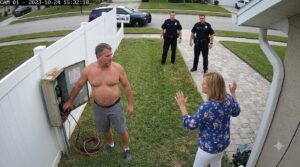
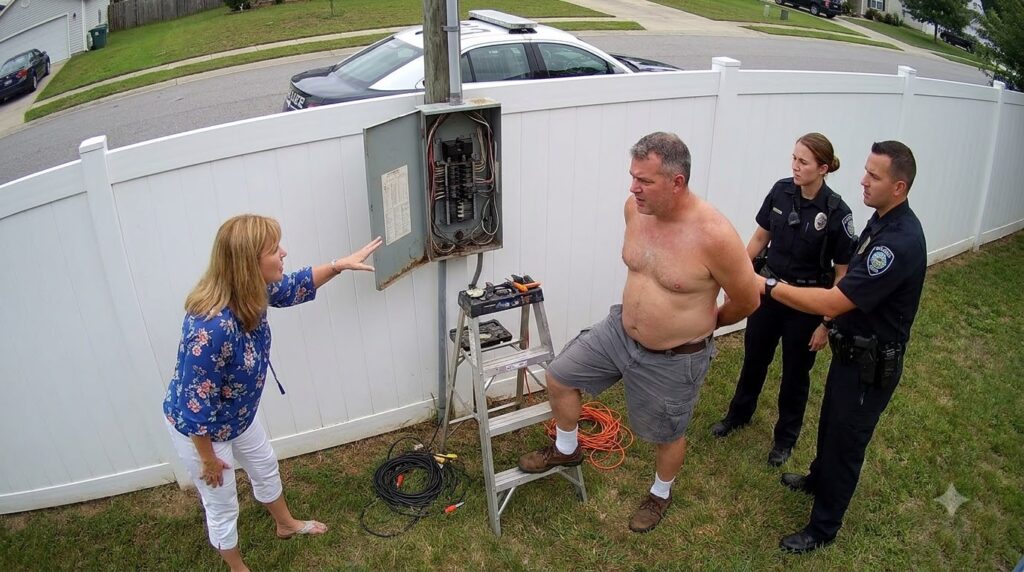
Officer Reyes didn’t hesitate. She grabbed the gray steel lid of the electrical enclosure and slammed it shut over the breakers, latching the draw-pull toggle with a heavy metallic snap. The dangling padlock bounced once against the vinyl post, dead weight swinging in the dampening air.
“Briggs!” Reyes called over her shoulder, her voice cutting through the rising whip of the wind. “What’s dispatch saying?”
Down on the curb, the driver’s side door of the patrol cruiser was kicked wide. Briggs stood half out of the cab, his radio mic keyed to his collar, his face illuminated by the harsh, cyan glow of the dashboard laptop. He wasn’t talking to dispatch. His fingers were hammering the faded keys of the terminal with hurried, clumsy strikes.
“Briggs!” she shouted again, rain beginning to darken the shoulders of her dark polyester uniform.
“Reyes, you need to look at this,” Briggs shouted back. His voice was cracked, devoid of the flat authority he had worn ten minutes earlier. He didn’t look toward the lawn; his eyes were glued to the screen, his chest rising and falling hard against his utility harness. “Step down here right now.”
Reyes shot a hard look at Arthur. “You stay on this turf. If your boots cross that trench line, you’re in cuffs.”
“Where am I going to go, Officer?” Arthur sat back on his haunches, wiping a greasy palm across his bare forearm, leaving a smear of black silt and rain. “My house is anchored to the same chalk bed as hers. If that shelf drops, my living room is the cellar.”
Brenda was already stumbling down the slope of her manicured lawn toward the vehicle, her capri pants sodden, mud clinging to the cuffs. “What did you find? Is it a code violation? Tell me he’s getting cited!”
Reyes reached the driver’s door first, her hand resting on the rain-slick roof of the cruiser. “What is it?”
Briggs pointed a blunt index finger at an amber-and-black scanned microfiche file displayed on the cracked LCD screen. The header was stamped with an eagle insignia and the faded typography of a bygone bureaucracy: DEPARTMENT OF ENVIRONMENTAL RESOURCES — SUB-SURFACE REGION 4.
“I ran the borehole tag number,” Briggs said, his breath hitching. “Borehole twelve-B isn’t an unmapped storm interceptor. It never was.”
Brenda pushed in between them, squinting through the open window, her wet hair plastering against her cheeks. “What does it mean? What are those numbers?”
“In seventy-six,” Briggs read, scrolling down through scanned lines of typewritten bureaucratic jargon, “the county approved an emergency variance for the valley tanneries and chemical solvent processors off Old Mill Road. They had three million gallons of heavy chlorinated hydrocarbons and hexavalent chromium tailings ponding behind an earthen dike that was about to breach into the state river.”
Reyes leaned closer, her eyes scanning the pale pixels. “What did they do with it?”
“They didn’t treat it,” Briggs murmured. “They drilled forty-eight high-pressure injection wells into the limestone karst along this entire ridge. Borehole twelve-B was the central high-capacity shaft. They pumped forty years of chemical sludge right into the dry cavern system under eighty pounds of hydraulic head, then poured six feet of sulfur-resistant concrete down the collar, signed off on an administrative sealing order, and dissolved the oversight committee forty-eight hours before the county boundary redistricting.”
“This entire development…” Reyes began, turning her head slowly to look back at the quiet row of split-level suburban homes, the trimmed hedges, the basketball hoops anchored into asphalt driveways.
“The whole cul-de-sac,” Briggs confirmed, hitting the page-down key. “The county red-lined forty acres in seventy-eight as an unrecorded industrial toxic injection reserve. Permanently condemned for residential occupancy. Zero value. No deed transfer authorized without a federal reclamation review.”
“That’s impossible!” Brenda shrieked, clutching the frame of the cruiser door. “I paid two hundred and sixty thousand dollars for this house in two thousand four! The title insurance was clear! The county clerk stamped the deed!”
“They stamped it because the developer bought the archived land patents under an agricultural shell corp,” Arthur’s voice came from behind them.
He had walked down the lawn, his bare feet leaving dark, muddy impressions across the fescue. He stood on the asphalt curb, the C-clamp hanging heavy in his left hand, water dripping from the gray stubble on his jaw.
“The county didn’t lose the records, Brenda,” Arthur said, his eyes hollow, fixed on the pavement between his feet. “They buried them under the tax reassessment board. When the chemical company went belly-up, the municipality owned the liability. If they admitted there was forty feet of pressurized, toxic hydraulic muck sitting under a honeycombed limestone ridge, the entire valley would have been classified an unfunded federal Superfund site. So they let the builders pour floating slab foundations, laid down topsoil, and collected property taxes for thirty years.”
Reyes turned to face him, her uniform soaked through, the storm wind tossing the tree branches above their heads into wild, thrashing arcs.
“You knew,” Reyes said. Her voice was barely louder than the patter of the rain, but it struck harder than the thunder rolling above. “You knew when you bought it.”
“I found the vent tube in ninety-eight when my sump pump pulled up green water,” Arthur whispered. “I dug out the crawlspace by hand. I found the brass plate on the casing head.”
“And you stayed?” Brenda choked, her face twisted with revulsion and disbelief. “You stayed here and said nothing?”
“If I talked, they would have put barricades at the end of the road before sundown,” Arthur said, taking a step toward her, holding his blackened, calloused hands out into the pouring rain. “Where was I supposed to go, Brenda? My entire pension went into that concrete slab! Every dime I made running tool-and-die for thirty years was tied to this address! Who buys a condemned house over a toxic chemical well? Who gives you a mortgage on a poison hole?”
Before Brenda could answer, a dull, concussive boom reverberated through the street.
It didn’t come from the sky.
It came from beneath the street gutter. A geyser of black, foaming sulfur water blew the cast-iron storm grate four inches into the air with a deafening metallic clatter, spewing a plume of foul, caustic spray across the wet blacktop.