CHAPTER 2: THE RIGHTOFWAY SURVEY
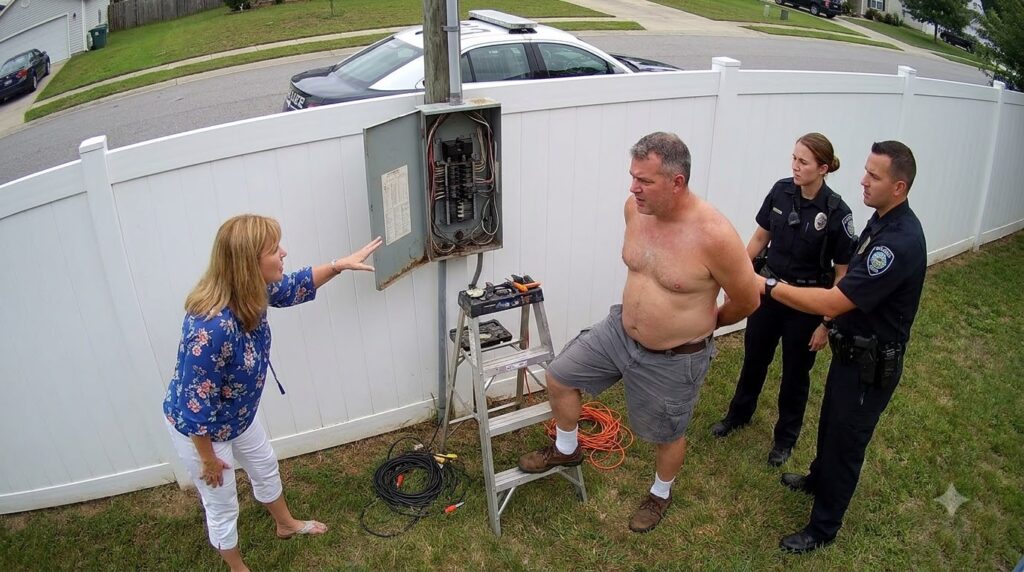
The white beam cut the shadowed cavity of the utility box, pinning the lead-jacketed run in stark, chalky contrast.
Arthur did not blink. A bead of sweat collected in the sparse gray hair above his left ear, ran a slow track over the salt-burned skin of his jaw, and fell into the trampled fescue.
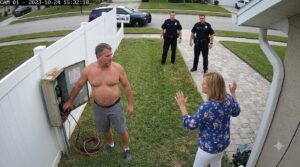
“What is that?” Brenda demanded. She didn’t step closer—she knew better than to crowd the female officer’s elbow—but her neck stretched forward, tendons taut like bowstrings under her floral collar. “Officer, look at that. That isn’t residential code. That’s been spliced in under the footer. He’s siphoning juice off the grid before it hits the transformer!”
The female officer didn’t answer right away. Her name tag read V. REYES, stamped into black enamel with the gold seal of the county sheriff pinned above the breast pocket. Her thumb stayed resting on the ribbed barrel of her Streamlight, the glass lens hot enough to warp the dust motes hovering in the gap.
“Turn around, sir,” her partner said. His voice was lower, flattened by the dry hum of the patrol unit behind them. “Set the tool on the ladder step. Both hands where I can see them.”
Arthur exhaled through his nose, tasting the grit of the yard. “The pliers are insulated to one thousand volts, Officer. If you want me to drop ’em on the grass where there’s six open splices and forty amps live on that bus bar, I will. But you’ll be calling the fire department instead of a tow truck.”
The male officer’s hand tightened on his duty belt, the black nylon creaking. “Ladder step. Slow.”
Arthur leaned forward with deliberate slowness, feeling every knot of muscle across his bare upper back. He set the heavy Klein linesman pliers on the grooved aluminum shelf of the stepladder. The metallic clink was small, sharp, and final. He straightened up, letting his hands hang empty at his sides, fingers loose.
“Step two paces left,” Reyes said. She didn’t look at Arthur; her focus remained fixed on the scarred rim of the junction box. “Away from the trench line.”
Arthur moved two paces left, his work boots sinking into the dry, yielding loam along the property boundary. The cedar pickets of the boundary fence vibrated with a faint, rhythmic shudder—not the five-cycle hum of sixty-hertz alternating current, but a dull, low-frequency pulse that traveled through the soil itself, vibrating through the thick soles of his boots.
“You smell that?” Brenda said, taking a jerky half-step into the grass. “Smells like burning insulation. He’s going to light the whole hedgerow.”
“Ma’am, get back on your porch,” the male officer ordered, turning his shoulders enough to angle her out of the operating radius. “We aren’t going to tell you again.”
“I have every right to be on my side of the survey stake!” she fired back, but her voice thinned. She retreated three paces, her sandals kicking up dry dandelion puffs from the neglected strip between their drives. Her arms folded tight across her chest, fingers digging into the floral cotton. “I know what’s under there, Arthur. The hum at three in the morning. My basement walls are sweating because whatever you’ve got running down there is pulling ground water right into my sump.”
Arthur kept his jaw set, his eyes fixed on Reyes’s hands.
Reyes adjusted the angle of the light, tilting it toward the corner where the lead line vanished into a bored opening in the poured-concrete footing beneath the white vinyl fence. The lead was gray, powdery with white oxidation where the earth had eaten at the casing over forty seasons. Near the collar, stamped deep into the soft metal, an oval cartouche was still legible: C.W.B. DIV-4 / RESTRICTED UTILITY.
“You licensed to touch municipal junction runs, Mr. Vance?” Reyes asked. Her voice was level, completely stripped of Brenda’s shrill panic. It was the tone of someone measuring the depth of a hole before deciding whether to jump in.
“That box was on the fence when I bought the parcel in ninety-two,” Arthur said. His voice sounded like dry gravel dragged over a shovel blade. “The breaker inside was sixty-amp, federal pacific. Fire trap. I was swapping the enclosure for a NEMA three-R rainproof before the storm rolls in tonight.”
“With forty-year-old lead cable hooked to the bottom lugs?” Reyes raised her chin slightly, the flashlight beam pivoting down to where the fresh dirt was piled along the fence line. Arthur had dug a trench fourteen inches deep and six feet long, running parallel to the pickets. “Where’s that feed coming from?”
“Main drop from the street pole,” Arthur lied cleanly, smoothly, without a hitch in his chest. “Runs underground through the right-of-way.”
“Bull,” Brenda called from ten feet back, her voice shaking with righteous fury. “The street drop enters on the west gable of his garage! I saw the linemen string it three summers ago after the ice storm! That thing on the fence isn’t connected to the pole at all!”
Reyes didn’t confirm or deny Brenda’s outburst. Instead, she took a flat wooden tongue depressor from her chest pocket—the makeshift tool of a cop who’d seen too many amateurs fry themselves on residential junction repairs—and gently tapped the lead line near the collar.
The sound wasn’t the hollow ring of an electrical conduit carrying stranded copper.
It was a dull, dense, leaden thud. Solid.
And as the wood struck the lead, the low-frequency tremor in the ground hitched. For a fraction of a second, the deep, mechanical pulse under their feet sputtered, then caught again, grinding with the heavy, unlubricated groan of a heavy-duty rotary pump laboring beneath several tons of wet clay.
Reyes’s eyes shifted from the box to Arthur’s face. She didn’t look angry; she looked distinctly careful. Her gaze dropped to his bare feet, to the dirt packed beneath his toenails, and then to the small, rusted brass key dangling from a loop of twine tied around his left wrist, half-tucked into the cuff of his cargo shorts.
“Mr. Vance,” she said quietly, her partner stepping closer, his shoulder now squarely between Arthur and the open panel. “Whose meter is turning when that compressor kicks on?”