
CHAPTER 3: THE SUBPANEL INQUEST
“Whose meter is turning when that compressor kicks on?”
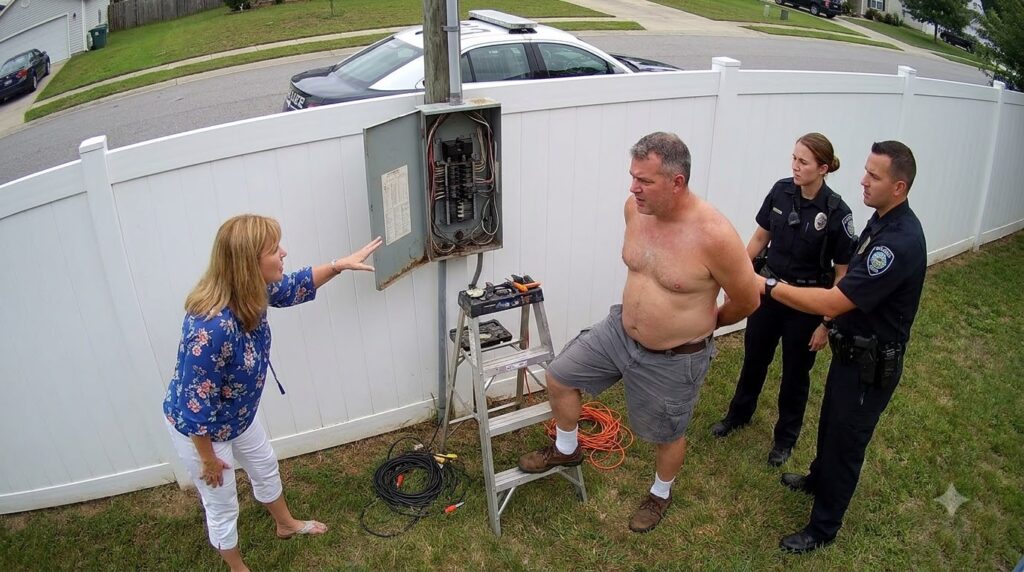
The question hung between them, thick with the sulfur sting of dry fescue and hot plastic. Arthur did not flinch, but his left hand slowly drifted down, curling against the rough seam of his cargo shorts to screen the twine around his wrist. The brass key dug cold against his tendon.
“Nobody’s meter turns on a dead run,” Arthur said. “It’s an auxiliary feed to the shed out back. Old three-wire pull from the breaker bank.”
“Don’t lie to her, Arthur!” Brenda lunged two steps forward, slapping a folded bundle of paper against her palm. The sound cracked like dry pine. “I brought the printouts! Three months of bills from Tri-County Electric. Look at the graphs, Officer! Look at them!”
Officer Briggs took half a step back, holding out an open palm to check Brenda’s forward drive without breaking his gaze on Arthur. “Ma’am, keep your distance. Stay on the sidewalk.”
Brenda thrust the papers forward anyway, the corners fluttering in the humid draft. “My baseload jumped four hundred kilowatt-hours starting the second week of June. Every single night at midnight, my smart meter logs a surge that dips my voltage down to ninety-four volts. My refrigerator was kicking off on thermal overload! I had a certified tech out here last Monday. He put an inductive clamp right against my foundation wall. The draw isn’t inside my house—it’s bleeding straight through the footing from his property line!”
Officer Reyes kept her flashlight pinned on the open enclosure. Her tongue depressor shifted, nudging the bundle of black-sheathed conductor where it sank through the bottom knockout hole into the ditch. The rubber was perished, brittle with age, crosshatched like reptile hide.
“You said you were replacing an unpermitted Federal Pacific panel, Mr. Vance,” Reyes said, her voice dropping into that measured, flat cadence that offered no purchase. “Federal Pacific panels used square bus bars and double-pole push breakers. But this box here—this isn’t an FP breaker. Look at the screw terminal on that lower toggle.”
She tapped the frame. The dull sound echoed off the white PVC fence slats.
“That’s a commercial cutler-hammer contactor,” she said. “Rated for four-eighty three-phase. Residential service drops in this borough are two-forty split single-phase. You don’t get three-phase out here without an industrial transformer on the pole.”
“It’s a step-up rig,” Arthur muttered, his voice dry. “I run a machine lathe in the garage. Heavy spindle.”
“Lathes don’t cycle every twenty-two minutes through the night,” Brenda shouted, her fingers crinkling the utility bills until the edges shredded. “And they don’t smell like spoiled brine! Tell them what you put under the rose beds, Arthur! Tell them what’s down in the pit!”
Briggs turned his head slightly toward Arthur, his hand settling firmer over his holster flap. “Mr. Vance, what is connected to the other side of that lead line?”
Arthur’s mouth felt full of iron dust. He could feel the vibration again—a deep, resonant shudder that didn’t travel through the air, but came up through the hard-packed clay, vibrating the brass eyelets of his boots. It wasn’t the sound of an engine. It was the heavy, rhythmic gasping of an air-cooled condenser pulling cold air across coils deep beneath the frost line.
“There’s an old root cellar,” Arthur said slowly, calculating the cost of every syllable. “Built out of fieldstone back when this whole subdivision was an apple orchard. It’s behind the retaining wall. I keep a walk-in cooling box down there for deer meat and dry goods. That’s all it is. A compressor.”
“A walk-in cooler?” Reyes turned her head, her brown eyes locking onto Arthur’s face. The harsh daylight carved deep shadows under the brim of her cap. “Powered by an unmetered lead-jacketed feed bearing a County Water Board seal from nineteen-seventy-four?”
“The seal was on the conduit pipe when I excavated the footer,” Arthur said, holding his ground, forcing his shoulders to stay loose. “I just used the abandoned sleeve to pull a heavy-gauge line from my panel.”
“Then you won’t mind if we kill the toggle right now,” Briggs said, reaching toward the open box.
“Don’t touch it!” Arthur took an instinctive step forward, his boot sole biting the edge of the fresh dirt pile.
In an instant, Briggs’s shoulder shifted forward, his chest barring Arthur’s path, while Reyes’s hand dropped straight to her baton ring with a metallic clatter. “Stand back, sir! Hands out of your pockets!”
“If you throw that breaker under load,” Arthur breathed, his pulse thumping against his temples like a hammer on an anvil, “you’ll arc-flash that entire box. There’s no shunt trip on that line. You drop the contactor without venting the head pressure, and the condenser coils will blow the seal.”
Reyes didn’t touch the switch. Instead, she angled her flashlight down into the excavated trench at the base of the white fence. The loose dirt had shifted slightly under Arthur’s work boot when he stepped.
There, five inches down in the cut bank, sticking out of the red clay right alongside the lead line, was a cluster of three oxidized brass tally tags wired to an unshielded copper ground bar. Each tag was stamped with a faded date and a cold, hand-punched serial number.
Reyes leaned down, squinting at the lowest tag.
“This doesn’t say County Water Board,” she said softly, reading the metal through the glare. “It says Borough Geological Survey: Borehole 12-B. And someone cut the safety wire off it forty-eight hours ago.”
She looked up from the trench, her gaze shifting past Arthur’s bare, sun-scalded chest toward the hairline fractures running across the foundation of his garage, then back to the bowed retaining wall behind Brenda’s manicured hydrangeas.
“This isn’t a meat locker line, Arthur,” Reyes said, her voice dropping the formal title entirely. “What is that compressor pumping out from under these houses?”








