
CHAPTER 7: THE RESTORATION OF TERRITORY
Brenda Croft did not speak.
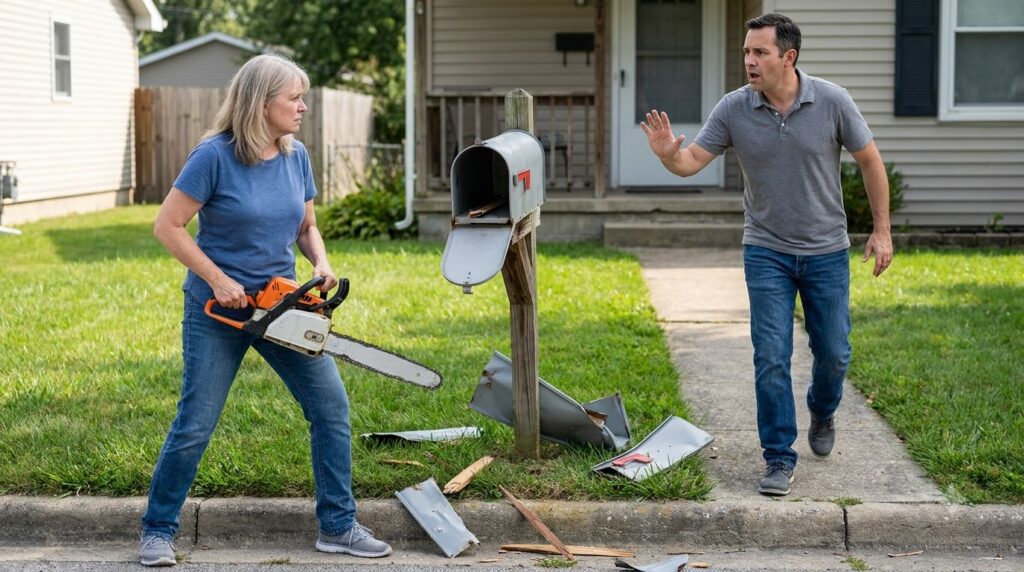
The silence that fell over Oakridge Way was heavier than the scream of the chainsaw. It was the absolute, suffocating vacuum of a collapsed regime. Slowly, her knees popping in the quiet afternoon air, she squatted over the pink surveyor’s chalk line. Her gloved hand reached for the top handle of the orange-and-white chainsaw.
As she lifted the heavy tool, her forearm brushed the yellow plastic clipboard resting on the turf. It flipped, spilling a loose cascade of color-coded violation notices across the grass. From the side pocket of the clipboard, the heavy brass key ring slipped free. It hit the asphalt with a sharp, high-pitched clink that echoed against the silent street.
Mark looked down at the brass tag. The noon glare caught the deep-stamped lettering. He didn’t need to pick it up to read the three-digit municipal code. Next to the numbers, deeply engraved into the metal, was a single word: CONDEMNED.
It was a city padlock key. For thirty years, Brenda had carried the physical key to her own husband’s illegally built garage, a constant, paranoid reminder of the municipal guillotine hovering over their property value. She had weaponized the entire neighborhood, terrorizing a dying man with fake easements, all to build a sixty-foot buffer against a city inspector who had never even bothered to return.
Richard Croft stared at the brass key on the asphalt. His face went entirely slack. He didn’t bend to help his wife. He simply turned, his shoulders sagging under a sudden, invisible weight, and began the long walk back toward number forty-two.
Brenda snatched the key from the street, her fingers trembling so violently she nearly dropped it again. She hugged the chainsaw to her hip, clutching the broken blue binder against her chest, and followed her husband. She didn’t look at the neighbors standing on their porches. She didn’t look at the county surveyor, who was already packing his laser level. She kept her eyes locked on the gray concrete of the sidewalk, a deposed warden making the longest walk of her life.
Mark watched them until they crossed their own property line. The calculus was complete. The threat was neutralized.
“Mr. Vance,” Inspector Hayes said, stepping forward. He extended a stiff, cream-colored cardstock rectangle. “My direct field office line. The federal incident report will be filed before close of business. Do not touch or dispose of the damaged post. It is now logged as physical evidence in a federal tampering case. We will have a forensics transport unit collect it in the morning.”
“Understood, Inspector,” Mark said, taking the card. The edges of the paper were sharp against his thumb.
Deputy Miller tipped his hat, his citation book securely snapped shut. “If she sets foot on this parcel again, you call dispatch. Don’t engage. Just call.”
Mark nodded once. He stood on the edge of his walkway, completely still, as the white patrol cruiser and the dark government sedan pulled away from the curb, their tires crunching over the loose gravel. Chief Surveyor Miller followed minutes later, leaving only the bright pink chalk line glowing unnaturally bright against the green Bermuda grass.
The United States Postal Service carrier, who had remained parked ten yards away, finally killed his engine and stepped out of his truck. He walked over to the curb, looking down at the jagged pine stump and the mangled aluminum.
“I can hold your mail at the regional hub until you get this sorted, sir,” the carrier said, his voice respectful, almost quiet.
“No need,” Mark replied. The adrenaline was finally beginning to bleed out of his system, leaving behind a cold, clear focus. “Give me three minutes.”
Mark walked past the shattered wood, up the driveway, and punched the keypad on his father’s garage. The heavy aluminum door rolled upward on greased tracks. He walked past his father’s old workbench, past the neatly organized pegboards, and gripped the handle of a fifty-pound steel post driver. In the corner, leaning against the drywall, was a temporary heavy-duty steel U-channel post.
He carried the cold, black iron out into the sunlight. The air still smelled faintly of two-stroke exhaust and fresh pine sap, but the heat of the afternoon was beginning to break.
Mark positioned the steel U-channel post exactly three inches inside the pink chalk line—well within his deeded boundary, but as close to the absolute edge of his sovereignty as physics allowed. He slid the heavy iron driver over the top of the post.
He gripped the handles. He lifted the fifty-pound iron cylinder, feeling the raw, mechanical weight of it in his lats and shoulders, and brought it down.
Clang.
The sound of steel striking steel rang out like a gunshot down Oakridge Way.
Clang.
Across the street, Mrs. Gable didn’t retreat inside. She watched from her lawn, her posture relaxed for the first time in a decade. Down the block, a neighbor raised a hand in a silent, solemn wave.
Clang.
With every strike, the steel post bit deeper into the dark earth. Mark felt the vibration travel down his forearms, a harsh, kinetic transfer of energy. This was not a negotiation. This was not a neighborhood committee meeting. This was the physical manifestation of a boundary. He was driving a spike through the heart of the HOA’s psychological control, securing his father’s legacy with iron, leverage, and the cold, unyielding mechanics of the law.
When the post was sunk three feet deep, immobile as bedrock, Mark lifted the heavy iron driver away. He retrieved a temporary, regulation-approved steel mailbox from the garage, bolted it to the top of the U-channel, and tightened the hex nuts until the wrench bit into the metal.
He stepped back.
The postal carrier walked up to the curb, slotted a stack of rubber-banded envelopes into the fresh metal housing, and snapped the door shut.
“Have a good afternoon, Mr. Vance,” the carrier said, touching the brim of his cap before climbing back into his truck.
Mark stood alone on the curb. The sun was dipping below the rooflines, casting long, sharp-edged shadows across the asphalt. To his left, the shattered remains of the old post lay in the grass, waiting for the federal transport. To his right, the pink chalk line stretched endlessly down the block, an undeniable border.
He looked down the street toward number forty-two. The driveway was empty. The front door was shut. The blinds were drawn tight. The neighborhood was quiet.
Mark Vance took a slow, deep breath of the cooling air, turned his back on the street, and walked back up the concrete path to his father’s house. The front door closed behind him, the heavy deadbolt sliding into place with a sharp, metallic click. The line was held.








