
CHAPTER 2: THE ASSESSMENT OF LEVERAGE
“You have five seconds to clear this lane before I add criminal trespass to the sheriff’s report, Brenda.”
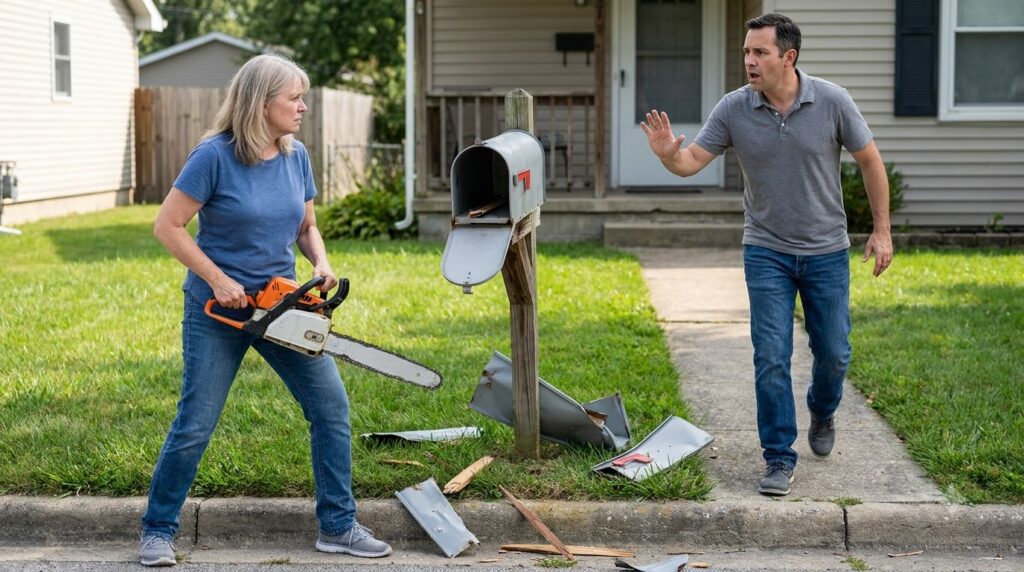
Mark didn’t lower the phone. The glass screen held her in a hard, digital grid—the orange housing of the chainsaw resting against her right shoe, the severed pine post splintered on the asphalt, the white USPS mail truck idling quietly in the background.
Brenda didn’t retreat. She reached down with one gloved hand, her fingers wrapping around the top handle of her yellow plastic clipboard. Tucked into the side pocket, partially obscured by color-coded violation notices, a thick brass key ring glinted in the noon glare. The key was long, heavy, and stamped with a three-digit municipal serial number—not an HOA key, and certainly not a house key. Mark noted the brass reflection, the angle of the serial tag, and the precise depth of the binder pocket without shifting his sightline from her eyes.
“You think a badge scares me, Mark?” Brenda’s voice remained razor-sharp, clipped and measured for the benefit of the mail carrier currently watching through his driver-side mirror. “Your father played these same semantic games when he refused to clear the drainage line in ninety-eight. The board took his deposit, and we’ll take yours.”
She picked up the chainsaw by its top bar, the dead engine clunking heavily against her hip, and turned her back on him. Her gray sneakers clicked with rhythmic, deliberate weight as she marched down the curb line toward her red sedan parked forty feet down Oakridge Way. She didn’t hurry. Every step was calculated to project absolute authority, a neighborhood officer returning to base after executing a routine administrative code enforcement.
Mark stood motionless on his concrete walkway until her taillights flickered, her car pulling into the driveway of number forty-two. Only then did he lower his arm. His shoulder muscles were locked tight, a subtle burn tracing down his triceps from holding the posture.
He didn’t inspect the ruined mailbox. Touching the physical debris before law enforcement arrived was an amateur mistake. Instead, he stepped backward up his porch steps, keeping his boots on the dry, gray concrete, and tapped the screen to lock the recording. The 4K file saved instantly to his local cloud backup—four minutes and twelve seconds of uninterrupted, high-frame-rate video showing the saw bar entering the wood, the debris falling, and Brenda’s explicit refusal to disarm.
He unlocked the front door, stepped inside the cool, shaded foyer, and let the heavy oak door latch behind him. The house smelled faintly of old paper and cedar—his father’s presence still lingering in the dark trim and narrow hallway.
Mark walked directly to his kitchen island. He set his phone on the black granite, flipped open his laptop, and pulled up the dual-channel emergency portal.
First line: County Sheriff’s Non-Emergency Dispatch. He entered the case reference number, uploaded a compressed thirty-second clip of the chainsaw blade making contact with the post, and flagged the entry under Active Property Destruction / Hazardous Tool Use.
Second line: United States Postal Inspection Service Regional Field Office. He selected Form 1510 / Mail Receptacle Destruction, attached the full four-minute video, and added the mail carrier’s truck vehicle number as a third-party witness present at the time of the offense.
As the second progress bar hit one hundred percent, Mark leaned over the counter, resting his weight on his palms. Through the front window, the afternoon sun hit the shattered wooden post, casting a jagged shadow across the curb line.
He pulled up his father’s digitized estate archive—folders compiled over thirty years of quiet, meticulous residence on Oakridge Way. In the subfolder marked HOA Correspondence / 2018-2022, dozens of scanned violation notices appeared, each signed in the same sharp, sloping cursive: Brenda Croft, Enforcement Chair.
He clicked through them, his eyes tracking dates, cited code sections, and proposed penalties. But as he cross-referenced the dates with the county parcel map displayed on his second monitor, a discrepancy emerged.
Every single notice Brenda had issued to his father wasn’t focused on aesthetics, paint colors, or lawn height. Every citation targeted structures positioned precisely along the western boundary line—the mailbox, the hedge row, the gravel drainage trench.
Mark zoomed in on the digital survey map. A faint red line cut through the western edge of his property, extending down the block past three other residential lots.
Brenda hadn’t been trying to fix a neighborhood eyesore. She had been establishing a physical paper trail along a specific, linear corridor.
Outside, the faint chirp of a siren sounded two streets over, approaching from the north. Mark closed the laptop lid, picked up his phone, and stepped back out onto the porch to meet the law.








