
CHAPTER 3: THE BLUEPRINT OF INCURSION
The siren didn’t stop at Oakridge Way. It wiled two blocks east, its high-pitched warble cutting out cleanly as the county cruiser turned onto the main avenue—diverted to an emergency call.
Mark didn’t waste the window of quiet. He locked his phone, pulled a pair of heavy leather work gloves from the porch drawer, and walked down the side steps toward the shadowed western boundary line.
The air along the side yard was cooler, held between the north brick wall of his father’s home and a high, unpainted cedar fence that belonged to number forty. The grass here grew wilder, less clipped, shielded from the road by a overgrown row of privet hedges.
Mark crouched near the back corner where the cedar fence met the hedge line. His father had always kept a heavy stack of blue slate pavers stacked against the corner post. Mark pulled three pavers aside, their rough undersides damp with dark soil and crawling with pill bugs.
Beneath the third paver, buried flush with the dirt, sat a circular steel pin—an official county land survey marker driven into the earth thirty years ago.
Mark pulled a small wire brush from his pocket and scraped the top clean. The brass cap shone dull yellow under the brushed rust. Stamped into the center were five numbers and a crosshair: SURVEY DIST 4 – PIN 8802.
He pulled a steel tape measure from his belt, hooked the lip onto the center crosshair, and walked thirty feet straight toward the roadside curb line where the ruined mailbox rested.
At precisely twenty-four feet, six inches, the steel tape crossed a strange irregularity in the turf. A square patch of sod—roughly twelve inches by twelve inches—looked subtly discolored, the grass blades growing at a slightly different angle than the surrounding Bermuda grass.
Mark knelt. He dug the gloved fingers of his right hand into the soil at the edge of the patch. The sod lifted easily, like a loose tile.
Underneath, embedded in the black loam, sat a fresh wooden stake painted neon orange at the tip. It wasn’t weathered. The pine smelled crisp, raw, and newly cut. Driven into the side of the stake with a staple gun was a small laminate tag printed with black block lettering: PROPOSED MUNICIPAL ACCESS EASEMENT – ROW 4B.
Mark’s fingers tightened on the orange pine until the wood grain creaked under his grip.
This wasn’t an HOA violation issue. It was a physical forgery.
There was no ROW 4B on the county parcel map he had just viewed inside. The city’s right-of-way ended at the asphalt edge. Someone had hand-driven surveyor stakes along his father’s private property line to fake an official municipal reservation.
He pulled his phone back out, taking four high-resolution macros of the fresh stake, the staple, the laminate tag, and its exact distance from the certified brass survey pin behind him.
His father had spent his final two years fighting off mysterious fines for “encroaching on community easements.” The old man had grown tired, confused by the legal jargon, and eventually paid two hundred dollars a month in false penalties just to keep the peace. He had believed the HOA board held legal jurisdiction over the strip.
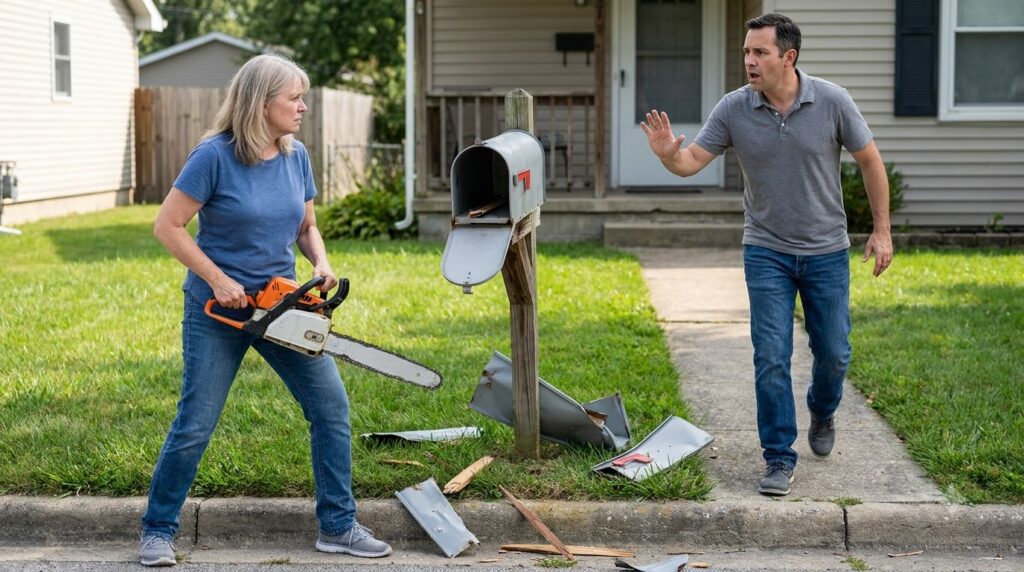
Mark stood up, brushing dirt from his knees. The calculation was clear now. Brenda hadn’t cut down the mailbox because it was an eyesore. She had cut it down because it sat directly in the path of the fake easement line—a physical obstruction that proved his father’s private deed extended all the way to the asphalt.
If the mailbox stood, her fake right-of-way was physically blocked. If she destroyed the post and forced Mark to reinstall a new one six feet back, she would successfully establish a physical boundary shift on the ground.
A heavy car door slammed down the block.
Mark turned his head slowly toward the street. Brenda Croft had stepped back out onto her driveway. She wasn’t carrying the chainsaw this time. She held a thick, dark-blue binder under her arm, and beside her walked a stocky man in a gray polo shirt—her husband, Richard Croft, president of the Oakridge Homeowners Association.
They weren’t walking toward their car. They were heading straight down the sidewalk toward Mark’s front lawn.








