
The Cold Calculus of Oakridge Way: A Tactical Reckoning at the Property Line
CHAPTER 1: THE ESCALATION AT THE CURB
The two-stroke motor shrieked at maximum throttle, sending a clouds of blue exhaust drifting across the manicured clover of Mark Vance’s front lawn.
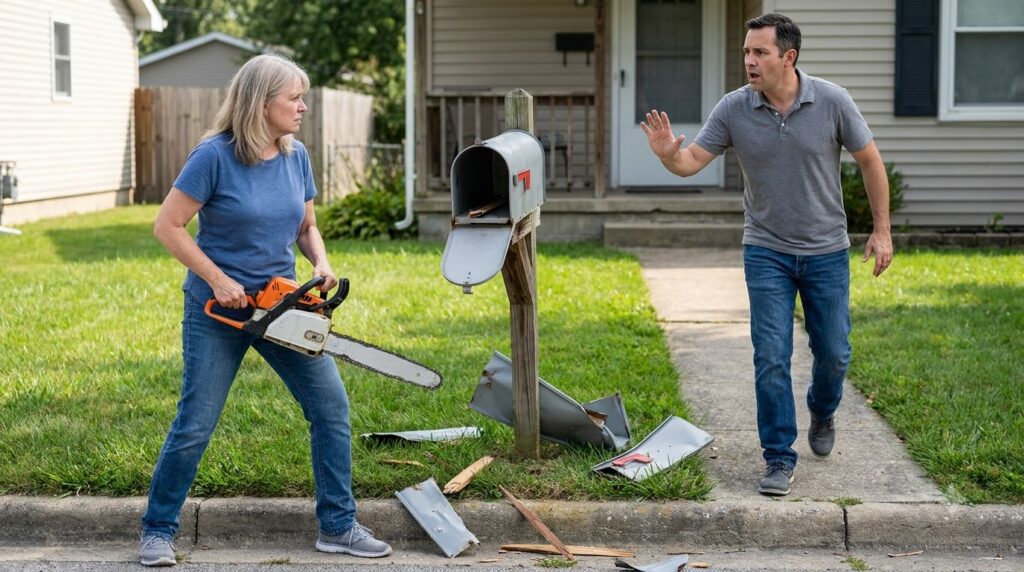
Mark didn’t run. Running invited unpredictability, and unpredictability was a tactical error when dealing with an operator holding an idling power tool. He maintained a steady, measured stride down the concrete walkway, his blue denim jeans brushing against the dry turf while his gray polo shirt remained crisp in the damp August heat. His eyes were locked not on the woman, but on the two-foot steel guide bar buried halfway through the wooden support post of his roadside mailbox.
Brenda Croft stood in a wide, braced stance on the curb lane. Her shoulder-length gray-blonde hair was pulled back by the backdraft of the saw’s cooling fan. Her blue T-shirt was stained with fresh wood pulp, her gray sneakers planted firmly on the public asphalt. She didn’t look like an unhinged neighbor; she looked like a worker executing a contract.
Metal shrieked. The bar bit through the thin aluminum housing beneath the wooden post. Splintered pine, torn gray sheet metal, and plastic outgoing mail dividers clatter-slid across the grass, spraying tiny fragments onto the dry asphalt of Oakridge Way.
“What are you doing? Stop destroying that mailbox right now!” Mark’s voice was not a scream. It was a precise, high-volume command, pitched to cut through the rasp of the two-stroke engine without betraying a tremor of adrenaline.
Brenda’s index finger eased off the throttle trigger. The saw’s scream dropped into a low, sputtering idle, the chain spinning to a halt along the grooved bar. She didn’t drop the tool. She didn’t step back. She lowered the saw bar toward her right thigh, her gloved hands keeping a death-grip on the front loop and rear handle. Her chest rose and fell in rapid, shallow breaths, her face flushed red beneath a thin sheen of sweat.
Mark stopped four feet back from the curb—outside the six-foot sweep radius of the blade. He raised his left hand flat, palm forward, forming a physical barrier between his chest and the idling engine. His right hand remained at chest height, the smartphone lens humming as its autofocus ring locked onto Brenda’s eyes, the orange housing of the chainsaw, and the ruined metal collapsed on the turf between them.
“Put that chainsaw down right now,” Mark said. His tone dropped an octave, steady, flat, and devoid of heat.
Brenda’s jaw worked silently for a second before she locked her posture. She tilted her chin up, her eyes flicking once to the phone camera before settling back on Mark’s face with cold, practiced contempt. “This structure was non-compliant, Mark,” she said, raising her voice to ensure the sound carried toward the two-story colonial across the street where a curtain had just twitched. “Three written notices. Unapproved post height. Unapproved paint shade. Section 4 of the Oakridge Charter grants the board immediate abatement authority over hazardous roadside obstructions.”
Mark didn’t look down at the yellow plastic clipboard resting near her gray sneakers. He didn’t glance at the severed mail receptacle. He kept his eyes pinned to hers, calculating the distance between her forward foot and the property line.
“You stepped onto deeded private property with an active power tool, Brenda,” Mark replied, his voice barely above a conversational cadence. “You just committed premeditated property destruction on camera. Keep the saw right where it is.”
Brenda’s lips thinned into a pale line. “Record all you want. My husband is the board president, and this street will not look like a rundown probate assignment.”
Behind her, the passenger window of a white United States Postal Service truck rolled down as it coasted to a stop ten yards away, its driver staring at the orange saw, the shattered box, and the silent standoff on the grass.

CHAPTER 2: THE ASSESSMENT OF LEVERAGE
“You have five seconds to clear this lane before I add criminal trespass to the sheriff’s report, Brenda.”
Mark didn’t lower the phone. The glass screen held her in a hard, digital grid—the orange housing of the chainsaw resting against her right shoe, the severed pine post splintered on the asphalt, the white USPS mail truck idling quietly in the background.
Brenda didn’t retreat. She reached down with one gloved hand, her fingers wrapping around the top handle of her yellow plastic clipboard. Tucked into the side pocket, partially obscured by color-coded violation notices, a thick brass key ring glinted in the noon glare. The key was long, heavy, and stamped with a three-digit municipal serial number—not an HOA key, and certainly not a house key. Mark noted the brass reflection, the angle of the serial tag, and the precise depth of the binder pocket without shifting his sightline from her eyes.
“You think a badge scares me, Mark?” Brenda’s voice remained razor-sharp, clipped and measured for the benefit of the mail carrier currently watching through his driver-side mirror. “Your father played these same semantic games when he refused to clear the drainage line in ninety-eight. The board took his deposit, and we’ll take yours.”
She picked up the chainsaw by its top bar, the dead engine clunking heavily against her hip, and turned her back on him. Her gray sneakers clicked with rhythmic, deliberate weight as she marched down the curb line toward her red sedan parked forty feet down Oakridge Way. She didn’t hurry. Every step was calculated to project absolute authority, a neighborhood officer returning to base after executing a routine administrative code enforcement.
Mark stood motionless on his concrete walkway until her taillights flickered, her car pulling into the driveway of number forty-two. Only then did he lower his arm. His shoulder muscles were locked tight, a subtle burn tracing down his triceps from holding the posture.
He didn’t inspect the ruined mailbox. Touching the physical debris before law enforcement arrived was an amateur mistake. Instead, he stepped backward up his porch steps, keeping his boots on the dry, gray concrete, and tapped the screen to lock the recording. The 4K file saved instantly to his local cloud backup—four minutes and twelve seconds of uninterrupted, high-frame-rate video showing the saw bar entering the wood, the debris falling, and Brenda’s explicit refusal to disarm.
He unlocked the front door, stepped inside the cool, shaded foyer, and let the heavy oak door latch behind him. The house smelled faintly of old paper and cedar—his father’s presence still lingering in the dark trim and narrow hallway.
Mark walked directly to his kitchen island. He set his phone on the black granite, flipped open his laptop, and pulled up the dual-channel emergency portal.
First line: County Sheriff’s Non-Emergency Dispatch. He entered the case reference number, uploaded a compressed thirty-second clip of the chainsaw blade making contact with the post, and flagged the entry under Active Property Destruction / Hazardous Tool Use.
Second line: United States Postal Inspection Service Regional Field Office. He selected Form 1510 / Mail Receptacle Destruction, attached the full four-minute video, and added the mail carrier’s truck vehicle number as a third-party witness present at the time of the offense.
As the second progress bar hit one hundred percent, Mark leaned over the counter, resting his weight on his palms. Through the front window, the afternoon sun hit the shattered wooden post, casting a jagged shadow across the curb line.
He pulled up his father’s digitized estate archive—folders compiled over thirty years of quiet, meticulous residence on Oakridge Way. In the subfolder marked HOA Correspondence / 2018-2022, dozens of scanned violation notices appeared, each signed in the same sharp, sloping cursive: Brenda Croft, Enforcement Chair.
He clicked through them, his eyes tracking dates, cited code sections, and proposed penalties. But as he cross-referenced the dates with the county parcel map displayed on his second monitor, a discrepancy emerged.
Every single notice Brenda had issued to his father wasn’t focused on aesthetics, paint colors, or lawn height. Every citation targeted structures positioned precisely along the western boundary line—the mailbox, the hedge row, the gravel drainage trench.
Mark zoomed in on the digital survey map. A faint red line cut through the western edge of his property, extending down the block past three other residential lots.
Brenda hadn’t been trying to fix a neighborhood eyesore. She had been establishing a physical paper trail along a specific, linear corridor.
Outside, the faint chirp of a siren sounded two streets over, approaching from the north. Mark closed the laptop lid, picked up his phone, and stepped back out onto the porch to meet the law.
CHAPTER 3: THE BLUEPRINT OF INCURSION
The siren didn’t stop at Oakridge Way. It wiled two blocks east, its high-pitched warble cutting out cleanly as the county cruiser turned onto the main avenue—diverted to an emergency call.
Mark didn’t waste the window of quiet. He locked his phone, pulled a pair of heavy leather work gloves from the porch drawer, and walked down the side steps toward the shadowed western boundary line.
The air along the side yard was cooler, held between the north brick wall of his father’s home and a high, unpainted cedar fence that belonged to number forty. The grass here grew wilder, less clipped, shielded from the road by a overgrown row of privet hedges.
Mark crouched near the back corner where the cedar fence met the hedge line. His father had always kept a heavy stack of blue slate pavers stacked against the corner post. Mark pulled three pavers aside, their rough undersides damp with dark soil and crawling with pill bugs.
Beneath the third paver, buried flush with the dirt, sat a circular steel pin—an official county land survey marker driven into the earth thirty years ago.
Mark pulled a small wire brush from his pocket and scraped the top clean. The brass cap shone dull yellow under the brushed rust. Stamped into the center were five numbers and a crosshair: SURVEY DIST 4 – PIN 8802.
He pulled a steel tape measure from his belt, hooked the lip onto the center crosshair, and walked thirty feet straight toward the roadside curb line where the ruined mailbox rested.
At precisely twenty-four feet, six inches, the steel tape crossed a strange irregularity in the turf. A square patch of sod—roughly twelve inches by twelve inches—looked subtly discolored, the grass blades growing at a slightly different angle than the surrounding Bermuda grass.
Mark knelt. He dug the gloved fingers of his right hand into the soil at the edge of the patch. The sod lifted easily, like a loose tile.
Underneath, embedded in the black loam, sat a fresh wooden stake painted neon orange at the tip. It wasn’t weathered. The pine smelled crisp, raw, and newly cut. Driven into the side of the stake with a staple gun was a small laminate tag printed with black block lettering: PROPOSED MUNICIPAL ACCESS EASEMENT – ROW 4B.
Mark’s fingers tightened on the orange pine until the wood grain creaked under his grip.
This wasn’t an HOA violation issue. It was a physical forgery.
There was no ROW 4B on the county parcel map he had just viewed inside. The city’s right-of-way ended at the asphalt edge. Someone had hand-driven surveyor stakes along his father’s private property line to fake an official municipal reservation.
He pulled his phone back out, taking four high-resolution macros of the fresh stake, the staple, the laminate tag, and its exact distance from the certified brass survey pin behind him.
His father had spent his final two years fighting off mysterious fines for “encroaching on community easements.” The old man had grown tired, confused by the legal jargon, and eventually paid two hundred dollars a month in false penalties just to keep the peace. He had believed the HOA board held legal jurisdiction over the strip.
Mark stood up, brushing dirt from his knees. The calculation was clear now. Brenda hadn’t cut down the mailbox because it was an eyesore. She had cut it down because it sat directly in the path of the fake easement line—a physical obstruction that proved his father’s private deed extended all the way to the asphalt.
If the mailbox stood, her fake right-of-way was physically blocked. If she destroyed the post and forced Mark to reinstall a new one six feet back, she would successfully establish a physical boundary shift on the ground.
A heavy car door slammed down the block.
Mark turned his head slowly toward the street. Brenda Croft had stepped back out onto her driveway. She wasn’t carrying the chainsaw this time. She held a thick, dark-blue binder under her arm, and beside her walked a stocky man in a gray polo shirt—her husband, Richard Croft, president of the Oakridge Homeowners Association.
They weren’t walking toward their car. They were heading straight down the sidewalk toward Mark’s front lawn.
CHAPTER 4: THE INTERCEPT
“Stay on your side of the apron, Richard.”
Mark didn’t raise his voice. He stood on the edge of his paved walkway, four feet behind the severed post, his gloved hands relaxed at his sides.
Richard Croft stopped two inches short of the property line. His gray polo shirt was stretched tight over a heavy stomach, his neck flushed a dark, mottled red against his white collar. Beside him, Brenda held the thick blue binder against her ribs like a shield, her knuckles white against the vinyl cover.
“We aren’t here to play juvenile games, Vance,” Richard said. His voice was thick, practiced, conditioned by fifteen years of gaveling down complaints at municipal community centers. “You’re harboring an illegal structure on a designated right-of-way. Brenda executed a lawful abatement after three formal notices went ignored.”
“Show me the county recording,” Mark said.
Richard blinked, his jaw shifting slightly. “The HOA charter—”
“I didn’t ask for the charter,” Mark interrupted, his voice dropping into a cold, flat cadence. “I asked for the county recorder’s plat book and page number establishing ROW 4B as a dedicated public or municipal easement. You have the binder right there, Brenda. Open it.”
Brenda’s eyes darted to her husband before she snapped the binder open. She didn’t flip to an official seal or a county survey document. Instead, she turned to a plastic sleeve protecting a hand-drawn grid map marked with red grease-pencil lines cutting across four separate residential parcels along the curb.
Mark stepped forward, stopping precisely at his deed line. His eyes swept the page in two seconds.
The map wasn’t an official record. It was an internal proposal map drafted on drafting paper, featuring a stamped header from a private civil engineering firm, with four properties highlighted in yellow: his father’s house, number forty, number thirty-eight, and thirty-six. Across all four lots, a shaded six-foot strip was labeled Proposed Private Utility Expansion & Access Corridor ROW-4B.
It wasn’t a public easement. It was an aggressive, unrecorded land grab—a clandestine effort to manufacture an access corridor through private yards to connect the rear cul-de-sac to a commercial utility project planned on the adjacent avenue.
“That’s a draft utility schematic,” Mark said, his eyes rising from the paper to lock onto Brenda’s. “It’s not recorded. It’s not stamped by the county clerk. You’ve been issuing fraudulent fines against my father for three years based on an unapproved private easement proposal.”
Brenda’s chest rose in a sharp, shallow breath. She pulled the binder back against her chest, snapping the cover shut. “The board has broad discretionary authority to prepare infrastructure improvements—”
“The board has zero authority to seize deeded private land or use power tools to destroy federal mail receptacles,” Mark replied.
“You don’t understand how this neighborhood operates, kid,” Richard snapped, stepping half an inch closer, his leather shoe edging over the asphalt lip onto the turf. “Your father knew when to cooperate. If you block this corridor, you’re tying up every property value on this street in administrative litigation for five years.”
“My father paid your fake fines because he was sick and tired of fighting you,” Mark said. He pulled his smartphone from his pocket, holding the screen up so Richard could see the active upload status indicator. “I’m not sick, Richard. And I’m not tired.”
Across the street, three more front doors swung open. Mrs. Gable stepped all the way off her porch, her arms crossed over her apron, accompanied by two neighbors from down the block. A delivery truck pulled over near the curb, its driver leaning out the window to watch the standoff.
Richard’s face tightened as he noticed the gathering eyes. He leaned in, lowering his voice to a harsh whisper. “You think you’re clever because you know how to read a parcel map? You don’t have the survey documentation to back this up in court.”
“I don’t need to wait for court,” Mark said softly. “The county surveyor’s truck just pulled onto Oakridge Way.”
At the end of the block, a yellow utility van equipped with rooftop strobe lights slowed to a halt behind Brenda’s red sedan, its side panel clearly painted in bold black lettering: COUNTY LAND RECORDS & BOUNDARY SURVEY DIVISION.
CHAPTER 5: THE VERIFICATION OF BOUNDARIES
The yellow utility van hadn’t even killed its engine before the driver’s side door swung open.
A tall man in a high-visibility orange vest and a battered khaki cap stepped onto the asphalt, carrying a tripod mounted with a digital total-station laser level over his right shoulder. In his left hand, he held a weathered leather field folder branded with the county seal.
Richard Croft took three rapid steps toward the surveyor, his hand instinctively reaching into his pocket for a card. “Officer, I called the department earlier to report an unregistered obstruction—”
“I’m not an officer, sir. I’m Chief Surveyor Miller with County Parcel Audit,” the man said, his voice flat, dry, and thoroughly unbothered by neighborhood politics. He didn’t shake Richard’s hand. He set the tripod legs onto the street asphalt, loosened the brass thumbscrews, and adjusted the level until the digital bubble centered with a sharp electronic beep.
Mark didn’t move from his position near the severed post. “Work order forty-eight, Chief Surveyor. Priority audit requested for Lot thirty-four, western boundary line.”
Miller glanced at Mark, then down at his digital tablet. “Vance estate. Right. Your father filed for a certified boundary re-verification three years ago, but the fee wasn’t processed until your probate update hit the clerk’s office last Thursday.”
Brenda stepped forward, thrusting her blue binder toward the surveyor’s chest. “We have the official right-of-way schematic right here! ROW four-B was approved by the neighborhood improvement committee—”
Miller didn’t take the binder. He pulled a pair of reading glasses from his vest pocket, hooked them over his ears, and unclasped his own leather folder. “I don’t care what your committee approved, ma’am. The county doesn’t recognize HOA sketchbooks. We recognize deed filings and field monuments.”
He walked straight past Brenda and Richard, stepping onto Mark’s lawn. He didn’t look at the shattered mailbox or the splintered wood. His eyes were glued to the ground as he tracked the exact GPS coordinates displayed on his handheld receiver.
He stopped three feet behind the hedge line, right at the corner where Mark had unearthed the brass pin under the blue slate pavers.
“Monument eight-eight-zero-two,” Miller muttered, kneeling in the grass. He touched the brass cap, then tapped a command into his tablet. “Monuments intact. Grade alignment clear.”
He pulled a spool of neon-pink surveyor’s chalk line from his tool belt, looped it tightly around the brass pin, and walked fifty feet straight toward the curb. He pulled the line taut, snapping it against the grass with a sharp thwack. A vivid pink streak cut through the turf, passing two inches outside the wooden post of Mark’s destroyed mailbox.
“The mailbox post sits four inches inside your deeded property line, Mr. Vance,” Miller declared, standing up and dusting his knees. “Your private boundary extends all the way to the curb line. There is no recorded county easement, utility reservation, or ROW four-B on this parcel.”
Mark felt a cold surge of vindication, but he kept his face completely expressionless. He looked directly at Richard Croft, whose jaw was working silently as his skin turned a mottled, bruised purple.
“You lied to my father for three years,” Mark said softly. “You used a fake utility map to extort two hundred dollars a month out of a dying man.”
“It wasn’t a lie!” Brenda shouted, her voice cracking as the watching neighbors murmured across the street. “The expansion map was drawn up by professional engineers! The commercial developer needed access—”
“What commercial developer?” Miller interrupted, frowning as he flipped a page in his county archive folder. “There’s no commercial development approved for this block. The only municipal filing on record for Oakridge Way involving boundary disputes isn’t about utility expansion at all.”
Miller pulled a yellowed, folded sheet from the back flap of his folder—a thirty-year-old document bearing a red stamp marked MUNICIPAL VARIANCE DENIAL – 1994.
“Lot forty-two,” Miller read aloud, his eyes tracking the old typewriter print. “An unapproved rear garage structure built two feet, four inches past the municipal property boundary into the city fire lane. Subject to mandatory demolition unless a continuous forty-foot access buffer is maintained across adjacent parcels.”
Mark froze. His mind recalculated the entire board game in less than two seconds.
The hand-drawn utility map inside Brenda’s binder wasn’t a corporate land grab. It was a elaborate smoke screen.
Brenda and Richard weren’t trying to sell an easement to a utility company. They were desperately trying to fabricate a fake sixty-foot corridor along the street to satisfy an ancient municipal fire-lane variance—because if the city ever conducted a real boundary audit, their own back garage at number forty-two would be condemned and torn down by the county.
They had destroyed his father’s mailbox—and harassed him for years—not out of greed, but out of absolute, panic-driven self-preservation.
“You built your garage over the city line,” Mark said, the realization settling into a razor-sharp edge. “And you used the entire street as a human shield to cover it up.”
Before Richard could answer, two official vehicles turned the corner of Oakridge Way—a white sheriff’s department patrol car with its lightbar flashing, followed directly by a dark gray government sedan bearing federal license plates.
CHAPTER 6: THE FEDERAL ENFORCEMENT
The door of the gray government sedan clicked open before the engine idle even cut out.
Inspector Arthur Hayes stepped onto the asphalt, his gold-lettered windbreaker catching the harsh noon glare. Right beside him, Deputy Miller adjusted his duty belt, his boots crunching on the loose gravel near the curb as his eyes swept the scene—the orange-and-white chainsaw sitting idle on the turf, the blue binder clutched against Brenda’s chest, the pink chalk line splitting the grass, and the splintered fragments of Mark’s roadside mailbox scattered across the curb lane.
Richard Croft took a quick, stiff step toward the deputy, raising a hand in a forced gesture of authority. “Deputy, I am Richard Croft, president of the Oakridge Homeowners Association. We were executing an administrative abatement on an unauthorized roadside obstruction when—”
“Save the speech, Mr. Croft,” Deputy Miller said, stepping cleanly past him without stopping. He walked up to the severed post, unholstered a small digital camera, and began taking methodical close-up photos of the chain-teeth bite marks in the wood and the severed metal casing.
Inspector Hayes walked straight to Mark. “Mr. Vance? I’m Inspector Hayes, United States Postal Inspection Service. You logged a priority report regarding willful destruction of an active mail receptacle?”
“I did,” Mark said, his voice completely level. “The full video recording is already uploaded to your regional portal. The physical damage occurred forty-five minutes ago.”
Brenda’s face turned paper-white as she stepped toward the federal agent, her voice rising into an anxious, defensive strain. “This isn’t a federal issue! This is a private neighborhood standards dispute! The mailbox violated height and color codes established under our charter—”
“Mrs. Croft,” Inspector Hayes interrupted, his voice dropping into a dry, quiet tone that carried lethal legal weight. “Under Title 18, Section 1705 of the United States Code, a post-mounted roadside mailbox, once installed and approved for the receipt of United States mail, is protected under federal law. Homeowner association bylaws do not, have never, and will never supersede federal property statutes.”
He opened his leather folder, pulling out a printed copy of the 4K doorbell footage Mark had uploaded less than an hour prior.
“Furthermore,” Hayes continued, holding up a crystal-clear printout showing Brenda measuring the post with a tape measure hours before returning with a gas power tool, “your actions demonstrate clear premeditation. You did not clear an immediate physical hazard. You brought a dangerous power tool onto deeded private land to destroy federal mail delivery infrastructure.”
Richard tried to step between his wife and the inspector. “We have broad maintenance authority under—”
“Chief Surveyor Miller has already verified that this post sat four inches inside Mr. Vance’s deeded private lot line,” Deputy Miller interjected, turning around with his citation notebook open. “Which means, Mr. Croft, your wife crossed a private property line with a weaponized power tool, committed criminal destruction of property, and attempted to enforce a non-existent easement to cover up a thirty-year-old municipal variance violation on your own parcel.”
A collective gasp rippled through the crowd of neighbors gathered along the sidewalks. Mrs. Gable took two steps forward onto Mark’s lawn, her arms crossed, glaring directly at Brenda. Down the block, two other homeowners who had paid Brenda’s “easement penalties” for years began talking in hushed, furious tones.
Brenda looked around at the circle of staring faces—the neighbors she had intimidated for over a decade, the county surveyor resting his laser level against his tripod, the sheriff’s deputy writing on his notepad, and the federal inspector holding the printout of her own face caught on camera.
Her hands began to shake. The heavy blue binder slipped from her gloved fingers, hitting the turf with a dull thud, its plastic sleeves scattering across the pink chalk line.
Deputy Miller pulled a formal citation slip from his pad, stepping directly in front of her. “Brenda Croft, you are being issued a criminal citation for property destruction and trespass today. In addition, Inspector Hayes is opening a formal federal case file with the District Attorney’s office regarding interference with federal mail delivery.”
Brenda opened her mouth to speak, but no sound came out. She looked at her husband, but Richard had pulled back a full step, staring at the ground, his face pale and completely drained of authority.
“Pick up your saw, ma’am,” Deputy Miller said softly. “Step back to your property line, and do not cross onto Mr. Vance’s land again.”
CHAPTER 7: THE RESTORATION OF TERRITORY
Brenda Croft did not speak.
The silence that fell over Oakridge Way was heavier than the scream of the chainsaw. It was the absolute, suffocating vacuum of a collapsed regime. Slowly, her knees popping in the quiet afternoon air, she squatted over the pink surveyor’s chalk line. Her gloved hand reached for the top handle of the orange-and-white chainsaw.
As she lifted the heavy tool, her forearm brushed the yellow plastic clipboard resting on the turf. It flipped, spilling a loose cascade of color-coded violation notices across the grass. From the side pocket of the clipboard, the heavy brass key ring slipped free. It hit the asphalt with a sharp, high-pitched clink that echoed against the silent street.
Mark looked down at the brass tag. The noon glare caught the deep-stamped lettering. He didn’t need to pick it up to read the three-digit municipal code. Next to the numbers, deeply engraved into the metal, was a single word: CONDEMNED.
It was a city padlock key. For thirty years, Brenda had carried the physical key to her own husband’s illegally built garage, a constant, paranoid reminder of the municipal guillotine hovering over their property value. She had weaponized the entire neighborhood, terrorizing a dying man with fake easements, all to build a sixty-foot buffer against a city inspector who had never even bothered to return.
Richard Croft stared at the brass key on the asphalt. His face went entirely slack. He didn’t bend to help his wife. He simply turned, his shoulders sagging under a sudden, invisible weight, and began the long walk back toward number forty-two.
Brenda snatched the key from the street, her fingers trembling so violently she nearly dropped it again. She hugged the chainsaw to her hip, clutching the broken blue binder against her chest, and followed her husband. She didn’t look at the neighbors standing on their porches. She didn’t look at the county surveyor, who was already packing his laser level. She kept her eyes locked on the gray concrete of the sidewalk, a deposed warden making the longest walk of her life.
Mark watched them until they crossed their own property line. The calculus was complete. The threat was neutralized.
“Mr. Vance,” Inspector Hayes said, stepping forward. He extended a stiff, cream-colored cardstock rectangle. “My direct field office line. The federal incident report will be filed before close of business. Do not touch or dispose of the damaged post. It is now logged as physical evidence in a federal tampering case. We will have a forensics transport unit collect it in the morning.”
“Understood, Inspector,” Mark said, taking the card. The edges of the paper were sharp against his thumb.
Deputy Miller tipped his hat, his citation book securely snapped shut. “If she sets foot on this parcel again, you call dispatch. Don’t engage. Just call.”
Mark nodded once. He stood on the edge of his walkway, completely still, as the white patrol cruiser and the dark government sedan pulled away from the curb, their tires crunching over the loose gravel. Chief Surveyor Miller followed minutes later, leaving only the bright pink chalk line glowing unnaturally bright against the green Bermuda grass.
The United States Postal Service carrier, who had remained parked ten yards away, finally killed his engine and stepped out of his truck. He walked over to the curb, looking down at the jagged pine stump and the mangled aluminum.
“I can hold your mail at the regional hub until you get this sorted, sir,” the carrier said, his voice respectful, almost quiet.
“No need,” Mark replied. The adrenaline was finally beginning to bleed out of his system, leaving behind a cold, clear focus. “Give me three minutes.”
Mark walked past the shattered wood, up the driveway, and punched the keypad on his father’s garage. The heavy aluminum door rolled upward on greased tracks. He walked past his father’s old workbench, past the neatly organized pegboards, and gripped the handle of a fifty-pound steel post driver. In the corner, leaning against the drywall, was a temporary heavy-duty steel U-channel post.
He carried the cold, black iron out into the sunlight. The air still smelled faintly of two-stroke exhaust and fresh pine sap, but the heat of the afternoon was beginning to break.
Mark positioned the steel U-channel post exactly three inches inside the pink chalk line—well within his deeded boundary, but as close to the absolute edge of his sovereignty as physics allowed. He slid the heavy iron driver over the top of the post.
He gripped the handles. He lifted the fifty-pound iron cylinder, feeling the raw, mechanical weight of it in his lats and shoulders, and brought it down.
Clang.
The sound of steel striking steel rang out like a gunshot down Oakridge Way.
Clang.
Across the street, Mrs. Gable didn’t retreat inside. She watched from her lawn, her posture relaxed for the first time in a decade. Down the block, a neighbor raised a hand in a silent, solemn wave.
Clang.
With every strike, the steel post bit deeper into the dark earth. Mark felt the vibration travel down his forearms, a harsh, kinetic transfer of energy. This was not a negotiation. This was not a neighborhood committee meeting. This was the physical manifestation of a boundary. He was driving a spike through the heart of the HOA’s psychological control, securing his father’s legacy with iron, leverage, and the cold, unyielding mechanics of the law.
When the post was sunk three feet deep, immobile as bedrock, Mark lifted the heavy iron driver away. He retrieved a temporary, regulation-approved steel mailbox from the garage, bolted it to the top of the U-channel, and tightened the hex nuts until the wrench bit into the metal.
He stepped back.
The postal carrier walked up to the curb, slotted a stack of rubber-banded envelopes into the fresh metal housing, and snapped the door shut.
“Have a good afternoon, Mr. Vance,” the carrier said, touching the brim of his cap before climbing back into his truck.
Mark stood alone on the curb. The sun was dipping below the rooflines, casting long, sharp-edged shadows across the asphalt. To his left, the shattered remains of the old post lay in the grass, waiting for the federal transport. To his right, the pink chalk line stretched endlessly down the block, an undeniable border.
He looked down the street toward number forty-two. The driveway was empty. The front door was shut. The blinds were drawn tight. The neighborhood was quiet.
Mark Vance took a slow, deep breath of the cooling air, turned his back on the street, and walked back up the concrete path to his father’s house. The front door closed behind him, the heavy deadbolt sliding into place with a sharp, metallic click. The line was held.







