
CHAPTER 7: THE BREAKING BOUNDARY
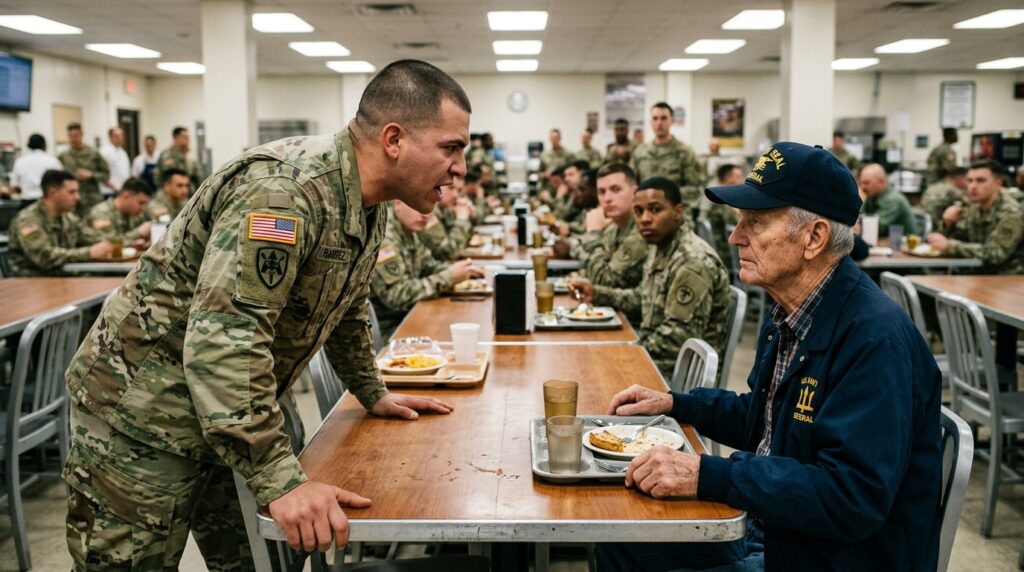
The fabric tore with a clean, explosive snap. When Miller’s shoulder dropped to commit his entire hundred and ninety pounds into a downward heave, he didn’t encounter the soft, yielding resistance of an old man’s brittle skeletal frame. He found iron.
Mac didn’t pull back. He didn’t push away. He moved with the vacuum of Miller’s forward over-commitment, his left hand snapping off the breakfast tray like a coiled mainspring. His fingers, rough as sixty-grit emery cloth, intercepted Miller’s thick right wrist from the inside out, his calloused thumb pinning the radial nerve against the boy’s own bone. It wasn’t a strike; it was an intersection of geometry. The pale, circular scar tissue twisting around Mac’s right knuckle caught the light under the humming fluorescent tubes as he stood up, his spine straightening with the slow, terrifying mechanics of a hydraulic crane lifting a dead weight from a harbor floor.
The floor plates didn’t slip. Mac’s right heel, anchored deep into the pitted, rusty depression where the old mess hall benches had been sheared off twenty years ago, provided the exact pivot point the kinetic sequence demanded. He rotated his left hip back three inches. That micro-adjustment stripped Miller of his remaining leverage, converting the specialist’s aggressive forward lunge into a helpless, accelerating descent toward the formica.
Miller’s eyes widened, the small veins in his white sclera bulging as his center of gravity left his boots entirely. He tried to disengage his fingers from Mac’s lapel, but the canvas was bunched too tight, locked under the crushing clamping force of Mac’s thumb. The young soldier’s bulk became his own executioner. The physical laws of momentum took the starched digital camouflage, the pristine brigade unit patch, and the heavy leather boots, tilting them over the shared centerline of the table.
The impact was a massive, dead sound that shook the industrial grease traps beneath the floorboards. Miller didn’t slide; his torso hit the center of the formica table flat, his ribs cracking against the yellowed laminate seam with a hollow, booming thud that sent Mac’s paper coffee cup launching into the air. The plastic tray buckled, the stale toast and yellow chalk eggs scattering across the gray granite-patterned surface as Miller’s legs flipped cleanly over his head, driven by the unchecked torque of the throw.
The stainless-steel condiment dispenser sheared off its bracket with a sharp, metallic screech. The heavy iron salt shaker, caught in the wake of Miller’s flying sleeve, rolled violently along the edge before spinning into the dark gap between the benches, leaving a white, gritty trail of coarse crystals across the floor like salt on an ice-locked deck. Miller’s entire mass carried over the opposite side of the table, his shoulders clearing the outer bench before he slammed flat onto his back against the industrial linoleum.
The wind left his chest in a single, wet gasp—a choked, metallic rattle that sounded like a pump sucking air out of an empty ballast tank. He lay perfectly flat, his arms splayed out like a broken mannequin, his close-cropped head bouncing once against the hard gray tile. The pristine unit patch on his shoulder was now smeared with cold grease and gray salt crystals, the crisp edge of the nylon thread fraying against the abrasive floor grit.
Mac remained standing on his side of the table lane. He hadn’t lost his footing by an inch. His breathing stayed even, his chest rising and falling behind the faded blue windbreaker with the slow, rhythmic cadence of a man who had timed his heart to the rise and fall of deep-water swells. He reached down with his right hand, his fingers unhurried and precise, and pulled the front of his jacket straight, smoothing the wrinkled canvas over the thick manila envelope hidden inside his pocket. The gold trident on his weathered cap remained perfectly level, catching the cold glare of the lights like a dull, metallic eye that had seen forty years of modern infrastructure rot into the dirt.
The mess hall was completely dead. The distant clatter of the scullery had vanished as if someone had pulled the main breaker on the entire installation. Fifty active-duty soldiers sat frozen on their benches, their forks suspended in the stale air, their mouths slightly open as they stared at the space where an active-duty specialist had been converted into a grounded casualty in less than two seconds of mechanical work. The silence was an absolute, physical weight—the institutional memory of the military facility recognizing, with absolute clarity, the distinct and unmitigable hallmark of high-tier special operations discipline executed by an asset who didn’t exist on their computers.
Miller didn’t move. His fingers twitched once against the gray linoleum, his blackened steel ring clicking softly against the concrete beneath the tile as he looked up into the unyielding face of the ghost standing over his table.








