
CHAPTER 3: THE BOAST OF THE YOUNG LINE
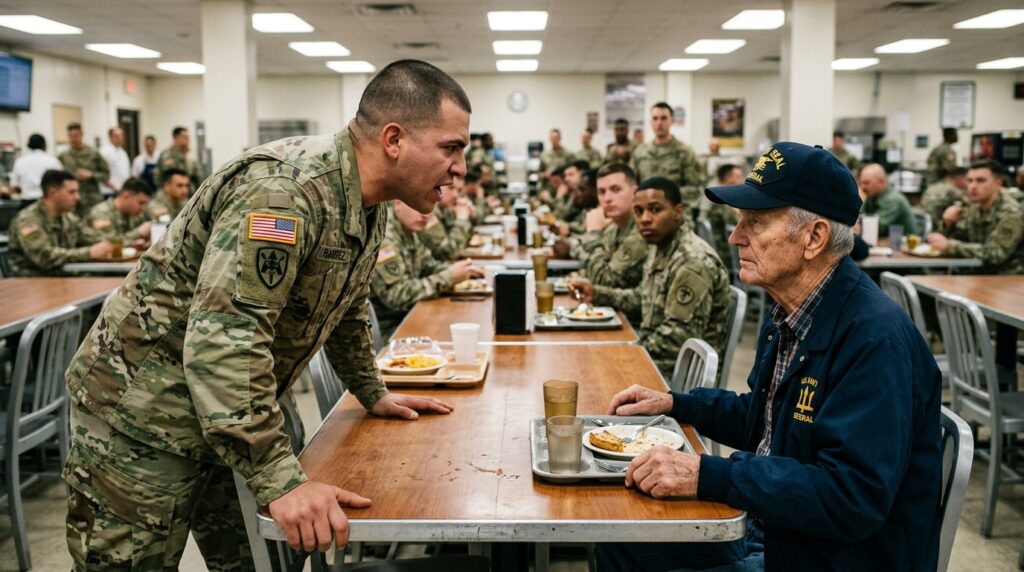
Miller’s square fingers dropped toward the brown composite material of the tray. The movement was a calculated insult, a slow-motion assertion of spatial dominance that relied on the quiet compliance of everyone wearing a faded windbreaker on a Tuesday morning. The dull, blackened steel ring on his left index finger—scarred across its perimeter with three sharp, parallel machine grooves—glinted under the low-hanging fluorescent banks. The light inside the mess hall didn’t dance; it died against the unwashed grease traps and the grease-filmed surfaces of the condiments.
Mac didn’t track the hand with his eyes. He tracked the left shoulder. The seam where the uniform sleeve met the yoke was strained, the nylon-threaded stitching pulled taut by the bulk of an active-duty frame that spent its deployments hauling crates and securing perimeters. The young man’s weight was still centered over his toes, a common structural error among soldiers who had only fought on level concrete or inside armored hulls. They forgot that the earth itself was always shifting, always offering a friction point to the man who knew how to sink his heels into the rust.
“You like the sound of your own jaw, kid,” Mac said, his voice level, dropping into the space between the rattle of plates. He didn’t pull the tray back. He didn’t lean away from the smell of old coffee and high-fructose energy drinks that accompanied Miller’s lean. “But you’re spending currency you haven’t earned yet. This table was anchored before your father had his draft card.”
A short, dry chuckle erupted from the far end of the bench—a corporal with a grease-stained thumb paused mid-bite, his eyes flickering toward the large unit insignia on the wall before returning to the spectacle. Miller didn’t look back at his squad. The skin around his ears darkened, a dull crimson creeping up from his high, stiff collar until it met the close-cropped line of his hair. His fingers tightened into a hard, rigid claw, his palm coming into direct contact with the rim of Mac’s breakfast plate.
The grease on the formica provided a slick, micro-thin barrier between their spaces. Mac felt the vibrations of the entire room—the distant clatter of the scullery, the rhythmic thud of the industrial dishwasher, the heavy, metallic sigh of the boiler behind the bulkhead. The world was built on these small, mechanical tolerances, pieces of iron grinding against pieces of iron until one of them turned to dust.
“You’ve got a lot of mouth for a man carrying a dead pass,” Miller muttered. He didn’t yank the plate; he pushed it, a deliberate four-inch slide that sent the stale toast tilting toward the edge of the laminate. His forearm muscles bunched under the digital camouflage fabric, the heavy cloth scraping against the metal trim of the salt shaker with a sound like sandpaper on a dry hull. “The admin pool is down the road, grandpas. This section belongs to the rotation. If you can’t walk it off, I’ll have the MP at the gate check that souvenir cap for a registration date.”
Mac’s fingers remained loosely curled near the base of his coffee cup. He was looking at the third button again, but his peripheral vision had already mapped the three inches of clearance between the bench and the steel leg of the table. A tactical landscape didn’t change just because the uniform colors did; the leverage points remained identical. A shoulder stayed a hinge. A throat stayed a soft target. A forward-leaning mass stayed an invitation from the gravity that eventually collected every soldier who stayed in the field too long.
“Forty seconds are up,” Mac whispered. His thumb felt the cold, pitted iron of the seat bracket behind his thigh. “Your sergeant just cleared the motor pool gate.”
Miller didn’t take the warning. He took the space instead, his upper body dropping another two inches into the interaction lane, his left shoulder dropping as he prepared to lift the tray by its corner. The movement was heavy, arrogant, and entirely devoid of balance.








