
CHAPTER 4: THE FADED BLUE ARCHIVE
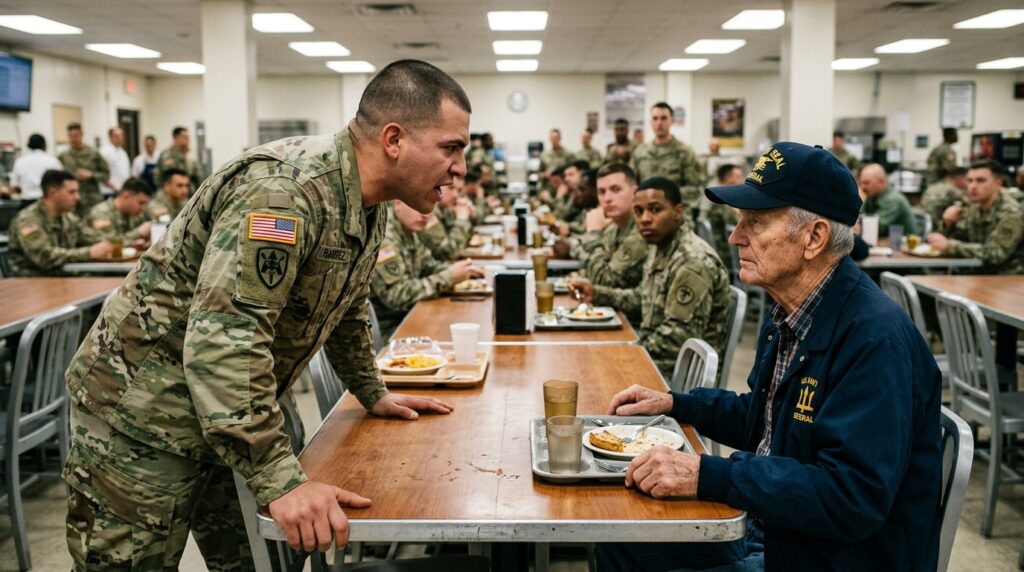
“You talk about dead passes like you’ve seen a real logbook, Specialist,” Mac said. His hand didn’t tremble as he spoke, though the dampness from the fog was working its way deeper into his lower back, finding the jagged silver seam of an old exit wound near his hip. He let his left arm drop slightly, his cuff brushing against the thick, fibrous edge of the manila envelope tucked into his inner pocket. The top corner of the paper was frayed, the fiber swollen by the coastal humidity, showing a faint streak of faded blue ink—a departmental serial number that ended in a double zero.
Miller’s gaze flicked down toward the bulge in the blue windbreaker. His eyes narrowed, the arrogance in his face hardening into a suspicious, professional calculation. A soldier who spent his days in modern rotations knew the shape of standard ordnance or administrative forms; he recognized the weight of a legal file even if he didn’t understand the clearances required to pull it from the subterranean archives behind the main garrison.
“The only logbook that matters is the one at the gate, old man,” Miller said, though his voice lacked the easy, sweeping weight it had carried ten seconds ago. He kept his palms pinned to the table, but the skin over his knuckles had gone from a aggressive red to a bloodless white. “And right now, the division doesn’t have an asset named MacInerney on the active manifest. I know every name on the roster from the third brigade down to the logistics auxiliary. You’re a ghost occupying space that belongs to people who actually have grease under their nails.”
The silence in the immediate lane had thickened, turning into that heavy, unyielding air that precedes a lightning strike over a salt flat. The two privates who had slid away were now sitting perfectly still three tables over, their mouths slightly open, their eyes darting between the clean digital camouflage of the specialist and the salt-whitened seams of Mac’s Navy cap. The industrial fans above them continued their low, rhythmic grinding, a mechanical clicking that sounded like a dry cylinder spinning in an empty chamber.
Mac took a small, deliberate breath through his nose. He could smell the parched oil from the motor pool outside, a scent that never changed, whether it was 1989 or 2026. It was the same crude petroleum that coated every landing craft from the Subic Bay berths to the piers down at Little Creek. He knew the taste of that iron before Miller’s mother had her high school physical.
“You think the world started when they handed you that digital pattern,” Mac murmured, his fingers remaining perfectly loose on the gray laminate. “You think because the computer doesn’t show a flag, there wasn’t a line drawn here before they laid this tile. Your commander was a lieutenant when we cleared the bilge on the Kittiwake. He didn’t look at rosters to see who was standing watch.”
Miller’s left eye twitched, the tiny muscle beneath the lower lid jumping twice. “Don’t talk about the Colonel like you sat at his table. You don’t know anything about the operations this unit has sustained while you were sitting on a porch somewhere collecting a pension.”
“I don’t collect a pension, son,” Mac said. He didn’t explain the lack of a monthly check. He didn’t tell the boy about the specific statutory omissions that occur when an operation is scrubbed from the federal register by a joint-service memorandum that remains classified under three separate maritime exclusions. He simply let his thumb rest against the cold, pitted iron of the seat bracket, feeling the structural resonance of the room through the steel. “The state doesn’t pay people who aren’t legally finished with their deployment.”
Miller didn’t take the cue. His ignorance was like a heavy armor plate—thick enough to stop a direct question, but entirely too heavy to let him pivot when the ground began to give way beneath his boots. He shifted his hips, his right knee catching the underside of the formica table with a loud, wooden clatter that made the salt shakers jump on their tracks.
“I’m clearing this table,” Miller whispered, his face darkening until the skin across his jaw looked like raw leather. “And if that file doesn’t have an MP signature on it by nine-fifteen, I’m personally escorting you to the perimeter fence.”
He reached out, his hand no longer aiming for the edge of the plastic tray, but swinging low toward the lapel of Mac’s blue windbreaker, his fingers open and rigid like a pair of iron pliers.








