
CHAPTER 7: THE TALLY AT THE COUNTER WINDOW
The door handle didn’t rattle when the second man came through the frame; it simply snapped. The cheap zinc alloy sheared with a sharp, dry pop that was buried beneath the roar of the rain on the roof planks. He was broader than the man in the gray shell, his shoulders carrying the heavy, thick slope of an operator who had spent his winters hauling drilling steel through the northern shale fields. He had a yellow grease pencil tucked behind his ear and a heavy steel-handled scraper clamped in his right fist.
“The gate’s down, Vance,” the broad man said. He didn’t look at Miller. He spit a dark stream of tobacco juice onto the dry corner of the pine floorboards, his work boots leaving deep, caked crescents of river silt in the wood. “The old man’s truck is still blocking the narrow turn by the culvert. We can’t get the second flatbed through the brush without scratching the side panels.”
“Move it,” Vance said. He didn’t lift his eyes from the small quartz watch. “Use the winch on the utility rig. If the axle snaps, log it as an obstruction of a county drainage easement.”
Miller shifted his weight one inch to the left. His wet work boot scraped against a loose nail head in the flooring, a low, rasping groan of metal on wood that made the broad man turn his head. The light from the salt-crusted window was dying now, turning the gray interior into a matrix of long shadows and cold, damp mist.
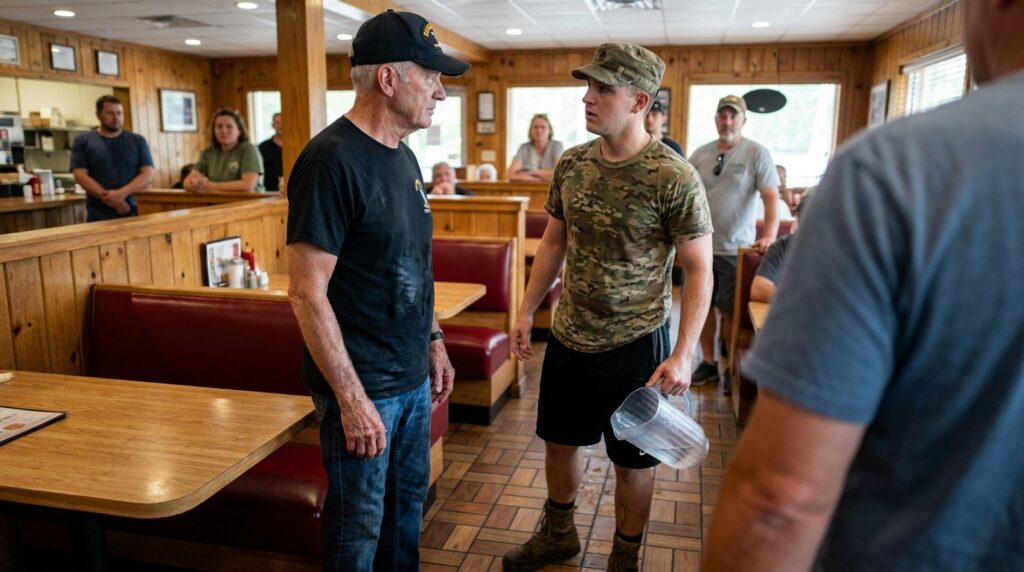
“You’re not moving the truck, son,” Miller said.
The broad man didn’t hesitate. He didn’t monologue or announce his intent; he simply stepped forward with the heavy, unhurried momentum of a machine that had been cleared to work a field. He brought the steel-handled scraper up in a short, tight arc meant to clear Miller’s shoulder and drive the flat edge into his ribs before the older man could adjust his stance on the slick planks.
Miller didn’t drop his hands. He didn’t swing. He stepped into the arc, shortening the distance before the tool could find its velocity.
His left forearm—thick with the ancient, unyielding muscle of a man who had survived thirty winters on the salt flats—intercepted the broad man’s wrist. The impact sounded like two heavy timber baulks hitting each other in an eddy. The momentum didn’t stop; it traveled straight through the broad man’s shoulder, his leather boots slipping on the wet silt he’d tracked into the room.
Before the scraper could clear the space between them, Miller’s right hand found the broad man’s collar. His fingers closed around the coarse canvas, his iron watchband catching the light as he twisted the fabric once, locking the man’s throat against his own weight. It wasn’t a tactical demonstration; it was the raw, heavy economy of a man who didn’t have the lung capacity for an extended argument.
He drove his elbow down into the joint of the broad man’s arm, a short, heavy thrust that sheared the leverage clean out of the wrist. The steel scraper fell, its heavy blade biting two inches into the pine floorboards with a dull thud.
The room went quiet again, save for the rhythmic, metallic ticking of the quartz watch in Vance’s hand.
“The gate stays down,” Miller said, his breath coming in a low, even rumble that didn’t shake the canvas bill of his cap. He didn’t look at the broad man who was now gasping on his knees, his hands hooked into his throat to find the air Miller had taken. He looked directly at Vance, whose face had gone the pale, flat color of lard under the fluorescent glare of the kerosine lamp.
Vance slid the quartz watch back into his pocket. His right hand stayed close to his shell coat, his fingers tracing the outline of a heavy cellular receiver that remained dead without the terminal box outside. “You’re seventy-nine years old, Miller,” he said, his voice dropping into that transactional chill that had no warmth left in it. “You can hold the door until five o’clock. You can even hold it until six. But the county line is already redrawn on the digital server. By morning, the state map won’t even show this creek.”
“The creek doesn’t read the map, Vance,” Miller murmured.
He didn’t release the canvas of the broad man’s shirt until he’d backed him three feet toward the broken threshold. Outside, through the gray screen of the downpour, the yellow warning lights of the first grading machine were visible through the pines, their diesel engines screaming as they fought the slick mud of the culvert. Miller reached into his pocket and felt the cold, notched edge of the second key he’d retrieved—the one that didn’t match the pier house, but had the exact, three-digit serial number stamped into the ignition override of the county’s own heavy equipment.
He turned toward the dark interior where Tommy was still shaking by the wall, his wet shirt clinging to his ribs like a dead skin.
“Get the logbook, Tommy,” Miller said.








