
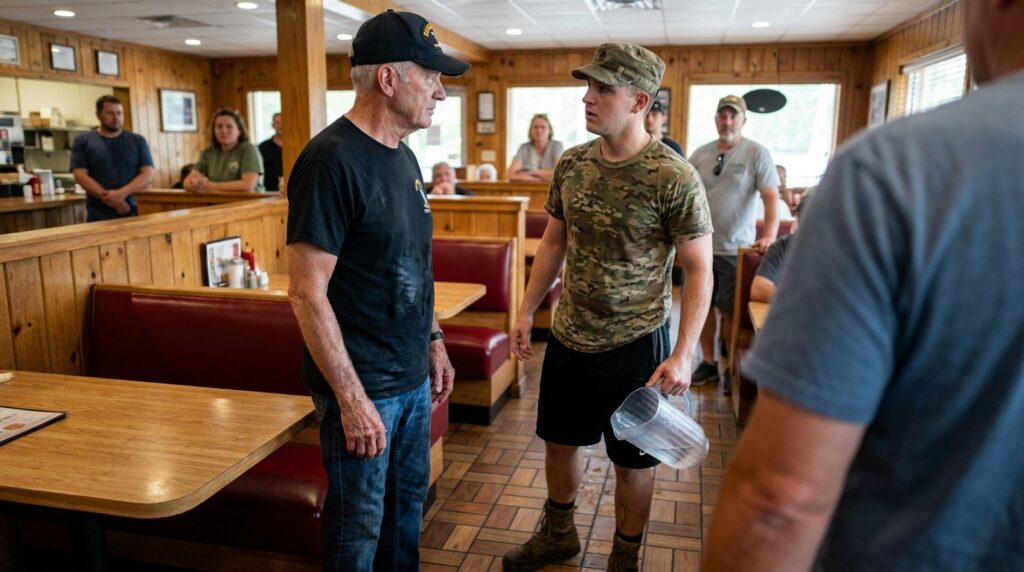
CHAPTER 3: THE LOWFREQUENCY RUMBLE
“You’re tracking water all over my clean gravel, Miller.”
Deputy Vance didn’t take his thumbs out of his heavy nylon utility belt. He was leaning against the rusted fender of his marked cruiser, his broad frame casting a short, sharp shadow in the brutal glare of the midday sun. The heat coming off the hood of the Ford was thick, distortion waves making the white paint look liquid. He looked at Miller’s soaked T-shirt, his eyes lingering on the damp cloth stretching across the older man’s ribs, then tracked the wet bootprints that left a dark path from the diner door across the gray gravel lot.
“Arnie’s grill is too hot,” Miller said, his voice flat as he stopped three feet from the deputy. “Smoked out the booth.”
“That boy who just sprinted past me didn’t look like he was suffering from smoke inhalation,” Vance murmured. He adjusted his sunglasses, the mirrored lenses reflecting a desaturated miniature of the gravel lot, the highway beyond it, and Miller’s unblinking silhouette. “Looked more like he’d seen a ghost with short gray hair and an attitude problem. His name’s Tommy. Lives out by the old processing plant.”
Miller didn’t answer. He reached down to his hip, his fingers catching the heavy leather edge of his work belt. The iron links of his watchband scraped against the metal buckle with a dry, sharp hiss. The silence between them grew, filled only by the rhythmic, metallic ticking of the cruiser’s cooling manifold and the high, thin scream of cicadas in the dry brush across the county road.
“The boy left his hat,” Miller said.
“He leaves a lot of things,” Vance replied, his tone turning transactional, the lazy small-town deputy persona slipping just enough to show the hard pragmatism underneath. He shifted his weight, his boots grinding a few pieces of granite into fine white dust. “He leaves bad debts at the hardware store. He leaves empty beer cans in the church parking lot. But he doesn’t usually go looking for fights he can’t buy his way out of unless someone tells him the target’s too old to swing back.”
Miller looked past Vance’s shoulder toward the highway. A heavy flatbed truck rumbled past, its trailer loaded with rusted iron beams and steel pipes from the demolition site down at the old valley pier. The scent of hot diesel exhaust and oxidized metal rolled over the gravel lot, thick enough to taste. The town was coming apart at the edges, the old structures being hauled away piece by piece to make room for something cleaner, something expensive that required a lot of concrete and no old men sitting in vinyl booths.
“You should check his boots, Vance,” Miller said quietly.
“Why’s that?”
“One of the copper eyelets came out on Martha’s floor. It didn’t look like surplus. Looked like something stamped out by a machine that makes thousands of them a minute for a firm up in the city.” Miller’s hand remained flat against his thigh, his fingers inches away from his pocket where the weight of a small object rested against his hip. When he’d stepped away from the booth, his boot hadn’t just covered the metal piece; his knuckles had retrieved something else the kid had dropped during the scramble—a notched brass key attached to a cheap plastic tag stamped with a lot number: 44-West.
Vance’s mouth tightened. He didn’t look down at Miller’s pockets, but his hand moved away from his utility belt, his fingers tracing the rusted edge of his cruiser’s door frame. “Lot forty-four is the old marsh parcel behind the processing plant, Miller. The one your old platoon commander’s family used to hold before the county reassessed the drainage tax.”
“I know what lot it is,” Miller said.
“Then you know there’s nothing out there but old tires and iron slag,” Vance said, his voice dropping into a lower register that was meant to be casual but lacked the necessary warmth. “Nothing worth getting your shirt wet over. Go home, Miller. Put some dry clothes on. The heat’s getting heavy today, and people your age should be sitting under a fan, not standing out here counting eyelets in the dirt.”
Miller didn’t move for three seconds. He watched the way the deputy’s eyes darted toward the highway, checking the mirrors, checking the empty stretch of asphalt that led down into the valley basin where the heavy machinery was already clearing the timber. It was the movement of a man who knew exactly which fences were being moved and who was paying for the wire.
“The shirt’ll dry,” Miller said.
He turned away from the cruiser, his boots finding the hard packed dirt of the shoulder. He didn’t look back to see if Vance was watching him go. The sun was directly overhead now, a white-hot iron plate that turned the horizon into a jagged line of gray heat, but Miller’s stride remained rhythmic, heavy, and unbroken as he headed toward the gravel road that cut through the dust toward the marsh.








