
CHAPTER 5: TRACKING THE GREASE STAINS BACK
The high-velocity whine of Deputy Vance’s cruiser didn’t drop its pitch until the tires hit the broken asphalt apron fifty yards out. Miller didn’t wait for the door to click. He caught Tommy by the upper arm—his thumb sinking into the tendon above the elbow with the unyielding pressure of an old iron clamp—and pulled the boy backward into the black shadow of the boiler room’s intake vent.
The corrugated siding groaned as they cleared the threshold, the sheet metal hot enough to leave a white line of blistered skin across a bare wrist. Inside, the air was different. It smelled of fifty years of rancid lard, tallow grease, and the cold, alkaline reek of damp concrete block. The light came through the roof in narrow, vertical pencils, cutting through a low suspension of pulverized insulation dust.
“Keep your mouth shut and your heels down,” Miller whispered. His voice was less than a vibration, a dry rustle that barely cleared the iron links of his watchband.
Outside, a car door slammed with the flat, heavy report of a wet plank hitting mud. Vance’s boots didn’t hurry. They had the rhythmic, arrogant crunch of a man who owned the county road and knew nobody within ten miles had the leverage to change his speed. The deputy’s shadow stretched across the broken intake grate, long and distorted, a black wedge that cut the sunlit weeds into clean halves.
“Tommy?” Vance called out. His voice was too loud, too performance-oriented, meant to verify an empty field rather than locate a body. “Tommy, if you’re out here messing around the drainage tiles again, your mother’s going to hear about that credit line at the hardware store.”
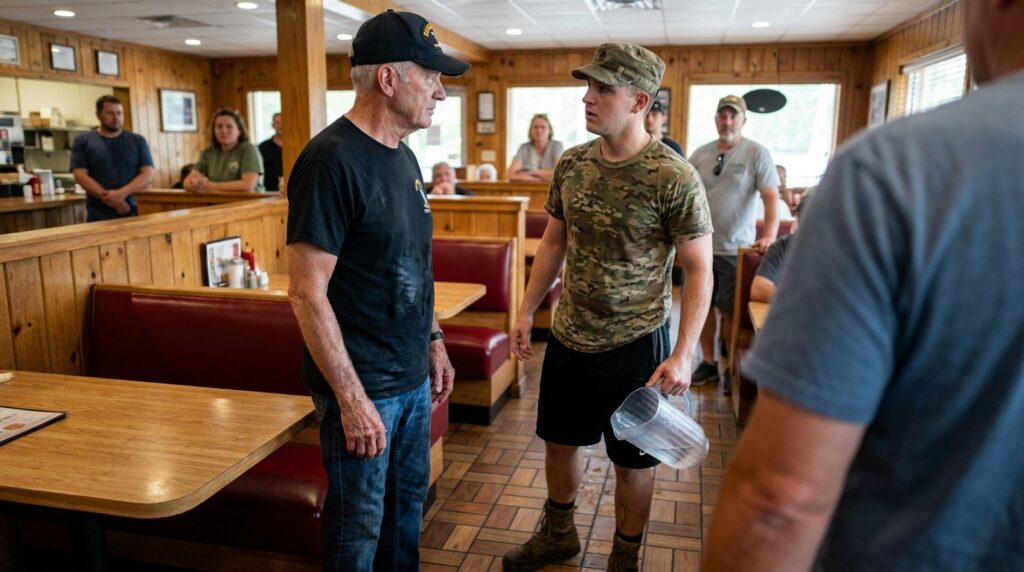
The kid under Miller’s hand went completely rigid, his ribs heaving against the black SEALs T-shirt Miller had used to crowd him against the iron structural beam. A single drop of sweat rolled down Tommy’s temple, carving a clean path through the gray silt on his jaw, but he didn’t breathe through his nose. He knew the pressure of Miller’s hand now; he knew that two millimeters more would push his clavicle down into his lung until the air came out red.
The shadow outside remained stationary for forty seconds. Then the boots turned, the gravel clicking as Vance retraced his steps toward the cruiser. The engine caught with a wet, heavy cough, the transmission sliding into reverse with a sharp clatter of U-joints, and the sound of the Ford faded back toward the valley pier.
Miller released the kid’s arm. Tommy slid six inches down the iron beam, his knees shaking as his heels hit a rusted pile of industrial scrap.
“They’re going to burn the pier house,” the boy whispered, his eyes wide in the gray dark of the boiler floor. He wasn’t looking at Miller; he was looking at his own boots, where the missing eyelet had left a frayed white circle in the salt-crusted leather. “The surveyor’s logbook is in the lockbox beneath the floorboards. The one my grandfather kept when the county line was redrawn in eighty-eight. It’s got the original high-water markers, Miller. If those files go missing, the developer doesn’t have to clear the deeds with the veterans’ board. The whole valley becomes a commercial commercial slip.”
Miller didn’t ask questions. He didn’t need the boy to fill in the ledger. He walked four paces into the center of the floor, his work boots kicking aside a cluster of calcified gaskets and heavy brass valve stems. Near the base of the secondary separator tank, where the concrete was stained the deep, permanent black of lubricating oil, a flat steel box sat open.
Someone had used a sledgehammer on the hinge—the welds were sheared clean, the edges of the metal curled back like peeled fruit.
Inside the box lay a single sheet of double-stamped paper, its edges blackened by a torch but the core legible. It was a bill of lading from the city terminal, dated six days ago, listing two hundred tons of structural concrete pilings and five thousand feet of security fencing billed directly to the county sheriff’s auxiliary fund. At the bottom, where the authorization seal should have been, was a sheared aluminum tag bearing the corporate hallmark of the valley’s primary real estate syndication.
The decoy was complete. The story Tommy had been told—the ancient grudge about a riverine patrol boat and a platoon commander’s missing inheritance—was just the grease used to turn the wheel. The boy’s grandfather hadn’t been cheated by Miller; he’d been used as a legal shield by the same men who were now paying his grandson in cheap boots and casino matches to clear the ground.
“They’re not burning the pier house, Tommy,” Miller said, his fingers closing around the charred sheet of paper until the brittle corners crumbled into black dust against his palm.
“How do you know?”
“Because the pilings are already in the marsh,” Miller said, pointing his calloused thumb toward the rear foundation of the boiler room where the concrete floor had begun to sag into the silt. Through a split in the masonry, the grey water of the ditch was visible, and beneath it, five feet down in the mud, the clean, white, machine-stamped corners of new commercial foundations had already been driven into the old platoon line.
Miller turned back toward the exit, his face settling into the heavy, unyielding expression of a man who had spent his youth calculating the structural failure of hulls under pressure. He didn’t look back to see if the kid was following. The air in his lungs tasted of old salt and scorched iron, and the first heavy drops of the June rain were beginning to hiss against the hot metal roof above his head.








