
CHAPTER 1: THE FRICTION OF SITANDWAIT
“You look at me again like I’m an entry on a balance sheet, Arthur, and we’re going to have a problem before the first boarding group is called.”
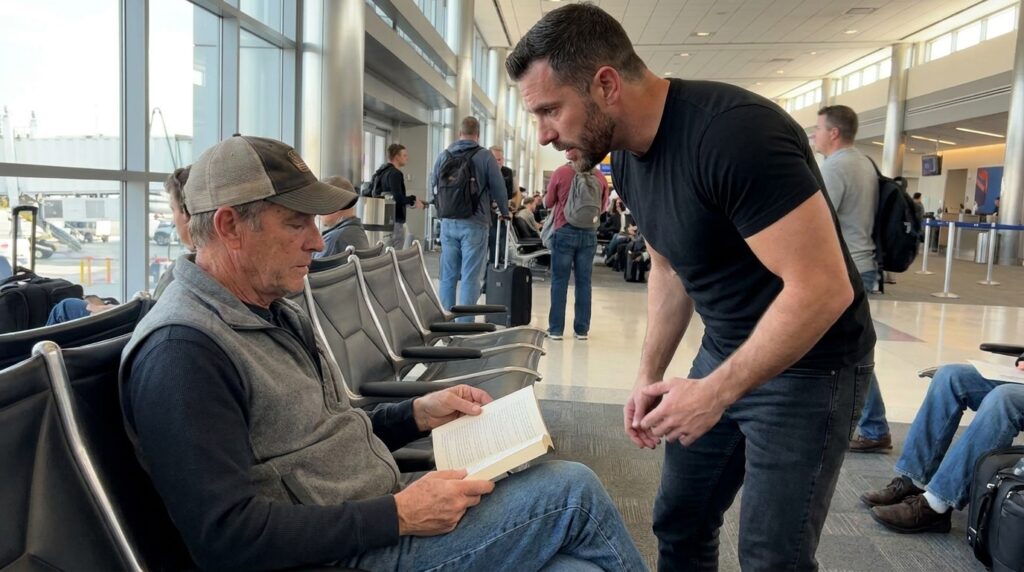
Arthur didn’t look up immediately. He let his thumb remain hooked under the corner of page one hundred and forty-two. The paper was cheap, acidic, smelling faintly of damp warehouses and old glue. On the desaturated linoleum of Gate B12, the shadow of Julian’s fitted black shirt fell straight across the print, cutting through a paragraph about the logistical failures of the winter retreat at Valley Forge.
“You’re vibrating, Julian,” Arthur said. His voice was low, dried out by thirty years of industrial air conditioning and bad diesel fumes. He didn’t raise his chin. “The boys in the back row can hear your teeth grinding from here.”
“I’m tired of the quiet act,” Julian muttered. He stepped deeper into the seating lane, his work boots squeaking against the grit on the floor. His knuckles were raw, stained with grease from the morning’s inspection at the yard. “Six months you’ve sat on the logistics reports. Six months of you playing the wise old hand while my crews are working fourteen-hour shifts on rotting tires. I built the northern route. Me.”
Arthur slowly lowered the book until it rested flat against his gray vest. The fabric of his shirt beneath it was heavy, damp with the stale heat of an airport terminal that hadn’t seen an upgrade since the late nineties. He looked at Julian’s eyes—the frantic, bloodshot tracking of a man who hadn’t slept since Omaha.
“You built a lane we can’t legally insure, Julian,” Arthur said. He let his thumbs rest on the worn binding. “And you did it with three notes that are currently floating through a secondary collections firm in Reno. You didn’t build a route. You built a fuse.”
Julian leaned down, his palms slapping the armrests of the empty seats flanking Arthur. The scent of sour espresso and leather jacket hit Arthur like a physical weight. “The board is voting on the expansion Tuesday. If my name isn’t on that prospectus as managing partner, those notes won’t matter. Because I’ll pull every driver from the line before the ink dries. Try moving forty tons of dry goods through the pass with just your memories, old man.”
Arthur didn’t pull back. He looked at the rusted rivet on the side of Julian’s watch strap. He noticed the slight tremor in the younger man’s left thumb—the classic sign of someone who had substituted amphetamines for breakfast.
“The gate agent is looking at us,” Arthur murmured, his tone shifting into something transactional, clipped. “And if she keys that mic for security, neither of us makes the 4:15 to Salt Lake. Sit down. Or stand there and let everyone see exactly how thin your skin has gotten.”
Julian’s mouth tightened into a hard, bloodless line. He looked around the sparse terminal, where two families and a traveling salesman were studiously ignoring them. He slowly stood up straight, pulling his jacket down over his belt. “We’ll see about that,” he whispered. “We’ll see who stays in the dirt when the ground moves.”
He didn’t walk away. He sat three rows over, his eyes fixed on the reflective glass of the window where the nose of an aging Boeing 737 sat in the gray drizzle.
Arthur lifted the book back to his chest. His fingers found the small, stiff ridge in the lower spine—the place where he’d tucked the certified mail receipt from the Reno firm three hours ago. The receipt wasn’t for a debt notice. It was an acquisition confirmation. Someone else already owned Julian’s fuse, and the name on the title didn’t belong to anyone in this terminal.
The overhead speakers crackled with static. “We regret to inform passengers for Flight 884 that due to an equipment discrepancy on the inbound aircraft, our departure has been pushed back forty-five minutes…”
Across the aisle, Julian’s phone began to vibrate against his thigh, the blue light reflecting off his jaw like a cold bruise.








