
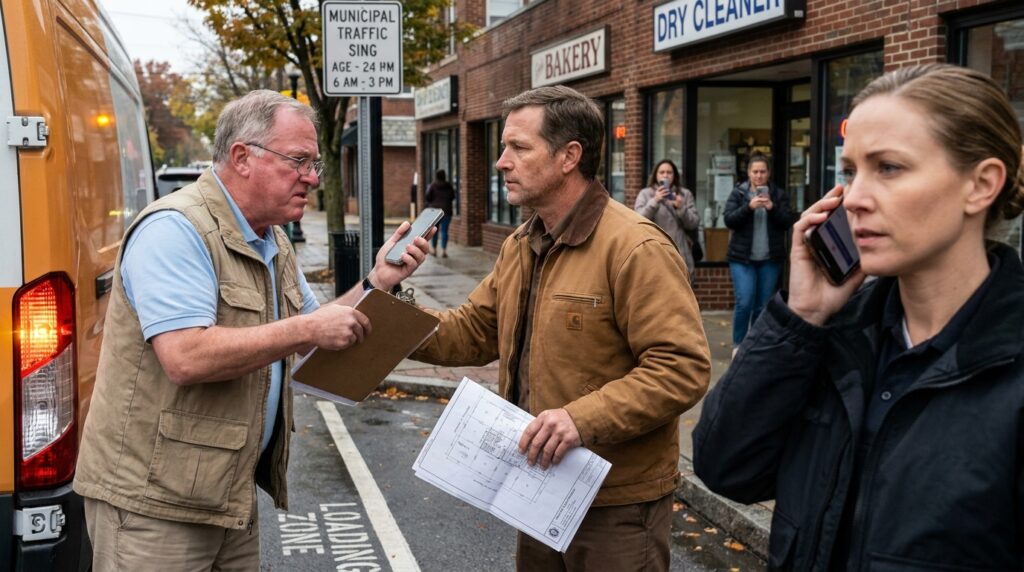
CHAPTER 5: The Speakerphone Reversal
The damp asphalt of Maple Street absorbed the morning glare, throwing up a thin, shimmering heat haze that distorted the edges of the storefronts. Julian Vance didn’t rush his movements. He stepped down from the cab of his delivery van, his boots meeting the grey pavement with a dull, heavy thud. The digital scan of the 1992 municipal street dedication plat rested securely inside his leather folio on the passenger seat, paired with Marisol Delgado’s witness statement from the specialty market.
It was 8:14 AM. The municipal loading window had just opened.
Before Julian could unlatch the rear cargo door, Arthur Pendelton materialized from the shadow of the brick dry cleaner. His pastel polo shirt was replaced today by a heavy canvas utility vest, his chest adorned with the same polished metal badge imitation. In his right hand, a laminated clipboard clutched like an officer’s baton; in his left, a smartphone already dialed to the local private impound service.
“I warned you yesterday, courier,” Arthur announced, his voice carrying deliberately across the waking lane to catch the attention of the morning commuters waiting at the corner bus stop. “You choose to ignore district fees, you forfeit commercial staging rights. I am having this vehicle winched off the public lane before you can finish signing your manifest.”
Julian did not blink, nor did he raise his voice to match Arthur’s public theater. He maintained the calm, unyielding posture of a man surveying a load-bearing column under maximum stress. He reached into his canvas jacket, withdrew the folded municipal right-of-way plat, and stepped forward until he stood two feet from the boundary line.
“There are no district fees applicable to public domain, Mr. Pendelton,” Julian said, his voice flat, steady, and loud enough to cut through the street traffic. “This forty-foot corridor was deeded to the municipality in 1992 under an unconditional public access easement. You have no legal standing to issue fines, levy tolls, or order impounds on city property.”
Arthur scoffed, a sharp, dismissive sound that bounced off the bakery windows. He raised his phone higher, pressing it against his ear while tapping the speakerphone icon with an aggressive thumb. “Tell it to the tow operator,” he snapped. “Let’s see how much your paperwork weighs when your van is sitting in a municipal pound four miles away.”
The speakerphone crackled to life, filling the morning air with a harsh electronic hiss as the automated dispatch tree clicked through its routing options. A tired dispatcher’s voice cut through the static on the other end. “Maple Street Towing and Recovery. State your badge or account code.”
“Arthur Pendelton, President of the Maple Street Business Association,” Arthur barked, his chest puffing out as he leveled a triumphant glare at Julian. “I have an unauthorized commercial vehicle squatting in a restricted loading zone at the corner of Maple and Fourth. Send a flatbed immediately. Full impound protocol.”
The dispatcher’s voice paused. A rustle of papers came over the line, followed by the clatter of a computer keyboard. “Hold on, Mr. Pendelton. Let me pull the regional zoning ledger for that specific block. Fourth and Maple… are you calling from the private side or the municipal corridor?”
“It’s a district-regulated zone!” Arthur insisted, his voice rising a octave as a small knot of pedestrians began to slow their pace near the curb. “We maintain the paving stones. Send the truck.”
“Sir,” the dispatcher interrupted, her tone sharpening with professional flat neutrality. “Our municipal database indicates that the forty-foot commercial lane between the bakery and the dry cleaner was deeded as a public right-of-way in 1992. We have no authority to tow a legally permitted vehicle from a public city zone unless the city transportation bureau issues a direct, signed citation.”
The silence that followed was absolute.
Across the street, Marisol Delgado stepped out of the specialty market doorway, her clipboard held loosely against her hip, watching the exchange with cold, unblinking eyes. Beside her, Ed Patterson paused his morning broom sweep, his gaze shifting slowly from Arthur’s rigid posture to the municipal sign bolted to the steel pole above them. Two local shop owners who had previously nodded along with Arthur’s committee meetings stepped back into the shadows of the brick arcade, their expressions closing off.
Arthur’s face drained of color, the mottled red fading into an ashen, chalky grey. He stared down at his phone as if the device itself had betrayed him. “That… that’s an administrative error,” he stammered, his public volume cracking into an awkward rasp. “The association holds local enforcement rights—”
“Sir, if you attempt an unauthorized tow on a public city lane without a city marshal present, that constitutes civil interference and illegal impoundment,” the dispatcher said crisply. “Do you want me to dispatch a municipal inspector, or are we cancelling this call?”
Arthur stared at the phone screen for three agonizing seconds before his thumb hit the red disconnect button, killing the audio with a sharp click.
Julian watched him lower the phone, his hand resting quietly on the handle of his canvas case. He didn’t gloat. In logistics, the collapse of a failing structure required no celebration—only clean geometry and a steady hand.
“Keep your clipboard, Arthur,” Julian said quietly, turning back toward the rear latches of his delivery van. “The street has its own memory.”
Arthur didn’t answer. He turned on his heel, his canvas vest brushing against the brick wall as he retreated down the alley without finishing his sentence. Behind Julian, the heavy cargo doors swung open with a clean, metallic snap, and the morning route finally began.








