
CHAPTER 2: The Silt and the Warning
The morning air tasted of stale tobacco and iron shavings. Julian Vance shifted his commercial van into low gear, the transmission groaning a dry complaint as he eased the heavy chassis down the alley behind the dry cleaner’s. The dashboard clock glowed a cold amber: 7:42 AM. Twenty minutes before the municipal loading window opened, and already the space was claimed by a shadow that didn’t belong to a customer.
A crisp, neon-orange warning notice fluttered beneath the wiper blade of a delivery pickup two stalls down. Julian didn’t need to step out of his cab to recognize the handwriting. It was penned with the aggressive, straight-edged slant of someone who spent their evenings drafting bylaws they had no legal authority to enact. Arthur Pendelton had been busy before sunrise.
Julian pulled his van into the designated freight bay, killed the ignition, and let the silence rush in. The street outside was quiet, save for the steady drip of a compromised gutter pipe splashing against a rusted corrugated iron wall. His fingers lingered on the steering wheel, tracing the worn patch where the rubber grip had worn down to the smooth wire mesh beneath.
Two days had passed since the first confrontation by the bakery, and the atmosphere along the commercial strip had tightened like a dry winch. Ed Patterson, who managed the hardware depot across the lane, had stopped his morning sweep with his broom when Julian drove past, his eyes sliding away toward the brickwork with studied neutrality. It wasn’t hostility yet; it was the cautious retreat of men who smelled trouble and preferred to stand downwind.
Julian stepped down from the cab, his boots crunching against a scattering of dry gravel. He reached out to lift the orange sticker from his windshield, peeling it off in one unbroken strip. The adhesive left a sticky residue that caught the grit of the morning dust. Beneath the printed text—Unauthorized Commercial Staging Penalty: $50—was a handwritten code in the bottom margin: Ref: M-14.
It wasn’t a city code. The municipality used alphanumeric zoning designations like C-2 and B-F. The ‘M’ prefix belonged exclusively to the Maple Street Business Association’s internal accounting ledgers—a private ledger that Arthur managed out of a spare room in the community clubhouse.
“Working early, are we, courier?”
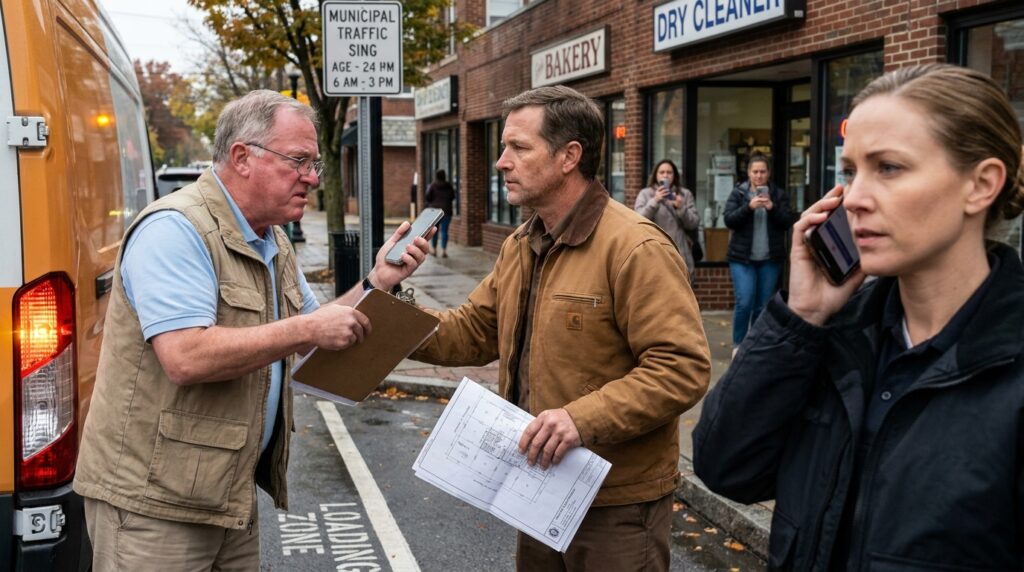
The voice came from the mouth of the alley, dry and thin like old parchment. Arthur stood beside a rusted utility box, his hands buried deep in the pockets of a slate-grey windbreaker. The pastel polo shirt of two days prior was gone, replaced by a utility vest adorned with various brass-pinned badges that looked suspiciously like security tokens from an industrial park lease that had expired a decade ago.
Julian didn’t turn around immediately. He folded the orange sticker twice, squared the edges against his palm, and slipped it into his canvas jacket pocket alongside yesterday’s harvest.
“The loading zone opens at eight,” Julian said, his voice level as he turned to face the older man. “My manifests are time-stamped by the freight terminal. You’re losing efficiency tracking cars that aren’t breaking ordinance, Mr. Pendelton.”
Arthur took two slow steps forward, his heels clicking against the concrete with a deliberate, metronomic cadence. He stopped four feet away, just outside the perimeter of Julian’s work zone, his chin tilted up with the practiced arrogance of a man who believed a laminated badge could rewrite a deed.
“Efficiency is maintained by order, Mr. Vance,” Arthur replied, his eyes narrowing as he stared at the rear cargo doors of the van. “And this district has enjoyed a very particular kind of order long before independent contractors started cutting corners on our back streets. You think a city permit protects you from local oversight? The board has ways of ensuring that businesses who choose not to cooperate find their operating costs exceeding their profit margins very quickly.”
Julian looked past Arthur’s shoulder, watching a stray cat pick its way across a pile of discarded cardboard boxes near the dumpster. He didn’t rise to the bait. In logistics, an opponent who stated their leverage openly was an opponent who had already revealed the perimeter of their control. Arthur wasn’t protecting the neighborhood; he was protecting a revenue stream that depended entirely on people being too tired to check the county archives.
“The engine’s cold, Arthur,” Julian said quietly, stepping past him toward the rear latch. “Move your clipboard. I’ve got freight to drop before the morning rush locks the street.”
Arthur didn’t move. He stood firm against the damp morning wind, his hand sliding slowly toward the leather folio tucked beneath his arm, his fingers twitching with the urge to write another ticket that would never reach a municipal desk.








