
CHAPTER 1: The Iron and the Asphalt
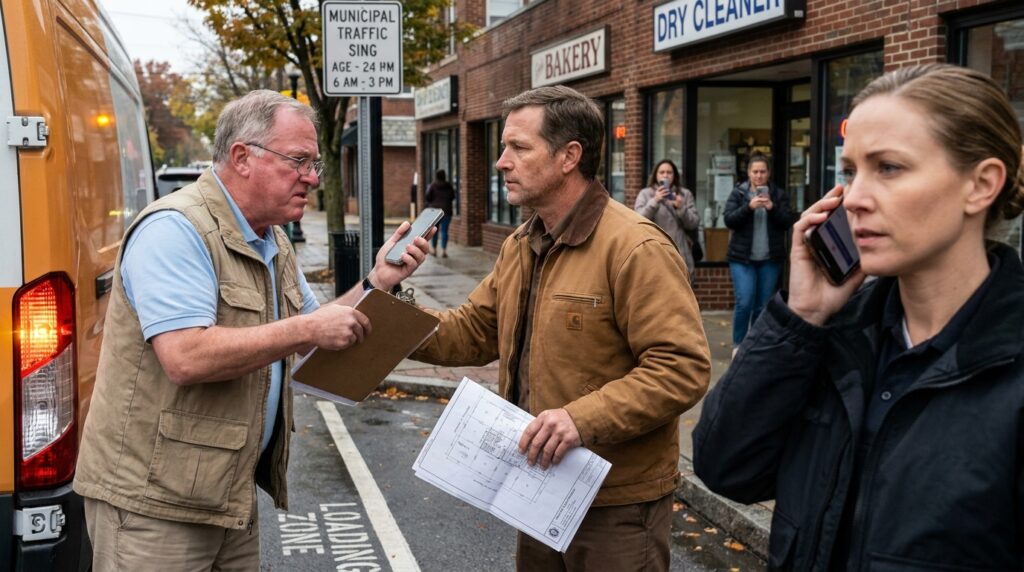
The diesel engine of the delivery van ticked as it cooled against the damp morning air of Maple Street. Julian Vance did not rush. After eleven years of urban logistics, his joints had learned the language of cold iron and unyielding concrete, and his mind had been trained to treat friction not as an obstacle, but as a data point. He stood with one hand resting on the cold metal latch of the rear cargo door, watching the reflection of the sunrise distort across a greasy puddle near the curb.
The street smelled of roasted chicory from the corner café and wet exhaust pipe. To anyone else, it was just another Tuesday morning delivery run through a busy commercial strip. But to Julian, the space between the bakery awning and the dry cleaner’s entrance was a narrow corridor of compressed rules. His hazard lights blinked in a steady, amber rhythm, casting a rhythmic pulse over the white-striped loading zone stenciled beneath his tires.
“You delivery drivers think you own every inch of asphalt in this district,” a sharp voice cut through the drone of passing traffic.
Julian did not turn around immediately. He finished sliding his manifest clipboard into the canvas pocket of his jacket, smoothing the edge of the paper with a calloused thumb. Only then did he pivot on his heel.
Arthur Pendelton stood three paces away, his pastel polo shirt stretched tight across a rounded frame, a pristine laminated clipboard clutched in his right hand like a badge of office. Arthur’s silver-rimmed glasses slid halfway down the bridge of his nose as he glared down at the white stripe beneath Julian’s front tire, his lower jaw set in the permanent, humorless rigidity of a man who measured his self-worth by how many people he could inconvenience before noon.
“This is a restricted retail clearance zone,” Arthur announced, pitching his voice deliberately so the pedestrians waiting at the crosswalk could hear every syllable. “Commercial drop-offs concluded at eight o’clock. You are in direct violation of district association bylaws. Move this vehicle right now, or I will call the impound yard before you finish unloading your first crate.”
Julian maintained the steady, unblinking posture of a man who had spent decades reviewing structural blueprints where panic carried a heavy price. He did not raise his voice to match Arthur’s theatrical cadence. Instead, he reached into his breast pocket, drew out a folded municipal placard copy, and pointed quietly to the green-and-white city traffic sign bolted directly to the steel pole beside Arthur’s shoulder.
“The municipal traffic code explicitly designates this specific forty-foot zone for commercial freight handling between eight in the morning and eleven,” Julian said, his tone flat and level. “The district association bylaws do not supersede city ordinance, Mr. Pendelton.”
Arthur’s face flushed a dull, mottled red. He didn’t look up at the sign; he simply slapped an unofficial orange warning sticker onto Julian’s side mirror, muttering something dark about outsiders who refused to respect local order.
Julian watched the sticker settle against the glass. He reached out, peeled the paper backing off with surgical precision, folded it twice, and slid it into his pocket alongside his manifest. But as he turned back toward his cargo bay, his peripheral vision caught something odd reflected in the side mirror—a second set of footsteps lingering by the alley entrance, watching the exchange with an intent, calculating stillness that didn’t belong to a casual bystander.








