
CHAPTER 3: The Ledger and the Aisle
The refrigeration units along the back wall of the Maple Street Market hummed with a low, bone-chilling vibration that cut through the humid air of the dairy aisle. Julian Vance stood motionless beside a stack of wire milk crates, his thumb tracing the jagged edge of an inventory manifest. He didn’t look up when the heavy glass door of the dairy case clicked shut, though he felt the shift in air pressure before he heard the familiar squeak of rubber soles against the linoleum.
Arthur Pendelton did not walk alone. Flanked by two members of the district merchant committee—men whose eyes carried the guarded, flat expressions of property owners who had long since traded independence for a quiet life—Arthur stepped into the narrow aisle, deliberately blocking the return path toward the registers.
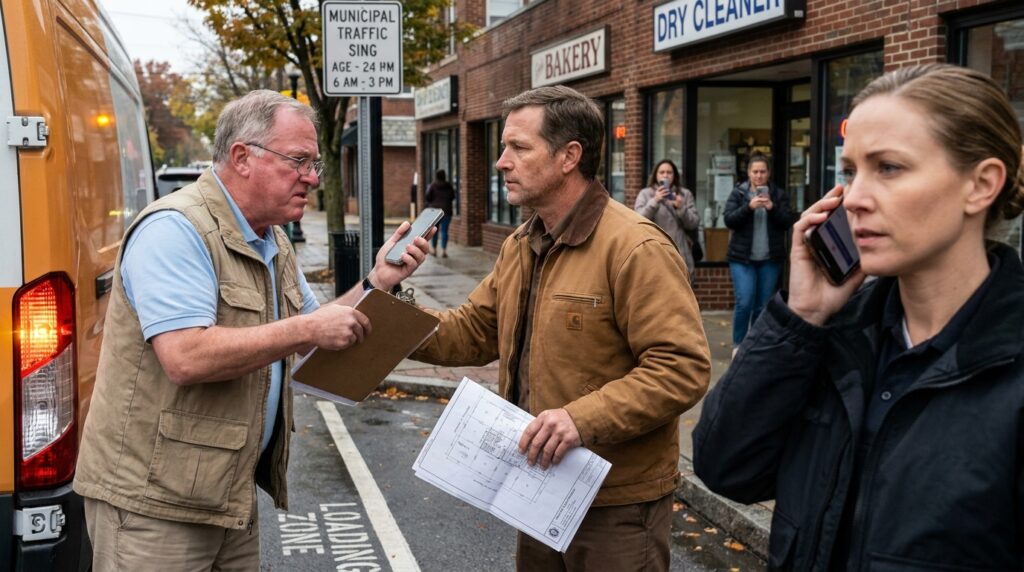
“It has come to the board’s attention, Mr. Vance, that your service continues to operate under the dangerous assumption that municipal convenience overrides local commercial stability,” Arthur announced, pitching his voice to carry past the stacks of butter and bottled cream, ensuring the cashiers near the front counter could hear every syllable.
Julian lowered his clipboard by an inch. The metal ring binder made a soft, metallic scrape against his canvas jacket. “The loading zone is governed by city traffic ordinance, Mr. Pendelton. Not a committee resolution.”
“A resolution that protects the integrity of our shared streetfront,” interjected one of Arthur’s companions, a man named Henderson whose hardware store sat three doors down from the bakery. Henderson crossed his arms, his flannel sleeves rolled tight against thick forearms. “You’re bringing heavy freight into a retail corridor that wasn’t engineered for continuous axle load. If the pavement fails, the assessment falls on every shop owner on this block. We aren’t going to let an outsider break the paving stones just to save ten minutes on a drop schedule.”
Julian kept his breathing steady, feeling the cold draft from the open freezer case bite through the fabric of his sleeve. He recognized the tactical pattern immediately. This wasn’t about the asphalt or the weight limits; it was an attempt to corner him in a semi-public space where a sharp word could be twisted into a threat, creating the paper trail Arthur needed to justify an emergency ban.
“The axle weight of my vehicle complies with standard urban delivery parameters,” Julian said evenly, his voice refusing to climb to their theatrical pitch. “If you have concerns about structural wear, you can submit an official inquiry to the municipal engineering department. They keep records on file.”
Arthur’s mouth tightened into a thin, bloodless line. He reached into his windbreaker pocket and produced a small, leather-bound receipt book—the private ledger used to track the district’s internal fee collections. He flipped it open with an aggressive snap of the wrist, exposing a page covered in handwritten columns and neat rows of figures.
“Records are maintained right here, courier,” Arthur snapped, stepping closer until the smell of stale pipe tobacco and damp wool washed over Julian. “And right here, your service is listed as delinquent on three separate district maintenance assessments totaling four hundred and fifty dollars. Pay the fee to the committee registry today, or I will personally ensure that every merchant between the square and the railway tracks denies you access to their receiving docks before the week is out.”
Deep inside Julian’s coat pocket, the digital voice recorder application on his phone continued to run its silent, unbroken loop, capturing the explicit demand for unauthorized cash exactions in a public market aisle. Julian looked down at the receipt book, noting the specific bank routing numbers stamped lightly on the stub beneath Arthur’s thumb—a private account held not by the city, but under the corporate title Maple Street Commercial Defense Fund.
The decoy structure of the dispute clicked into place with the cold certainty of a gear locking into a damaged housing. The parking tickets, the manufactured code violations, the public warnings—none of it was about the street or the pavement. It was a toll gate erected across a public right-of-way, designed to bleed independent operators until they paid tribute to a private pocketbook disguised as a civic board.
“Four hundred and fifty dollars,” Julian repeated, his voice dangerously soft. “That’s an interesting line item for a public loading zone, Arthur.”
“It’s the cost of doing business in our district,” Arthur retorted, his eyes flashing with the triumph of a man who believed he had successfully boxed his target into a corner. “Take it or leave your keys.”
Julian did not argue. He did not raise his voice, nor did he reach for the receipt book. He simply pulled a carton of whole milk from the shelf, placed it neatly into his wire handbasket, and turned his back on them, walking slowly toward the checkout counter without another word. Behind him, Arthur’s laughter echoed dryly off the tile walls—a premature victory note that faded the moment Julian stepped past the registers and felt the crisp autumn wind hit his face.








