
CHAPTER 4: The Archive Dive
The municipal zoning office smelled of damp cellulose and vinegar-based ink. Beneath the fluorescent hum of a single flickering tube in the basement archive, Julian Vance straightened a heavy, unhinged cardboard box across the zinc-topped examination table. The air was thick with the weight of decades past, holding the stagnant heat of a building that had long since forgotten the sound of an open window.
He did not come for opinions. In logistics, opinions were noise; geometry and time were the only data points that mattered.
His fingers slid across the rough edge of a rusted metal filing drawer until they found what he had been tracking since the confrontation in the dairy aisle: the 1992 street dedication plats for the Maple Street commercial corridor. The papers were yellowed at the margins, bound together by a corroded brass staple that had stained the surrounding bond paper a rusty orange.
Julian unclipped his pen light, casting a sharp, clean circle of white illumination across the folio. He traced the heavy black ink lines of the original surveyor’s map, checking parcel numbers, right-of-way boundaries, and dedication stamps. There it was, stamped in the bottom right corner with the seal of the county commissioner: Dedication of Public Access Easement — Fee Simple to Municipality, Unconditional.
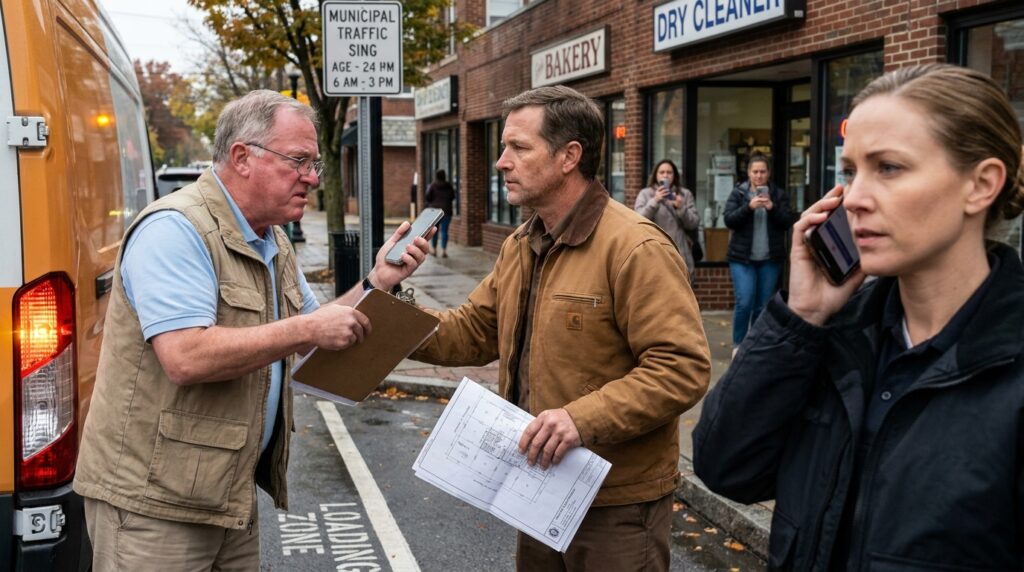
The commercial loading zone outside the bakery wasn’t private association property. It never had been. It was public domain, deeded over to the city thirty-four years prior precisely to prevent local merchants from erecting private toll gates across public infrastructure. Arthur Pendelton’s entire regulatory framework—every ticket, every warning sticker, every calculated demand for cash expediting fees routed through the Maple Street Commercial Defense Fund—was built entirely on a foundation of administrative bluffing.
A soft scraping sound echoed from the top of the concrete stairs. Julian looked up, his hand sliding instinctively into his pocket to brush against the smooth metal casing of his digital recorder.
“Looking for historical preservation permits, Mr. Vance?”
The voice belonged to Elena Vance—no relation, though they shared the same sharp, unblinking evaluation style—a senior archivist whose desk sat just outside the caged partition. She peered over the rim of her reading glasses, her expression neutral, holding a fresh batch of property ledgers under one arm. “Most couriers don’t spend their Tuesday afternoons reviewing thirty-year-old right-of-way ordinances.”
“Just verifying boundary limits,” Julian said quietly, lifting the fragile plat sheet with both hands to ensure it lay completely flat under the light. “When a local committee starts charging administrative fees for a public curb, it pays to check who holds the master deed.”
Elena let out a short, dry breath that sounded like rustling paper. She set her ledgers down on the edge of the zinc table, her eyes lingering on the municipal stamp at the bottom of the map. “Arthur Pendelton has been pulling those plats from the public rack for years whenever a new driver tries to push back. Most people don’t look past the first page of the association charter. They assume if someone wears a badge and talks loud enough in a public market, the rules they’re quoting actually exist.”
“They exist until someone reads the secondary clauses,” Julian replied, pulling a portable scanner from his canvas satchel.
The device hummed to life with a soft, electronic whir, its green scanning bar sweeping rhythmically across the face of the 1992 dedication document. Each pass captured the high-resolution vector lines, the commissioner’s seal, and the precise legal language prohibiting any private entity from levying tolls or restricting commercial access within the forty-foot zone.
Yet, as the green light flickered across the final page, a sudden, cold realization settled in Julian’s chest. Having the document in the basement archive was entirely different from forcing a public confrontation on the street. Arthur wasn’t operating alone, and the business association had deep ties to the local magistrate who handled municipal code infractions. If Julian rolled his van into the loading zone tomorrow morning armed only with a paper map, Arthur wouldn’t read the ordinance; he’d double down, call a tow truck under emergency powers, and let the legal fees mount while the truck sat in an impound lot four miles across town.
The paper was a shield, but a shield didn’t stop a spear. To break the blockade permanently, Julian needed more than a quiet archive victory. He needed a live, irreversible public collapse—one where the trap Arthur had laid for others finally snapped shut around his own ankles in front of the entire neighborhood.
Julian carefully unclipped the scanner, folded the original plat back into its rusted folder, and slid the digital memory card into his shirt pocket. The archive was quiet, but outside on Maple Street, the morning sun was climbing toward the peak of another long, calculated day.








