
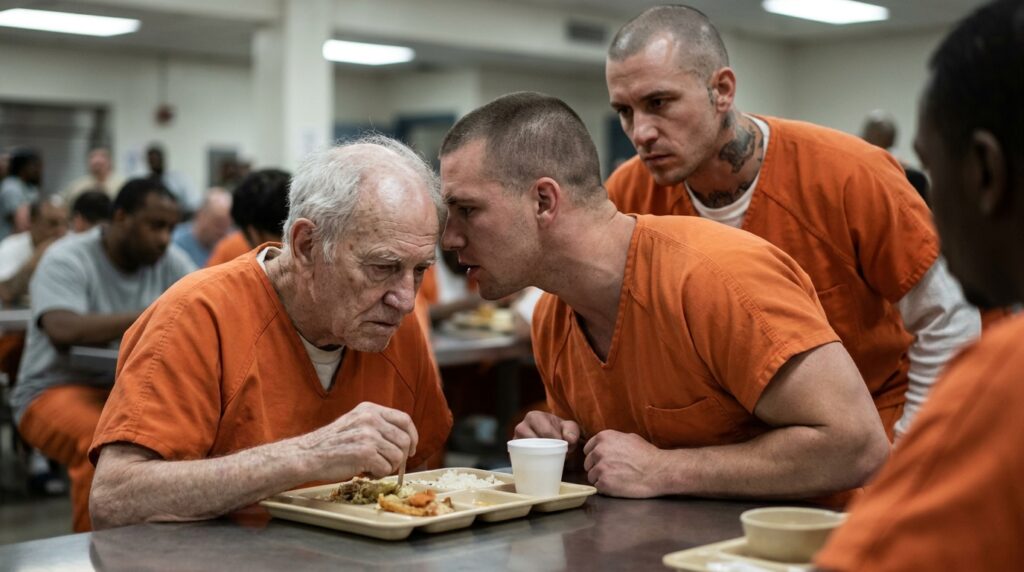
CHAPTER 4: THE HORIZON OF THE COLD CORNER
The heavy leather glove didn’t shove him down; it steered him. Vance’s grip remained a static, crushing weight on the old man’s collarbone as they crossed the threshold of the lower sally port and stepped out into the desaturated glare of the afternoon recreation yard. The sun was low, a pale white disk hanging over the razor wire that stripped the color from the dirt, leaving the world a flat landscape of charcoal shadows and gray concrete.
“Keep your boots moving toward the western wall,” Vance said behind him. His voice was thin, dry as a dead leaf scraping across stone. The guard had his heavy winter jacket unzipped, his right hand buried deep in his pocket where the silhouette of a heavy duty key ring pressed against the canvas. “The boy’s waiting by the old drainage grate. You two are going to finish the conversation you started over the trays.”
The old man didn’t resist. His right hand remained pinned inside his jumpsuit pocket, his thin fingers curled around the eight-inch bar of sharpened iron he had retrieved from the laundry floor. The metal was warm now, taking on his own body heat, its ground point pressing lightly against his palm. He walked with measured strides, his old knees working with a dry, clicking precision as they neared the shadow of the brick ventilation shaft.
The boy with the buzz cut was already there, leaning his shoulder blade against the pitted limestone of the wall. He had changed out of the torn shirt; he was wearing a clean, state-issued denim jacket, but his fingers were twitching against his seams. Beside him stood the shadow with the neck tattoos, his arms loose, his weight balanced on the balls of his heavy rubber boots.
Vance stopped ten feet back, his boots grinding into the parched earth of the track line. He didn’t check the towers. He knew the guard on the tier-four perch was looking toward the western gate, his line of sight intentionally broken by the angle of the old boiler stack.
“Show him the print,” Vance said, his voice dropping into the low hum of the wind through the chain-link mesh.
The boy didn’t move, so the tattooed companion reached into his inner pocket. He didn’t pull a blade. He pulled a small, faded piece of photographic paper, its edges curled and stained with the distinctive brown ring of old laundry starch. He held it out horizontally, his thumb covering the lower right corner where a state evidence archive stamp had begun to bleed through the stock.
The old man looked down. The image was desaturated, the high-contrast silver halide print showing three men standing beside the old coal hopper in the winter of nineteen ninety-four. On the left was Vance’s father, young then, his guard uniform crisp and his badge catching the glare of an ancient flashbulb. In the center was the inmate who had died in the laundry tubs three weeks later. And on the right, looking straight into the lens with a flat, emotionless stare that time hadn’t altered, was the old man himself.
“My father didn’t sign that transfer ledger,” Vance said from behind, his boots shifting on the dirt. “He wasn’t even on the tier the night Miller went into the bags. You signed his name with the clerk’s pen. You kept that yellow slip in the wall for thirty-two years because you needed a shield in case the state ever dug up the floor under the old boilers.”
The old man looked from the photograph to the boy with the buzz cut. The boy’s jaw was tight, his breathing shallow. He wasn’t a predator anymore; he was a witness who had realized too late that he was standing inside the perimeter of an old execution ground.
“Your father was exactly where I put him, Vance,” the old man said. His voice was a low, gravelly rasp that didn’t rise above the whistling of the wind in the wire. He slowly withdrew his hand from his pocket, letting the sharpened iron bar slide down his sleeve until the blunt end rested securely against the heel of his palm. “He was a weak man. He took twenty dollars from the commissary fund to leave the boiler door unlocked on a Tuesday night. He thought he was buying a house in the suburbs. I bought his name instead.”
Vance’s face went stiff, the skin around his mouth turning the color of old lard. “You framed him. You let the board think he took the cartel’s money for the Miller hit.”
“He did take it,” the old man whispered, his eyes narrowing as he took a single, short step forward, narrowing the distance between his iron and the guard’s belt line. “He took it from me. I was the one who authorized the transfer from the old intake accounts. I was the block captain before your boy here was even breathing coal dust. I built the track your father walked on until his knees gave out.”
The ultimate reality of C-block didn’t belong to the guards or the cartels; it belonged to the architecture of the secrets buried beneath the stone. The old man hadn’t been targeted by an escalating chain of youthful ambition; he had systematically provoked the young crew from the moment they arrived on the tier, using their hunger for status to draw Vance down into the basement darkness where the old files could be opened one last time. He needed Vance to bring the photograph out of the administrative vault. He needed the last physical copy of the ninety-four register in the open yard before the lookback committee crossed the main gate tomorrow morning.
A sharp, sudden shadow fell across the limestone wall as the sun dipped behind the upper tier block.
The tattooed companion didn’t wait for Vance’s order. He saw the shift in the old man’s weight, the slight flare of the denim sleeve where the ground iron was seeded. He lunged forward, his heavy wrench swinging in a flat, horizontal arc designed to crush the old man’s shoulder.
There was no sound of impact, only the quick, dry scrape of canvas shoes on parched earth as the old man pivoted into the blind spot beneath the wall mirror. His arm moved with a mechanical, short-stroke leverage that had nothing to do with youth and everything to do with decades of repetition. The sharpened iron found the soft seam beneath the shadow’s armpit with a dull, hollow thud that was instantly swallowed by the roar of the boiler exhaust vents.
The shadow went down without a sound, his boots kicking once against the limestone foundation before his weight settled into the gray dirt.
The boy with the buzz cut backed away, his hands raised, his back hitting the chain-link fence until the wire shrieked against the iron posts. He looked at the old man, then down at the photograph that had fallen into the dirt between them, its surface already drinking the dark, expanding moisture from the shadow’s uniform.
Vance reached for his belt, his leather-gloved fingers clawing at the brass clasp of his holster, but his hand stopped when the high, metallic click of a rifle bolt echoed from the observation tier above. The guard on the perch wasn’t looking at the western gate anymore. His barrel was lowered, leveled directly at the center of Vance’s chest, and the small, yellow transit slip that the old man had hidden behind the cell sink was now tucked securely into the breast pocket of the tower sergeant who had just stepped onto the catwalk.
The old man didn’t run. He stood over the photograph, his breathing slow and even, the cold air of the yard filling his lungs as he watched the senior guard slowly drop his keys into the parched earth. The ultimate truth was out of the wall now, but the horizon remained wide, the long shadow of the cellblock expanding across the yard as the alarm whistle began its first, long wail.








