
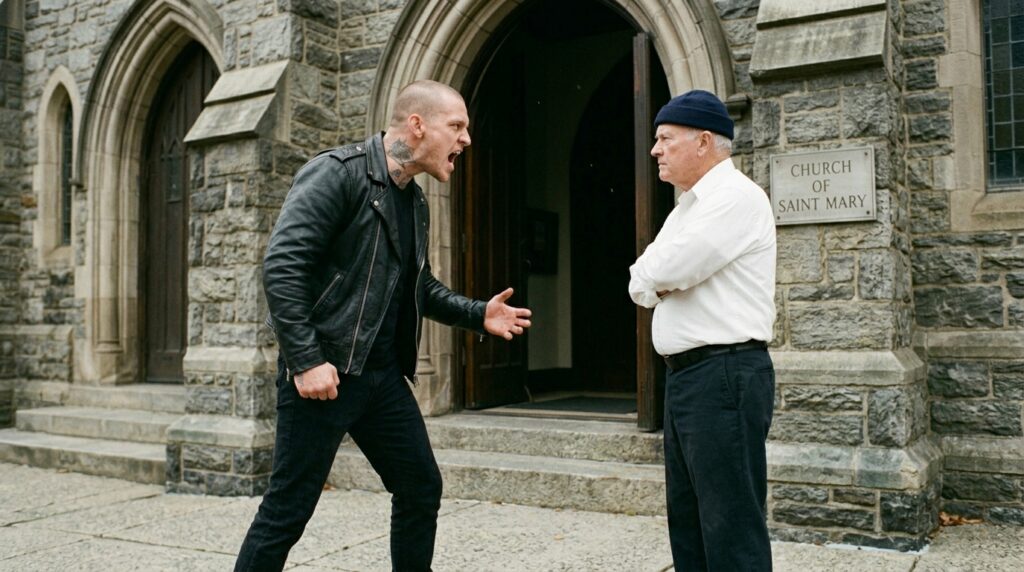
CHAPTER 7: THE FINAL GATE
“This is a closed perimeter, Vance. Step away from the latch.”
The warning came through a vehicle loudspeaker, distorted by the downpour and the low, heavy idle of three diesel trucks parked across Elm Street. The flashing amber bars on the cabs painted the wet asphalt in rhythmic, desaturated slashes of orange light. Behind the lead truck, a half-dozen figures stood in matching municipal worker coats, their hands resting on industrial pry-bars and hydraulic shears. Beside them, his leather jacket dark with water, Marcus stood next to the man with the scar.
Thomas stood directly inside the iron gates of the parish courtyard, his boots planted on the wet stone where he had broken Marcus’s grip six chapters ago. His white hair was plastered against his forehead, water streaming down the deep creases of his cheeks. His left knee had gone completely cold, a locked, iron weight that refused to register pain anymore—only a absolute stiffness that anchored him to the threshold. He kept his left hand on the cold iron vertical bar of the gate; his right hand held the canvas-wrapped ledger open against his hip.
Behind him, the heavy oak doors of the church creaked open. It wasn’t the police department. It wasn’t an official legal rescue. Father Joseph stepped onto the steps, flanked by twenty residents from the surrounding blocks—the old shopkeepers from 4th Street, the retired rail workers, the people whose names had been meticulously lined up in Marcus’s weekly payout books. They didn’t carry weapons or tools; they simply stood on the stone stairs, their faces pale but steady under the amber glare of the city trucks.
Councilman Harris stepped out from the passenger side of the lead truck. He didn’t wear a uniform; he wore a tailored trench coat that grew dark under the driving rain. He walked up to the iron perimeter fence, his leather shoes splashing through the mud until he stood two feet from Thomas, separated only by the rusted vertical bars.
“You’re holding an illegal assembly on a condemned safety hazard, Thomas,” Harris said, his voice carrying the flat, institutional authority of a man who owned the codes and the courts. “The precinct council has signed the emergency eminent domain warrant. The property belongs to the city logistics authority as of five o’clock. Move the people back, or Vance’s pension won’t be the only thing the board reviews on Monday.”
Thomas didn’t open the latch. He raised his right hand, pressing the grease-stained ledger against the rusted iron bar right at Harris’s eye level. The rain-soaked pages were turning translucent, but the black ink of Harris’s signature remained crisp under the amber strobe light.
“The board won’t be reviewing anything, Donald,” Thomas said. His voice was a low, mechanical growl that stayed beneath the drone of the engines, but it carried the absolute weight of forty years on the street. “The state attorney’s office received a digital copy of this ledger twenty minutes ago. Along with the carbon applications Miller left in the rectory. They didn’t just go to the clerk; they went to the internal investigations bureau at the central precinct.”
Harris didn’t look at the paper. He didn’t flinch. “The internal bureau is run by my committee, Vance. You think you’re the first retired detective to bring a notebook to a captain’s desk? The city needs this terminal. The council signed the papers. A few broken windows on an old parish don’t change the civic necessity.”
“The city council didn’t sign a civic necessity,” Thomas murmured, his hand tightening around the iron bar until his knuckles turned the color of bone. “They signed a private real estate holding that uses their own names on the Vanguard LLC articles of incorporation. You didn’t condemn these houses to build a road, Donald. You condemned them to liquidate the neighborhood’s equity into your own retirement accounts.”
The silence that followed didn’t come from the rain. It came from the sidewalk. Officer Vance had stopped his cruiser fifty feet back, his roof lights silent, his driver-side door pinned open against the wind. He didn’t step out with his baton drawn. He stood behind the frame of the door, his personal radio mic held to his lips, his eyes locked on the councilman. Behind him, two more district cruisers pulled onto the curb, their tires grinding through the gravel slag, their engines dropping into a silent, expectant idle.
The workers in the orange vests began to step back toward the beds of the trucks, their hands dropping away from the pry-bars. They were city employees; they worked for a wage, not a criminal conspiracy, and the sight of three active-duty cruisers blocking their own escape lane was a calculation that didn’t fit their job descriptions.
Marcus looked at the man with the scar, his jaw twitching as he took a step toward the alley, but Vance’s cruiser door finally swung shut. The officer stepped onto the pavement, his leather belt clicking as he walked toward the gate, his hand resting on his sidearm with a slow, deliberate movement that mirrored Thomas’s old tactical rhythm.
“Councilman,” Vance said, his voice flat, cutting through the rain with the standard procedural cadence of an arrest warrant. “We have an order from the county magistrate’s office to hold the execution of the eminent domain decree pending a structural review by an independent state engineer. You and Mr. Miller need to come down to the administrative complex to verify the signatures on the Vanguard filing.”
Harris turned, his face shifting into a pale, desaturated mask under the amber lights. He looked at Vance, then back at Thomas, who still stood unblinking inside the gate, his navy cap channeling the rainwater onto the granite threshold. The system hadn’t broken from the outside; it had jammed because an old operator had jammed his own body into the gears.
“This line doesn’t move, Donald,” Thomas said softly.
He pulled his pocket watch from his vest one final time. He pressed the release, the silver lid clicking open to show the cracked glass face exactly at six o’clock. The metallic tick inside was steady, unhurried, a small iron pulse that had outlasted the mill, the rail yard, and the men who had tried to clear the block.
Thomas turned his back on the street, his boots striking the wet stone steps as he walked toward the parish doors. The churchgoers opened the lane for him, their hands reaching out to touch his rain-soaked sleeve in absolute silence. He didn’t look down at his hands, and he didn’t check the street behind him. The gates were closed, the threshold was intact, and the quiet men were still keeping the walls.








