
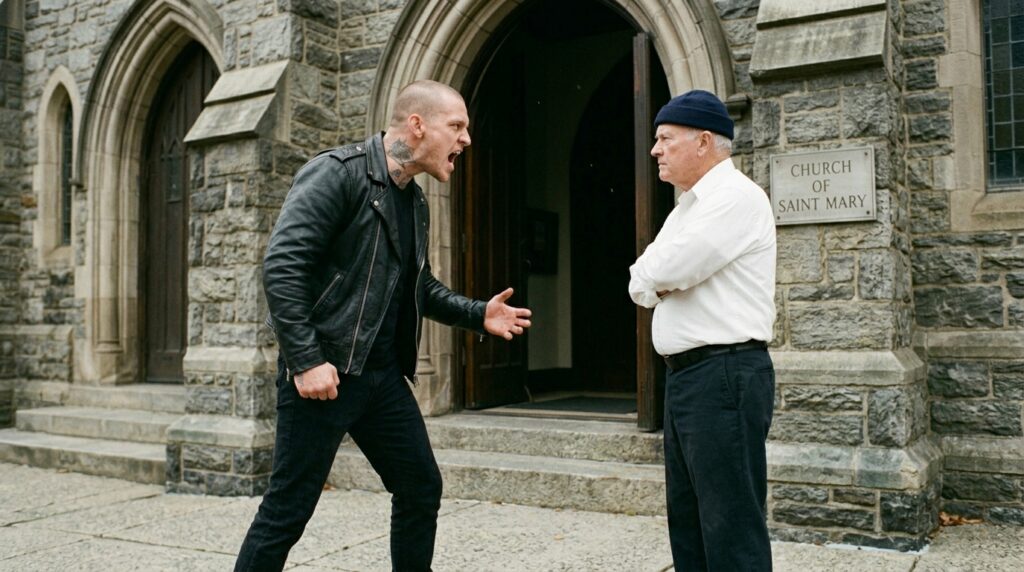
CHAPTER 4: THE DINER CONVERGENCE
The Formica tabletop rattled against its iron base as two hundred pounds of dense muscle dropped into the booth directly across from Thomas. The scent of hot lard and burnt coffee from the diner’s kitchen was instantly overridden by the smell of rain-soaked leather and damp wool. Thomas didn’t jump. He kept his large, weathered hands wrapped around his heavy ceramic mug, the black coffee inside barely rippling as he looked across the grease-stained surface.
It wasn’t Marcus. It was an older man, late fifties, with a face like pitted iron and a thick scar bisecting his left eyebrow. He wore a dark, oil-stained mechanic’s jacket with no name patch, but his posture was strictly military—shoulders set tight, chest pinned forward against the edge of the booth. Behind him, standing near the entry door where the glass was patterned with grease and old condensation, Marcus stood with his arm cradled in a stiff cloth sling, his eyes drilling holes into the back of Thomas’s navy cap.
“You have a heavy hand for an old man,” the man with the scar said. His voice was a flat, low rumble that barely carried past the edge of the table, calculated to stay beneath the rattle of the old refrigerator case humming by the counter.
“The hand was as heavy as the threat required,” Thomas replied. He took a slow, deliberate sip of the bitter coffee, his arthritic knuckles clicking against the ceramic handle. He didn’t look back toward Marcus. He kept his eyes locked on the driver opposite him, analyzing the subtle micro-movements of the man’s jaw and the worn calluses on his index fingers. Range calluses. “Who are you?”
“The guy who pays Marcus to keep this block clear,” the man said. He reached into his coat pocket with his left hand, his movements smooth, completely devoid of street-level hesitation. He dropped a thick, leather-bound notebook onto the Formica. The cover was split along the spine, revealing the gray cardboard beneath, its edges rusted and stained with machine grease. “And the guy who’s telling you that your porch isn’t the only thing that’s going to get flagged by the housing authority if you keep standing on that church step.”
Thomas looked down at the notebook. The corner of a folded document protruded from the ledger pages—a green bank deposit receipt with an official corporate stamp from Vanguard Property Holdings LLC. Written in thick black ink across the top of the ledger page was a list of weekly financial payouts, each line matching a name of a small merchant on 4th Street. Next to Marcus’s name was a dollar figure that didn’t belong to a simple neighborhood protection racket. It was a corporate retention fee.
“You’re running a clearing operation,” Thomas said, his mind assembling the layout of the block, calculating the trajectory of the yellow tags. “Marcus provides the pressure, the city provides the paperwork, and Vanguard buys the carcass.”
The man with the scar smiled, a cold, short movement of his lips that didn’t reach his eyes. “It’s just civic maintenance, Vance. The neighborhood is dead. The rails are iron scrap. The parish is just four stone walls keeping a prime commercial zone from generating tax revenue. Vanguard is funded by people who don’t like empty spaces. They have a legal right to clear the lane.”
“A legal right doesn’t use stolen housing authority keys,” Thomas murmured, his hand dropping into his coat pocket where his fingers brushed against the cool iron teeth of the key he had taken from the dirt. He felt the heavy, metallic ticking of his pocket watch against his ribs, a steady countdown that seemed to narrow the walls of the narrow booth. “And it doesn’t fabricate structural rot on a house that’s stood for eighty years.”
“The city says it’s rotten, so it’s rotten,” the man replied. He leaned closer, his grease-stained collar rubbing against his throat. “Marcus was an amateur. He thought he could rattle your cage because you look like a ghost from the VA hall. I don’t make mistakes like that. I know exactly who you were at the precinct before the pension board cut you loose. But that was thirty years ago, Thomas. Your joints are dry. Your friends are buried or collecting disability. You can’t hold a perimeter by yourself.”
“I’ve held narrower gates,” Thomas said.
He didn’t wait for a counter-argument. Thomas slid his coffee mug to the side with a sharp click of ceramic on laminate. His right hand shot across the table, his fingers latching onto the edge of the leather-bound notebook before the man with the scar could react. The driver’s left hand instantly came down to pin the book, but Thomas didn’t pull back. Instead, he applied a short, downward leverage technique against the driver’s knuckles, his thumb driving into the soft tissue between the bones.
The man’s breath caught in his throat, his shoulders locking as the sudden physical pain paralyzed his arm. He didn’t scream—discipline kept his mouth shut—but his face turned a dark, desaturated gray as his knuckles turned white against the Formica.
Thomas pulled the notebook toward his side of the booth with an economic, sweeping motion, slipping it down into his wide canvas coat pocket before releasing the grip. He slid out of the booth, his left knee screaming under the sudden rotation, but his posture remained upright, rigid as a stone pillar.
Marcus stepped forward from the door, his good hand reaching under his jacket, but the man with the scar raised his left hand, shaking his head once as he massaged his numbed fingers. “Let him go,” the driver rasped, his voice strained by the lingering pain. “He wants the book. Let him read it. It won’t change the timeline.”
Thomas walked past Marcus without breaking his stride, his black boots striking the linoleum floor with a heavy, unhurried rhythm. The diner’s bell chimed over the door as he stepped out into the damp afternoon air, the cold wind immediately biting through his shirt. He pulled the notebook from his pocket as he walked toward the old rail yard lane, his thumb flicking open the first page.
It wasn’t just a corporate ledger. Tucked beneath the first Vanguard receipt was a carbon copy of a confidential city zoning application, dated three days ago. The signatory at the bottom wasn’t a corporate executive from Vanguard. It was the personal ink signature of Councilman Donald Harris—the head of the District 4 public safety committee, the exact man who oversaw Officer Vance’s old precinct.








