
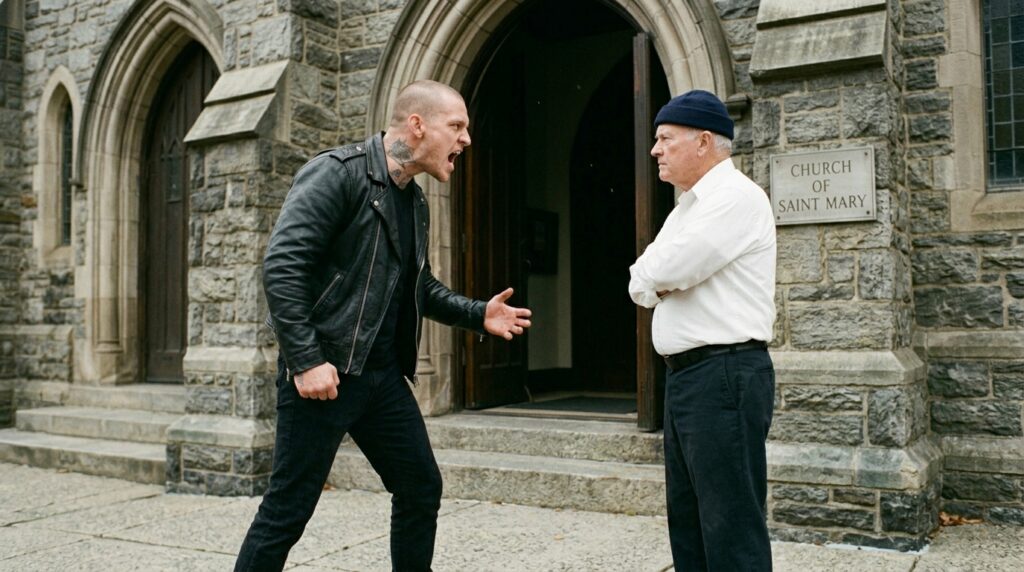
CHAPTER 5: THE COLD IRON RUN
The rusted iron latch of the line-side equipment shed didn’t drop with a click; it hit the bracket with a flat, industrial slam that vibrated through the floorboards beneath Thomas’s boots. The dim light filtering through the grime-crusted transom window was instantly cut in half. Outside, the rain had turned the gravel slag between the ties into a slick, dark mire, the smell of old creosote and sulfur dioxide rising from the dormant tracks like stagnant pond water.
Thomas didn’t rush the door. He kept his spine straight, his right shoulder resting against the rough-sawn pine frame of an old utility workbench. Inside his heavy coat pocket, his fingers remained steady against the canvas-wrapped inspection log, his pocket watch clicking with a rhythmic, unhurried iron stroke against his ribs. His left knee burned from the three-block march along the switching line, a deep, persistent ache that told him exactly how little leverage he would have if forced into a dead sprint across the yard.
“You should have left the book in the booth, Vance,” a voice called out through the rafters. It came from the shadows behind the dormant diesel generator, dry and flat, carrying the cold authority of a man who didn’t need to shout to be obeyed.
The man with the scar stepped into the narrow corridor between the storage crates. He wasn’t carrying a weapon, but his right hand was dipped into the pocket of his greasy mechanic’s jacket, the fabric pulled taut against a heavy, metallic silhouette. Behind him, two younger men from Marcus’s crew flanked the narrow exit lane, their black leather jackets slick with gray rainwater, their knuckles white against short lengths of iron plumbing pipe.
“The book belongs to the neighborhood,” Thomas said, his voice flat, cutting through the damp chill of the shed like a crosscut saw through dry oak. “And the signature at the bottom of the Vanguard deed belongs to Councilman Harris. He’s using your crew to depress the property values before the municipal safety committee moves on the parish land.”
The driver stepped closer, his boots crunching over iron filings and dry rot wood. The scar over his left eyebrow twitched under the pale yellow light of a single hanging bulb. “You always were a good investigator, Thomas. Too good for a precinct that ran on cash and favors. You think you found the bottom of the hole? You think Harris is just buying a few cheap storefronts for a corporate markup?”
“He’s clearing a path for a logistics terminal,” Thomas muttered, his mind checking the grid, matching the red lines on the text attachment to the old industrial switches outside the door. “The church sits right over the junction lane. If the parish surrenders the title, the city gets the federal infrastructure grant without an environmental delay.”
The man with the scar let out a short, guttural laugh that ended in a dry cough. “Vanguard isn’t a corporation, Vance. It’s a holding container. Harris doesn’t own it. The whole precinct council does. They’ve been buying the debt on these blocks since the old mills shut down thirty years ago. They don’t want the storefronts. They want the eminent domain declaration. If the neighborhood is declared an active safety liability, the city seizes every parcel for ten cents on the dollar.”
Thomas’s hand tightened within his pocket, his thumbnail digging into the fresh metal teeth of the housing authority key. The decoy secret had broken cleanly, but the reality behind it was heavier than a simple corporate payout. It was an institutional maw, a system that used its own code enforcement officers and street thugs to engineer the very decay they claimed to regulate.
“You’re not going to make it back to the parish with that ledger,” the driver said, his shoulder dropping as he braced his weight to close the gap. “Harris already signed the emergency enforcement warrant for your house. The trucks are moving toward Elm Street right now. Give me the book, Thomas. Go sit in your kitchen and let the city write the check.”
“The check is an insult,” Thomas said.
He didn’t wait for the driver to execute his reach. Thomas stepped backward, his heel striking the base of the old utility workbench. With a sharp, explosive lift of his right arm, he drove his palm upward into the bottom of a heavy iron vise bolted to the rotten pine. The rusted wood groaned, then sheared completely through under the levered force, sending eighty pounds of cast iron crashing into the concrete floor directly in front of the driver’s boots.
The concrete cracked with a sharp, gun-like report, spraying gray dust and stone chips into the air. The driver lunged backward to protect his shins, his balance breaking against a pile of old rail ties.
Before Marcus’s crew could clear the dust, Thomas turned toward the rear of the shed. His left leg screamed as he threw his full weight into a short, heavy iron pry-bar resting against the window frame. He drove the steel wedge into the padlock of the narrow tool-escape hatch—a lock stamped with the same municipal serial number he had tracked since the church steps. The rusted shackle gave way with a dry, metallic snap.
Thomas dropped through the low opening into the driving rain, his boots sinking into the wet slag of the yard. The cold wind slammed into his face, carrying the scent of iron rust and wet coal dust. He didn’t look back to see if the leather jackets were through the hatch. He pressed his hand against the ledger in his coat, his eyes fixed on the distant stone tower of the church rising through the desaturated gray dusk. The perimeter was collapsing, and the city wasn’t waiting for the seventy-two hours to expire.








