CHAPTER 6: THE MEASURE OF THE GRIT
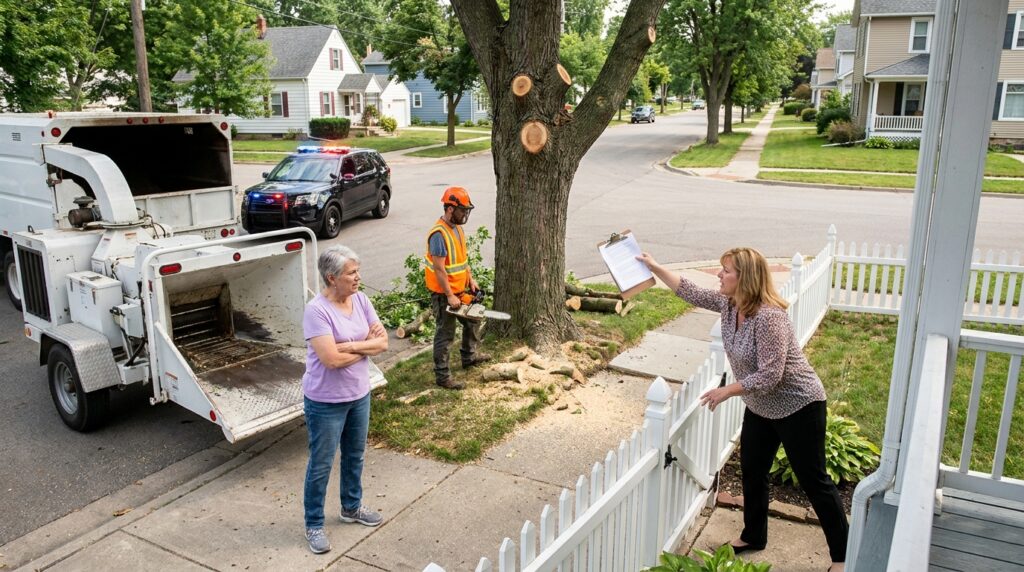
The red ‘HOLD’ notice on Eleanor’s digital report map caught the direct glare of the mid-morning sun, the ink appearing less like an administrative marker and more like a fresh, wet line of grease pencil drawn over old slate. The officer stayed on one knee for a long moment, his heavy uniform trousers soaking up the dampness of the mulch-covered earth, his thumb tracing the square edge of the oxidized zinc plate he had cleared at the base of the oak.
“This code,” the officer said, his voice level and flat as he looked up at Evelyn over his shoulder. His leather belt creaked with the movement, the heavy handcuffs jingling softly against his side. “It’s signed by a man named Arlan Vance. He was the field supervisor for Vanguard back in ninety-four. He’s the same surveyor who got pulled into the county registry hearing three years later for overlapping the ditch coordinates by thirty-six inches to clear the limestone shelf.”
Evelyn didn’t move her flats off the loose soil of the curb lane, but her hand dropped away from the upper margin of her clipboard. The white sheets of her printed bylaws rustled against her patterned blouse like dry husk leaves in an August wind. “Arlan Vance’s estate settled those boundary variances with the township before the corporate liquidation,” she said, though the speed of her words was slowing down, the rhythm breaking against the solid presence of the officer’s dirt-stained hands. “The water main was accepted by the district as an operational system, Officer. The physical line is what dictates the easement, not the old field logs.”
The contractor spat a dark stream of tobacco juice into the fresh pile of coarse sawdust near the wood chipper chute. He rubbed his palms together, the thick leather of his gloves making a rasping sound like a iron file on wood. “If Arlan Vance laid this main without a legal county variance, Chief, then that pipe isn’t a public utility run at all. It’s an unpermitted private encroachment on whatever land it’s sitting on. If my crew punctures that line, the city’s utility insurance won’t even answer the phone.”
Eleanor watched a single red strobe from the police SUV sweep across the weathered pine slats of Evelyn’s white fence. Every knot hole and split in the wood stood out under the light, silvered by decades of rain and sun, completely unaligned with the actual zinc coordinates sitting under the root flare. She didn’t feel the triumph she had expected when she spent those five hundred dollars on the private surveyor three months ago. She only felt the cold, hard weight of the labor—the forty years she had spent watching the soil move, watching the trees grow, knowing that the lines people draw on paper have very little to do with where the roots actually dig for water.
“Let me see that green folder, Eleanor,” the officer said, rising to his full height with a slow, deliberate grunt. He reached out his right hand, the skin grayed with the powder of oxidized zinc and dried leaf mold.
Eleanor pulled the plastic sleeve from her pocket and handed it over without speaking. Her fingers were steady, but the texture of the plastic felt uncomfortably smooth against her calloused skin, a clean piece of city documentation that was about to strip the last bit of certainty away from the cul-de-sac.
The officer laid Eleanor’s municipal arborist report flat against the hood of his cruiser, right where the paint was hot from the idling engine. He placed Evelyn’s aluminum clipboard directly beside it, his thick finger cross-referencing the ninety-four date stamp with the fresh engineering coordinates of the acoustic scan. He didn’t speak for two full minutes. The only noise on the street was the heavy, rhythmic vibration of the white wood chipper truck and the distant bark of a dog two blocks over.
“Evelyn,” the officer said finally, his voice dropping into that quiet, mid-valley drawl that meant a decision had already been indexed by the precinct clerk. “The city arborist didn’t just check the limbs. He checked the original plat map from before Vanguard ever dropped their first bucket into the dirt. This green sheet has a municipal correction attached to it. The city water department officially abandoned the Vanguard easement on this specific lot back in two thousand four when they ran the bypass down the main road.”
Evelyn took a half-step backward, her black shoes sliding off the concrete lip of the curb and onto the grass of her own lawn. The aluminum board tipped down until it was resting against her thigh, the loose pages fluttering as if they wanted to pull free from the clip. “They couldn’t abandon it,” she whispered, her sunglasses slipping down to the middle of her nose, revealing her eyes—pale, squinted, and entirely stripped of the authority she had carried off her porch ten minutes ago. “The pressure runs through this line. It services my house.”
“It services your house through a three-inch lateral that connects to the main road, not this main,” the officer replied, his eyes remaining fixed on the documents. He tapped the red ‘HOLD’ notice on Eleanor’s printout. “This old eight-inch line under the oak… it’s been dry since the county water project was completed twelve years ago. It’s not an active main, Evelyn. It’s an abandoned iron conduit that Vanguard left in the ground because it was cheaper than digging it out of the limestone.”
The contractor looked down at the chainsaw at his hip, a slow, greasy grin spreading across his weathered face. He looked at Eleanor, then at the massive, split limb that hung like a broken arm over the gravel driveway. “So,” he said, his thumb flicking the ignition switch back to the ‘RUN’ position. “There’s no utility run to compromise. There’s just six hundred pounds of rotten oak that needs to come down before it takes out a porch.”
Eleanor didn’t smile. She looked past the officer’s shoulder toward the white picket fence. Three feet behind those rotting pine slats, hidden under the green leaves of Evelyn’s manicured garden beds, the actual water pipe sat in the dark soil, still carrying the live pressure for the rest of the block—and it was sitting on land that Eleanor’s deed had claimed since nineteen eighty-six. The decoy secret of the abandoned Vanguard line had satisfied the officer and the crew, but the deep, absolute truth of the boundary layout remained locked in the dirt, a live wire that neither woman could touch without bringing the entire neighborhood down around them.
“Cut the split one first,” Eleanor told the contractor, her voice flat, matching the gray iron of the surveyor’s tag beneath her heel. “And keep the sawdust off her side of the fence.”