
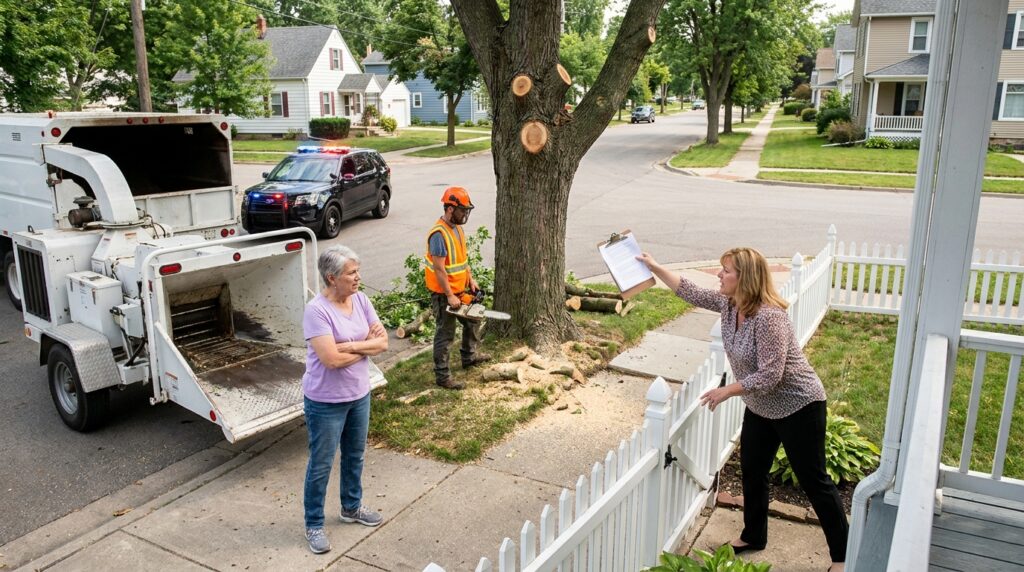
CHAPTER 3: THE INK IN THE SILENT SOIL
The rhythmic, silent red flash of the utility vehicle’s strobes caught the edges of the lower oak limbs, turning the weeping black sap into a sequence of dark, viscous beads that looked like old iron rivets. Eleanor did not turn her head toward the sound of the tires grinding against the loose gravel at the edge of the cul-de-sac. She was looking at the bottom margin of Evelyn’s third page, where the fibers of the paper had split and frayed from being flattened inside a rusted metal strongbox.
“The name at the seal isn’t the county registrar,” Eleanor said, her voice dry, carrying the flat weight of an anchor dropping into soft silt. She pointed a short, thick finger toward a blurred line of purple typewriter ink. “It’s Vanguard Estates LLC. Registered in ninety-three, dissolved by court receiver in ninety-seven. They didn’t leave a quiet title behind, Evelyn. They left five hundred thousand dollars in unrecorded mechanics’ liens and a surveyor who lost his license for moving iron pins over by the county creek.”
Evelyn’s knuckles didn’t loosen their grip on the aluminum board, but her flat black shoes made a small, grinding noise against the pavement as she tried to shift her silhouette, blocking the glare of the approaching strobe lights. “The corporation is gone, but the filing was cross-indexed to the municipal water extension,” she said, her chest rising rapidly beneath the floral pattern of her blouse. “The easement doesn’t vanish just because the developer went under, Eleanor. It’s an active asset. If your contractor cuts through the root system, he’s altering a designated utility path that services three other houses on this run.”
The contractor had entirely let go of the pull-cord now. He took three paces back, his scuffed leather boots leaving pale, dual tracks through the sawdust until his shoulder brushed against the cold, metal frame of the idling white wood chipper. The machine gave a heavy, mechanical shudder, a raw puff of diesel smoke curling from the square mouth of the chute and settling across the white slats of the boundary fence.
“Look at the date stamp on the extension application,” Eleanor murmured, her eyes remaining fixed on the paper, ignoring the sudden metallic clink of a heavy vehicle door latching shut forty feet behind them. “It says October eleventh, nineteen ninety-four. The water main wasn’t even buried until November. Someone backdated that form by three weeks to pass an inspection before the winter freeze hit the inspectors’ office.”
The micro-discrepancy was a small thing—a smudge of dried ink over a standard municipal filing code—but to Eleanor, it was the first cracked bone of the entire block’s history. For ten years, she had kept her desk drawer filled with the faded yellow envelopes of anonymous complaints Evelyn had channeled through code enforcement. Every letter had been typed on the same old ribbon, demanding her lawn be edged, her gutters cleared, her trash bins dragged back within twenty-four hours of collection. Eleanor had filed them all chronologically, never replying, never shouting across the lawn. She had simply waited, knowing that people who spend their lives polishing the surface of a boundary line are almost always trying to hide the fact that the foundation beneath it is completely hollow.
“It’s an official record,” Evelyn insisted, though her shoulder-length blonde hair shook slightly as she checked the perimeter of the work zone over the rims of her oversized sunglasses. The white sheets of her document rustled against the aluminum clip like dead leaves in a dry wind. “The city doesn’t ignore thirty years of continuous civil usage because of an administrative error on a date line. This work zone is unsegregated. It’s a public hazard.”
The heavy heel of a service boot struck the gravel behind them, loud and singular. The sound carried the slow, unhurried cadence of institutional authority, the distinct clink of a leather utility belt and metal handcuffs shifting against a dark wool uniform.
Eleanor took her hand off her hip, her fingers sliding down the outer seam of her jeans until they touched the rough, square corner of the green municipal folder tucked into her pocket. The plastic sleeve was warm from her skin, sticky with the humidity of the mid-morning heat. She knew what the responding officer would see when he looked at her map—he would see a bright green city arborist’s seal, fresh and damp from Tuesday morning’s inspection. But she also knew what he wouldn’t see unless he knelt in the dirt with an iron spade and began clearing the packed mulch away from the base of the oak. He wouldn’t see the zinc surveyor’s tag, oxidized down to a dull, leaden gray, sitting precisely three feet north of where Evelyn’s white picket fence terminated in the grass.
“Is there a problem with the right-of-way here, ladies?” the officer asked. His voice was a flat, mid-valley drawl, completely empty of drama, accustomed to the low-stakes territorial warfare of suburban cul-de-sacs where neighbors used local ordinances to settle scores older than the asphalt they parked on.
Evelyn didn’t wait for Eleanor to turn. She stepped directly into the officer’s path, the clipboard raised like a small silver shield between her patterned blouse and the dark fabric of his uniform. “Officer, I called twenty minutes ago,” she said, her arm rigid. “This crew is executing an unauthorized modification of a protected boundary tree. They’re working without an verified city engineer present on the easement.”
The officer didn’t look at the paper she forced into his space. He looked at the contractor’s orange hard hat, then at the massive, split limb hanging over Eleanor’s driveway, its weeping gray bark throwing a deep, cool shadow across the front tire of the police SUV.








