
CHAPTER 2: THE PAPER RAIN
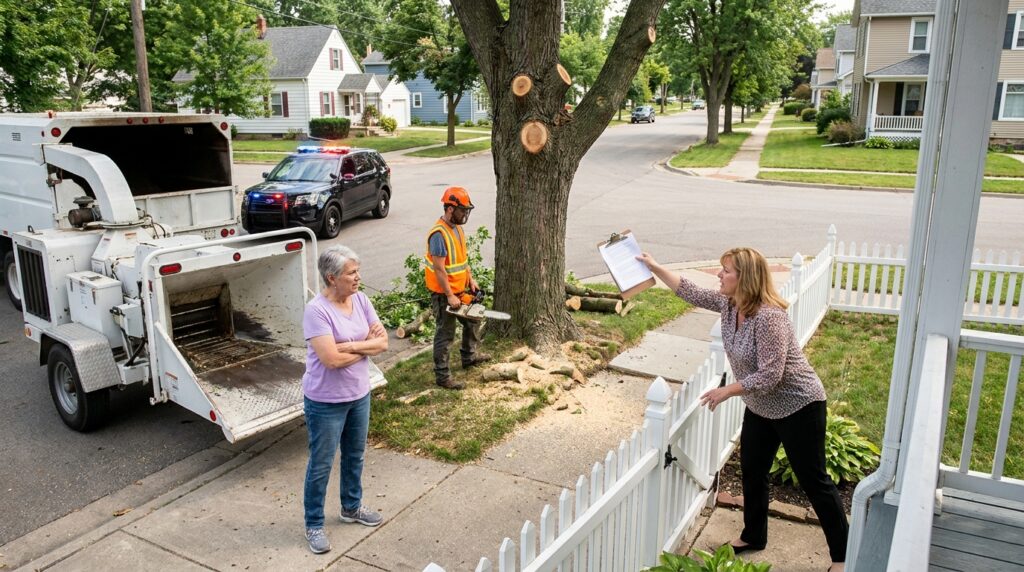
“The split near the fork,” Eleanor repeated, her voice cutting beneath the low, wet rattle of the chipper’s diesel cylinders. She did not look at Evelyn. She kept her eyes fixed on the contractor’s thumb, which was hooked into his heavy leather tool belt just above a tarnished brass buckle. “He’s on my clock, Evelyn. Every five minutes he spends reading your recycling pile is twenty dollars out of my maintenance fund.”
The contractor, whose safety vest was greyed with fine layers of pulverized oak bark, shifted his weight from one thick sole to the other. His boots left deep, distinct prints in the damp sawdust that was beginning to carpet the curb line. He pulled the paper closer to his face, his eyes narrowing under the plastic brim of his hard hat. “Ma’am,” he began, his tone carrying the careful, flat neutrality of a tradesman caught between two property taxes, “this stamp here… it’s got the county clerk’s seal from ninety-four. Says ‘Right of Way Restriction—Section Four.'”
Evelyn thrust the aluminum clipboard an inch higher, the metal corner catching a stray beam of morning sun and throwing a sharp white point against Eleanor’s chin. “It’s not recycling, Eleanor. It’s a legal encumbrance. It runs with the land. Your arborist can stamp whatever green cardboard he wants, but he doesn’t have the authority to override a recorded civil covenant. You touch that timber, and you’re cutting into county-controlled infrastructure.”
Eleanor took a slow, deep breath, her nostrils filling with the bitter, iron smell of dry earth and the exhaust fumes settling in the humid cul-de-sac air. Her fingers remained flat against the denim of her thighs, but her mind was already calculating the distance. Three feet to her left, the zinc surveyor’s tag lay beneath the black loam, its cold metal edges completely invisible under the leaves she had deliberately left undisturbed. She knew the numbers stamped into that zinc—they didn’t match the numbers on Evelyn’s clipboard, but they didn’t match her own public deed either. There was a discrepancy in the original platting, an ancient error that had slept in the dark for three decades. If Evelyn kept digging into the archives, she wouldn’t just stop the tree-trimming; she would uncover the line that sat three feet deep inside her own flowerbeds.
“That stamp is from the old drainage district,” Eleanor said, keeping her voice even, letting the gravel in her throat steady the contractor’s hand. “The one dissolved when they put the concrete culverts in back in ninety-eight. Look at the lower margin, son. There’s no secondary validation.”
The contractor turned the paper sideways, his rough thumb tracking down the yellowed margin where the ink had faded to a dry, rusty brown. A faint line of sweat was beginning to trace through the dust on his neck. He looked at Evelyn’s sunglasses, then down at the white picket fence that ran parallel to the work lane. The fence was old, its pine slats showing the gray rot of forgotten winters, but it sat precisely where everyone believed the world ended and began.
“It doesn’t need secondary validation,” Evelyn snapped, her flats clicking against a stray piece of limestone as she crowded the curb. Her patterned blouse shook with every breath, the fabric dry and loud. “The easement remains active until a formal quiet title action is filed in the district court. I’ve already sent the digital filing to code enforcement. If that blade touches the bark before the investigator gets here, I’m personally holding your company liable for triple damages under the state timber-theft statute.”
The contractor’s finger twitched away from the chainsaw’s pull-cord. He looked up into the canopy of the oak, where a massive, split limb hung like a broken shoulder over Eleanor’s gravel driveway. The wood there was dark, weeping a thin, black sap that smelled of rot and old iron. It was dangerous; a forty-mile-an-hour gust from the north would drop five hundred pounds of dead weight directly onto Eleanor’s porch roof. But the legal threat was a different kind of rot—one that could eat a small business’s insurance policy before the weekend.
“We need to be sure,” the contractor muttered, his voice dropping into his chest as he took a step away from the trunk. He reached up, wiping his brow with the back of a canvas work glove that left a smudge of dark grease across his temple. “I can’t have my guys operating if there’s an active stop-work notice pending with the city. We’ll hold here until the clerk verifies the docket.”
“There is no notice,” Eleanor said, her voice dropping into a register that was almost cold. She stepped off the concrete, her sneakers sinking into the loose soil right where the oak roots rose like iron pipes through the grass. “Look at the ink, son. Look at the signature at the bottom of that restriction page. That’s not a city clerk. That’s a private title surveyor from the development company that went belly-up during the mortgage squeeze.”
The contractor paused, his eyes dropping back to the paper. Evelyn didn’t pull the clipboard back, but her arm went rigid, the tendons in her wrist tightening until the skin over her knuckles turned the color of dry bone.
A sharp, metallic chirp sounded from the end of the block—the distinctive, short tap of a municipal siren clearing an intersection. Eleanor didn’t turn her head, but she felt the small vibration through the soles of her shoes as a dark blue utility vehicle rounded the corner of the lane, its rooftop strobes throwing a rhythmic, silent red flash against the gray undersides of the neighborhood leaves.








