CHAPTER 4: THE ACCORDION LINE
“The problem isn’t the tree, Officer,” Eleanor said, before Evelyn’s arm could extend any further into the space between them. She reached into her back pocket, the stiff plastic edges of her green city sleeve clicking against a copper rivet on her jeans as she pulled it free. “The problem is the arithmetic.”
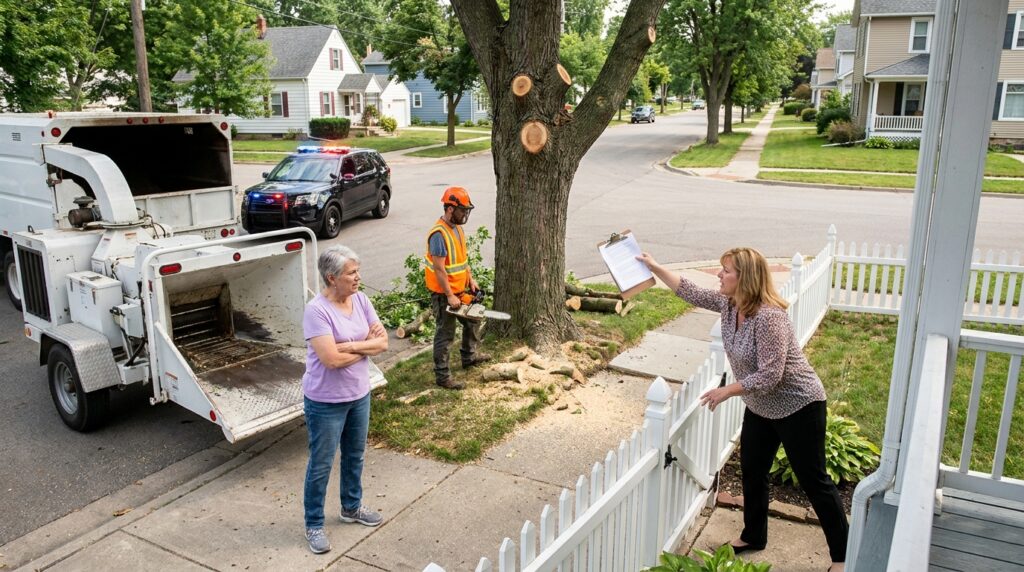
The officer took a slow step forward, his leather utility belt creaking under the weight of his sidearm and heavy flashlight. He didn’t take Evelyn’s clipboard. Instead, his eyes went to the ground, tracing the neat line of orange cones that separated the massive white wood chipper truck from the weathered pine slats of Evelyn’s fence. A fine layer of yellow pulp was still falling through the air, settling across the dark wool of his shoulders like pollen.
“She doesn’t have a valid work order,” Evelyn said, her voice rising an octave, sharpening against the mechanical thrum of the diesel engine. She tapped the aluminum frame of her board with a short, pale fingernail. “Look at the registration index. Vanguard Estates filed this right-of-way restriction thirty-two years ago. It’s a dedicated path for the municipal water extension. If those roots are severed, the structural integrity of the main line is compromised. The entire cul-de-sac loses pressure.”
The contractor shifted his weight against the fender of the truck, his canvas gloves tucked under his armpits. He looked at the officer with the exhausted, neutral tolerance of a working man who had spent his morning watching forty dollars an hour evaporate into a neighborhood dispute. “We checked the utility flags before we dug the truck tires in, Chief,” he muttered, pointing his chin toward three small, neon-pink plastic markers stuck in the turf near Eleanor’s mailbox. “Locates came back clear forty-eight hours ago. Nothing on this side of the ditch line but old gravel and oak roots.”
“The flags are based on the current public database, which hasn’t been corrected to reflect the ninety-four amendment,” Evelyn countered, her sunglasses sliding down the bridge of her nose as she leaned into the officer’s space. She thrust the white sheets toward his chest, the paper rustling like dry corn husks. “Look at the signature. That’s an official recorder’s mark.”
Eleanor watched the officer’s face as he finally reached out, taking the clipboard by its lower edge. His thumb, thick and calloused from years on the county beat, pressed against the frayed margin of the paper. He didn’t look at the text; he looked at the purple ink of the stamp, his eyes narrowing slightly as he noticed the way the corporate logo of Vanguard Estates sat slightly askew over the county clerk’s circular seal.
“This looks like an old developer’s proposal,” the officer said, his drawl low and level. He turned the board over, checking the blank back of the sheet. “Evelyn, the city hasn’t used this filing prefix since the township consolidation back in ninety-eight. If this easement isn’t recorded on the current county GIS map, it doesn’t exist for a field unit.”
“It exists because the infrastructure is physically in the ground,” Evelyn snapped. Her blouse shook with a short, tight breath, the bright floral patterns blurring against the gray background of her house. “The water district took over the Vanguard assets after the liquidation. They didn’t re-file every individual easement because the physical presence of the main constitutes public notice under state law. You can’t just cut through thirty years of continuous utility usage because someone forgot to transfer a folder during a merger.”
Eleanor took two steps to her right, her worn sneakers sinking into the soft, sawdust-coated turf near the base of the tree. Her heel brushed against a thick, knotted root that grew out from the trunk like an iron pipe, disappearing straight beneath the bottom rail of Evelyn’s white picket fence. She could feel the subtle, deep vibration of the earth under her feet—not from the idling truck, but from the massive, hidden pressure of the water main that ran somewhere beneath the grass. Except it didn’t run down the center of the ditch line. She knew from the private surveyor she had paid five hundred dollars in cash to three months ago that the pipe had been laid four feet off-center to avoid a limestone ledge that the Vanguard crew couldn’t blast through without shattering the neighbor’s foundation.
“The Vanguard crew didn’t lay the pipe where the paper says it is, Evelyn,” Eleanor said quietly. She held out her own green plastic sleeve, the municipal arborist’s seal bright and clean under the high sun. “The city arborist brought the utility locator out on Tuesday afternoon because I asked him to run a deep acoustic scan. The water main isn’t under my oak. It’s three feet inside your garden bed, running directly under your prize hydrangeas.”
Evelyn froze, her hand dropping off the top edge of her clipboard. The sunglasses stayed low on her nose, her eyes wide and motionless behind the dark glass as she looked from Eleanor down to the base of the fence line where the fresh saw-cut limbs lay piled like old bones.
The contractor let out a short, dry whistle, his hand moving back to the pull-cord of the chainsaw. “Well, now,” he said, looking at the officer. “That changes the liability framework just a bit, doesn’t it?”
The officer didn’t answer. He held both documents now—Evelyn’s yellowed corporate filing and Eleanor’s crisp municipal arborist report—his eyes tracking the two separate sets of numbers that claimed ownership over the same six feet of suburban dirt.