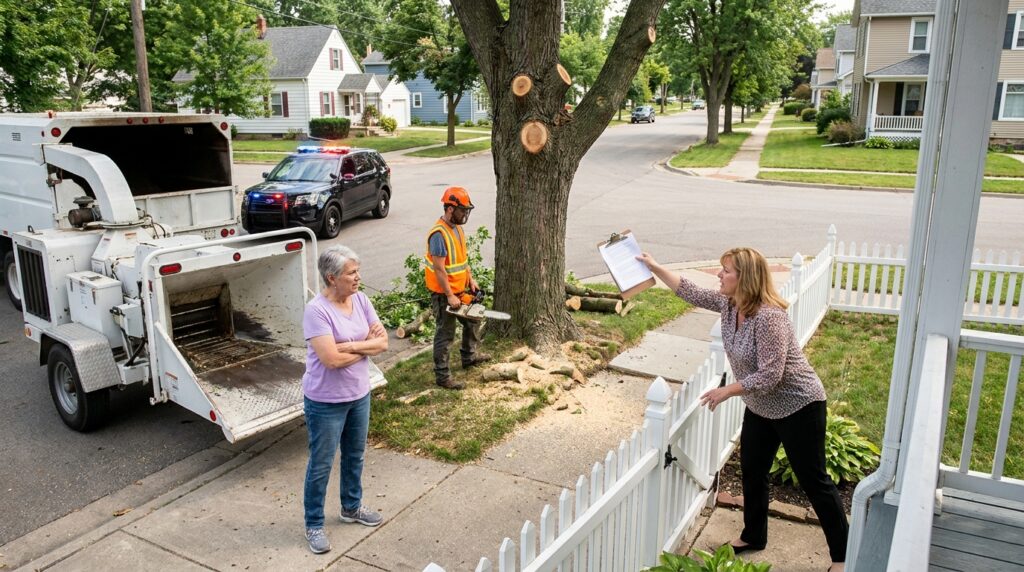
CHAPTER 5: THE COLD ROT IN THE RUN
“The scan is over three days old, Officer,” Evelyn said, her voice dropping into a hard, desperate register that scraped against the idling rattle of the diesel truck. She didn’t take off her sunglasses, but her fingers clawed into the edge of the aluminum board until the metal bowed slightly. “A deep acoustic read doesn’t override an index deed. If Eleanor has a private map showing a pipe deviation, it means she’s been holding onto unverified county data to bypass her liability for this oak.”
The officer turned Eleanor’s digital printout sheet over, his thumb dragging across the gloss finish of the paper where the municipal arborist’s layout was cross-referenced with the county coordinates. The red lightbar from his cruiser continued its slow, heavy sweep across the white slats of the boundary fence, painting every rotting pine knot in a momentary stain of dark rust. “The arborist’s report doesn’t list a deviation code, Eleanor,” he muttered, his voice carrying the flat, pragmatic indifference of a county unit who had spent thirty years watching neighbors use civil maps like brickbats. “It just says ‘Clear for Maintenance under Section Twelve.’ If there’s a water main three feet off-center, it’s not noted on the current field voucher.”
Eleanor didn’t move her feet from the turf. She felt the heavy, rhythmic vibration of the wood chipper through the thick rubber of her sneakers, the coarse powder of fresh sawdust settling on her skin like fine sand. “The field voucher only covers the canopy, Officer,” she said. She didn’t pull her hands from her pockets. She kept her eyes fixed on the low rail of Evelyn’s fence, where the gray wood met the packed, damp black mulch of the garden bed. “Look at the corner index on page two. The arborist didn’t run the acoustic line from the street center. He ran it from the old zinc tag behind my mailbox. The one Vanguard put down before they backdated the easement.”
The contractor let out a short, wet cough and stepped away from the white utility truck. He pulled a yellow-handled grease pencil from behind his ear and pointed it at the base of the tree trunk where the thickest root disappeared into the lawn. “Chief, if I run the blade through this lateral and the city main is actually sitting under the hydrangeas, the back-pressure is going to lift four hundred feet of asphalt before your dispatch can find the shut-off valve. I’m not dropping the saw into this ditch until someone from public works signs a hard indemnity waiver.”
“There is no waiver,” Evelyn snapped. She took two rapid steps forward, her flat black shoes sinking into the loose wood shavings until she was standing within three inches of the concrete curb. Her patterned blouse caught the direct heat of the high sun, the fabric smelling faintly of laundry starch and dry basement air. “The infrastructure is public property. If this contractor shuts down his equipment because of a hypothetical plumbing deviation, he’s in breach of his municipal clean-up mandate. I’ll have the district supervisor pull his commercial license before the office closes for lunch.”
The officer didn’t reply to Evelyn. He stepped past both women, his heavy boots crunching through the wood debris until he reached the edge of the fence line. He knelt down slowly, the leather of his utility belt popping as his weight shifted, his calloused fingers reaching down into the dark loam at the very base of the oak’s root flare. He cleared away a handful of rotted oak leaves and dry twigs, his knuckles brushing against a hard, flat piece of metal that sat wedged between two stones.
Eleanor watched his shoulder drop. She knew exactly what his hand was touching. It wasn’t the clean, round top of a standard city surveyor’s pin. It was a square, hand-stamped zinc plate, heavily pitted with three decades of ground oxidation and gray-white zinc crust. The stamped numbers were barely legible under the grease of the leaf mold, but the prefix didn’t match the city’s standard code. It was the old Vanguard identifier—the one used by a company that had changed its corporate name three times in eighteen months to hide an eight-inch main deviation that had been laid through private property without a legal title transfer.
“This pin isn’t in the GIS registry,” the officer said, his voice dropping into a lower, flatter tone as he stood back up, wiping his dirt-streaked palm against the side of his dark trousers. He looked at Evelyn, then back at Eleanor’s green plastic sleeve. “Evelyn, this tag says ‘V-Ninety-Three.’ That’s the old private platting code from the subdivision company. If the main was laid relative to this marker, then the utility run isn’t under the ditch at all. It’s sitting entirely inside your front yard.”
Evelyn’s chin twitched. She pulled her clipboard down against her chest, holding the loose sheets against her patterned blouse like an apron. “The fence has been in this exact position since ninety-six,” she said, her voice thinning until the text of her words lost their aggressive edge. “The property line is established by continuous adverse occupancy, Officer. Even if the original pipe was laid off-center, the boundary follows the wood slats. Eleanor can’t claim three feet of my lawn just because some developer used the wrong surveyor thirty years ago.”
“I don’t want your lawn, Evelyn,” Eleanor said quietly. She took her left hand out of her pocket and pointed down at the fresh saw-cut wood lying in the gutter. “I want the limb off my roof. But if we’re going by the ninety-four document you’ve got clamped to that aluminum, the city didn’t just take over the pipe. They took over the maintenance liability for every root that touches it. If that main cracks because of the oak, the county isn’t going to bill me for the repair. They’re going to look at the name on the original easement application.”
The contractor froze, his yellow grease pencil remaining suspended in the hot air between them. The officer turned the page of Eleanor’s report, his thumb stopping at an unshaded diagram at the very bottom of the municipal data run—a set of engineering coordinates that had been stamped with a red ‘HOLD’ notice from the water district clerk’s office three days prior.