
CHAPTER 4: THE MANAGERS LEDGER
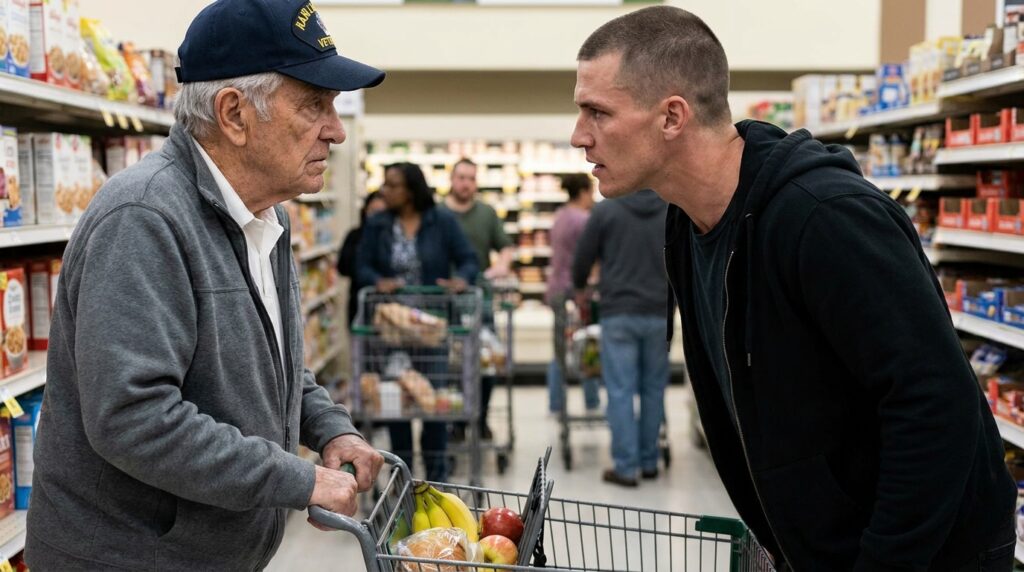
“Lower your hand, Miller,” Vance whispered. “Get your cart out of this aisle right now.”
Miller didn’t drop his arm instantly. His large frame hitched, the synthetic black fabric of his jacket bunching around his shoulder blades as his teeth clicked together. He looked at Vance, then back at Arthur’s open, dry palm, his jaw working the stale spearmint gum with a wet, rhythmic snap. “He’s an old man, Mr. Vance. He’s blocking the whole retail floor. We’ve got an agreement regarding the perimeter clearing.”
“We don’t have an agreement for this,” Vance said. His voice was thinner than a split reed, but his right hand—the one unaffected by his old shoulder distortion—reached out and clamped onto the heavy collar of Miller’s black jacket. The fabric gathered under Vance’s blunt fingers, the small metal zipper teeth rattling together with a high, dry click. “You take your property and you walk. Now.”
The dynamic broke with a sudden, unprincipled jerk. Miller didn’t step back; he ripped his shoulder away from Vance’s grip with enough lateral momentum to slide his steel-toed loggers six inches across the salt-filmed floor. His heavy wire cart spun on its broken rear caster, its heavy galvanized side-rail catching the edge of Arthur’s basket with a vicious, metal-on-metal tear. The force of the strike sheared the small, rusted cotter pin completely off Arthur’s front wheel. The tiny piece of iron snapped like a dry twig, pinging off the base of the citrus pallet and skittering into the dark space beneath the open frozen food cases.
Without the cotter pin, the wheel buckled. Arthur’s cart tilted sixty degrees, the wire basket bowing under the sudden weight of the turnips and lard blocks as they spilled onto the linoleum. The sudden loss of structural leverage caught Arthur off balance. His hip flared with a hot, sickening heat as the old shrapnel shifted against the bone, his boots sliding through the slick layer of crushed oranges that had dropped from the splintered crate. He fell forward against the tilting rail, his right hand slipping from the center pillar of the carriage.
As his torso dropped toward the steel grid, the heavy canvas lining of his jacket pocket split along its ancient, frayed seam. The small, hard cardboard ledger he had been shielding slipped through the tear, hitting the zinc-plated grid of the cart with a heavy, hollow thud before dropping flat onto the wet floorboards.
Miller looked down at the book. His small, pinned pupils widened as his eyes caught the dark thumbprint of heavy winch grease across the top cover. His hand dropped from his cart handle, his fingers hooking toward the leather binding before Vance could intercede. “That’s company log material,” Miller grunted, his boots crunching through the split rinds as he lunged down. “That belongs in the field trailer.”
Arthur didn’t try to stand. He stayed on his left knee, his breathing shallow, his fingers flat against the cool, grease-filmed linoleum to stabilize his frame while the world ran gray around the edges. He watched the mechanical certainty of Miller’s reach, but his own left arm was already moving through a shorter arc. He didn’t use force; he jammed his split work boot directly against the spine of the ledger, pinning the thick paper binding to the floor just as Miller’s fingers closed on the corners.
The paper tore with a dry, screaming sound. The top layer of the binding peeled back, exposing three hand-drawn topographical maps executed in fading purple ink. Across each page, heavy black grid lines had been struck through the old ridge boundaries—the exact sector lines of Arthur’s homestead, labeled with corporate acquisition stamps and an ink-stamped foreclosure date that matched the upcoming Monday. Below the stamps was a neat, typewritten list of field enforcement targets. Arthur’s name sat at the very top, marked with a specific, handwritten marginal note: Accelerate spatial pressure. Target isolated. Institutional leverage cleared through regional commercial hub.
Miller froze, his thumb still holding the torn fragment of the cover. He looked up at Arthur, his face no longer holding the casual impatience of a weekend shopper. The white fight scar under his ear had turned a dark, angry purple against his neck. “You shouldn’t have had that in your coat, old man. That was extracted from the county clerk’s dead file three days ago.”
“It was in my pocket,” Arthur said, his voice coming out in a thin, rhythmic wheeze through his teeth. “Because your field operator left his grease on my gate latch last night. You’re five feet inside my perimeter.”
Vance stepped between them then, his bad leg dragging with a heavy, wet scrape as he drove his entire torso into the gap. He didn’t look at Miller; he dropped his hand down and seized the torn edge of the maps, his eyes scanning the purple lines with an old, frantic speed that Arthur hadn’t seen since the radio frequencies went white with static in the hills behind Tam Ky. Vance’s fingers trembled so hard they left small, damp crescents on the corporate acquisition stamps.
“This is the hub,” Vance whispered, his head turning slowly toward the high glass pane of his office, then down to Arthur’s split boot. “The whole block. They didn’t buy the ridge, Arthur. They bought the easement through the store basement. They’re tracking the old operational line.”
Miller stood up slowly, his heavy chest expanding as he kicked his broken cart aside, the wire frame clattering against the frozen food units with a long, resonant vibration. “The easement is signed, Vance. You’ve been cashing the logistics checks for twenty years to keep this building out of bankruptcy. You don’t get to hold a line now just because the old captain crawled out of his hole.”
He turned toward the exit, his steel-toed boots striking the floor with a heavy, deliberate rhythm that sounded like an iron hammer hitting dry clay. He didn’t look back at the passive crowd of witnesses who were still standing frozen between the aisles, their faces blank with the silent discomfort of an entire neighborhood realizing the ground beneath their grocery store had been sold by the foot.
Arthur stayed on his knee, his fingers tracing the torn edge of the ledger where the purple grid lines met the black winch oil. The decoy secret had broken in his hand, but the deeper architecture—the reason Vance’s leg dragged, the reason his name was on a typewritten list inside a commercial manager’s files—remained locked behind the green curtains of the elevated booth, waiting for the monday line to drop.








