
CHAPTER 2: BUMPING IRON
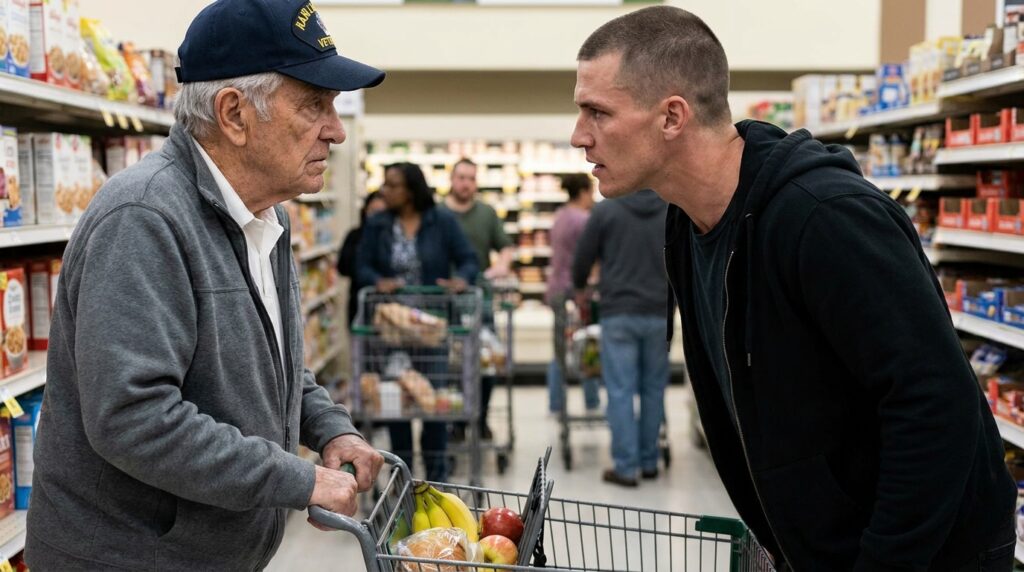
The steel mesh of Arthur’s grocery cart squealed as the young man’s wider, heavier basket ground against its side, shearing off a flake of rusted protective zinc. The sound was like an iron spade hitting granite. The impact jarred through Arthur’s hip, the old metal fragments near his pelvic bone flaring with a hot, localized prickle that signaled a structural limit.
Arthur did not adjust his feet. He kept them set six inches apart, boots flat against the salt-crusted linoleum, using the weight of his own lean frame to anchor the cart wheels against the base of the citrus display. The wooden pallet groaned beneath the side-pressure, a splinter of pine snapping off near the floor.
“You’re in the wrong lane, old man,” the younger man said, his chest expanding under the black nylon of his jacket. The synthetic fabric hissed as he leaned his weight into the push, his forearm resting flat across the top rail of Arthur’s carriage. His skin was tight, hairless, and smelled of cheap paraffin wax and sulfur-based laundry soap. “Aisle’s for people who have somewhere to be before the ice melts.”
Arthur looked at the young man’s hand where it clamped the wire mesh. The knuckles weren’t white from fear; they were thick, scarred across the middle joints by concrete or heavy rigging rope, the fingernails trimmed straight across with dark grease packed into the cuticles. It was the hand of a specialized laborer—someone paid by the hour to remove obstacles.
“This store has four entry lanes,” Arthur said, his tongue dry against his teeth. The cadence was low, dropping beneath the high-frequency hum of the open-topped frozen food cases behind them where rows of cardboard fish sticks frosted under the cold light. “You chose this one.”
The young man didn’t blink. His pupils were small, pinned by the overhead fluorescent tubes. “I chose the straight line. You’re the bottleneck.”
He shoved again, a sharp, lateral jerk designed to make Arthur’s boots slide. The cart wheels skittered two inches, the loose front cotter pin rattling like a dead leaf in a gutter. The movement forced Arthur’s left hand deeper into his canvas jacket pocket to balance his torso. His fingers closed back around the hard, unexpected edge of the cardboard ledger he had discovered moments before. The surface was rough-grained, bound at the spine with thick linen thread, and as his thumb moved over the cover, it came away wet with a smudge of heavy, unrefined oil—the specific black lubricant used on the high-tension winches of corporate land-clearing equipment.
The young man saw the movement of the pocket. His jaw tightened, the white scar beneath his ear twisting into a small hook. “What do you have in there, Arthur?”
The name hung between them, flat and cold. Arthur had not given it. His veteran cap had no name tape—only the gold twill of his old battalion numbers, faded to the color of wet straw.
The silence between them spread outward now, an oil slick on clear water. To their right, the young shelf-stocker stopped his knife mid-stroke across a cardboard box lid, the brown corrugation half-severed, holding his breath as the cold air from the freezer aisle pooled around his ankles. A woman three carts back slowly lowered a package of smoked bacon into her basket, her eyes fixed on the gray canvas of Arthur’s back. Nobody moved toward the exit. In a modern suburban market, violence was supposed to be loud and fast; this was slow, structural, like an old timber settling under mud.
Arthur let his thumb press into the ledger through the fabric. The geometry of the confrontation was changing. This wasn’t a random surge of weekend impatience. The young man’s boots were heavy steel-toed loggers, clean of mud but worn at the inner heel from standing on iron platforms. He was positioned three inches too far to the left, blocking the only line of sight between the produce scale and the manager’s elevated glass booth at the front of the store. It was a containment pattern.
“You’ve been out to the ridge,” Arthur said, his voice dropping another octave, flat as a plank.
The young man’s fingers didn’t leave the mesh, but the tension in his forearm shifted from a push to a hold. His breath came out through his nose, smelling faintly of stale spearmint and iron filings. “The ridge is private asset space now. Old fences don’t mean anything to an excavator.”
“The fence is iron,” Arthur said. “It stays where the post was driven.”
“Iron rusts,” the young man whispered. He leaned in another inch, his black shoulder blocking out the light from the citrus display, his bulk casting a long, desaturated shadow over Arthur’s small collection of turnip greens and hard lard blocks. “And old men die in the woods without anyone hearing the tree fall. Clear the aisle.”
Arthur looked past the young man’s ear, toward the high glass pane of the office. A reflection shifted behind the dust-filmed green curtain. A shadow was moving down the wooden steps of the platform—a heavy, limping gait that Arthur recognized by the rhythmic creak of the floorboards forty feet away.
Arthur’s hand came out of his pocket. He didn’t pull the ledger with it. He kept his fingers open, palm flat, the skin dry and lined like an old topographical map, placing the heel of his hand directly against the rusted center pillar of his own cart. He didn’t strike; he simply locked his elbow into a straight, unyielding line of bone, shifting his center of gravity three inches forward until his chest was an inch from the young man’s black jacket.
“The line doesn’t move,” Arthur said.








