
CHAPTER 3: THE RAISED PALM
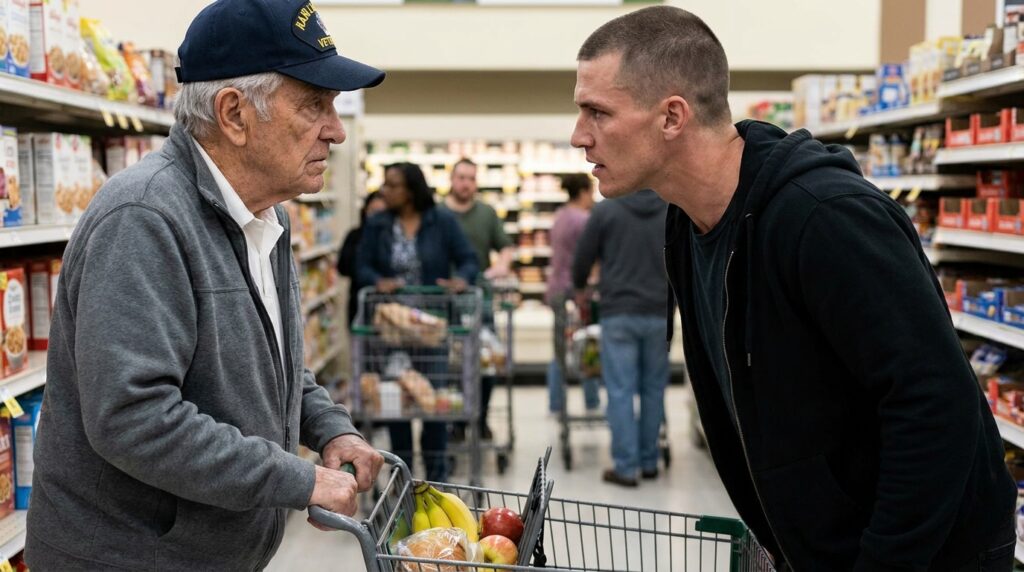
“The line doesn’t move,” Arthur said.
The words did not drop between them like a challenge; they settled like cold iron bars driven into the floorboards. The younger man’s chest stayed pressed against Arthur’s rigid skeletal framework, the thin nylon of his jacket separating two completely different systems of leverage. One was driven by the short-term combustion of mass and youth; the other by decades of kinetic architecture that had learned exactly how much stress an old joint could take before the bone splintered.
The bully’s upper lip leaned downward, teeth catching the lower edge of his skin. “You think you’ve got a square yard here, old man? I’ll push this wire right through your ribs.”
He threw his shoulder forward, a rough, spasmodic surge of his weight meant to break the straight alignment of Arthur’s arm. But Arthur had already dropped his center of mass three inches, bending his rear knee just enough to transfer the pressure directly down his thigh and into the thick heel of his leather work boot. The rubber heel caught a dry pit in the linoleum, anchoring. The steel frame of Arthur’s cart absorbed the remaining force, its rusted side-mesh groaning as the galvanized wire bowed inward, the little cotter pin on the wheel vibrating with a short, high-frequency hum that sounded like a dying wasp.
Then Arthur raised his right hand.
He didn’t pull back for a blow. He didn’t tighten his fingers into a knuckle-cluster. He simply lifted his arm from the elbow, a slow, hydraulic elevation that brought his wide palm upward until it stood perpendicular to the young man’s throat, exactly five inches from the silver chain. His fingers were splayed wide, the old skin stretched tight across thick, calcified knuckles that had turned the heavy cranks of field howitzers while the skies over the jungle ran white with phosphorus. The palm was dry, rough as a rasp file, and completely steady. It didn’t waver a millimeter. It was a physical wall, an absolute territorial boundary expressed through three pounds of bone and tendon.
“Take a step back,” Arthur said. His voice was lower now, a rhythmic vibration that came from the center of his chest rather than his throat. It was the same low-frequency frequency he had used to steady young radio operators whose legs had been blown out under the mortar pits at Dak To. “And leave.”
The young man’s forward momentum ceased instantly. It wasn’t the physical hand that stopped him; it was the lack of friction. In his world, an old senior citizen either cringed or screamed for help, creating a recognizable current of fear that he could ride like an excavator through loose topsoil. The absolute lack of heat from Arthur—the cold, tactical silence behind that wide palm—disrupted his inner calculations. He froze mid-lean, his boots squeaking once against the floor before his heels locked.
The ambient noise of Aisle 4 vanished. It didn’t fade; it dropped out like a severed copper line.
Behind the wood display, the shelf-stocker’s hand stayed suspended inside the orange crate, three fingers clamped around a soft-skinned citrus fruit, his body frozen in a half-bent posture. The woman who had been holding the package of smoked bacon stood perfectly still, her thumb pressing so hard into the plastic wrapping that the clear casing let out a small, sharp crinkle that sounded like dry kindling breaking three aisles over. Farther back, near the bakery counter, a small child stopped swinging from the metal bar of a stroller, his eyes widening as he caught the sudden, unnatural weight of the silence.
The young man’s throat clicked as he swallowed. A bead of sweat, thick and slow, formed along the clean edge of his buzz cut, traced the curve of his skull, and ran down the pale groove of the old fight scar beneath his left ear. His knuckles, still wrapped around the plastic handle of his cart, didn’t loosen, but the skin around them had changed from white to a dull, stagnant purple.
“You’re crazy,” the young man whispered, his eyes darting down to the level horizontal edge of Arthur’s palm, then back to the faded gold lettering on the blue cap. “You’re an old man in a grocery store. You don’t have anybody out here.”
“I have the ground under my boots,” Arthur said, his eyes never leaving the center of the young man’s face. “That’s always been enough.”
The heavy, limping gait from the front of the store had reached the lip of Aisle 4. The sound of a leather-soled shoe dragging its outer welt across the floorboards stopped right behind the bully’s black jacket.
“Is there an issue with the lane configuration here, Miller?”
The voice was thin, dry, and carried the specific, raspy edge of a man who had spent thirty years breathing the chemical vapors of commercial floor wax and institutional ammonia. The Store Manager stood at the edge of the produce frame. He wore a clean, white short-sleeved shirt with a green corporate tie pinned neatly to his breast pocket, but his right shoulder hitched lower than his left, a permanent structural distortion from an old injury that had never knitted straight. His eyes weren’t looking at Miller; they were fixed on the tarnished gold embroidery of Arthur’s cap, his face turning the color of skimmed milk under the fluorescent light.
Miller didn’t turn his head, but his shoulder dropped an inch, the black nylon relaxing its surface tension. “Old man’s blocking the citrus line, Mr. Vance. Won’t clear his cart for the weekend rush.”
The manager didn’t look at the cart. He took a single, slow step closer, his bad leg dragging with a distinct, metallic scratch against the linoleum. When he spoke again, his voice lacked any of the institutional authority of a supermarket representative. It sounded small, cracked, like a dry boot stepping on gravel.
“Lower your hand, Miller,” Vance whispered. “Get your cart out of this aisle right now.”








