
CHAPTER 7: THE TURN IN THE SOIL
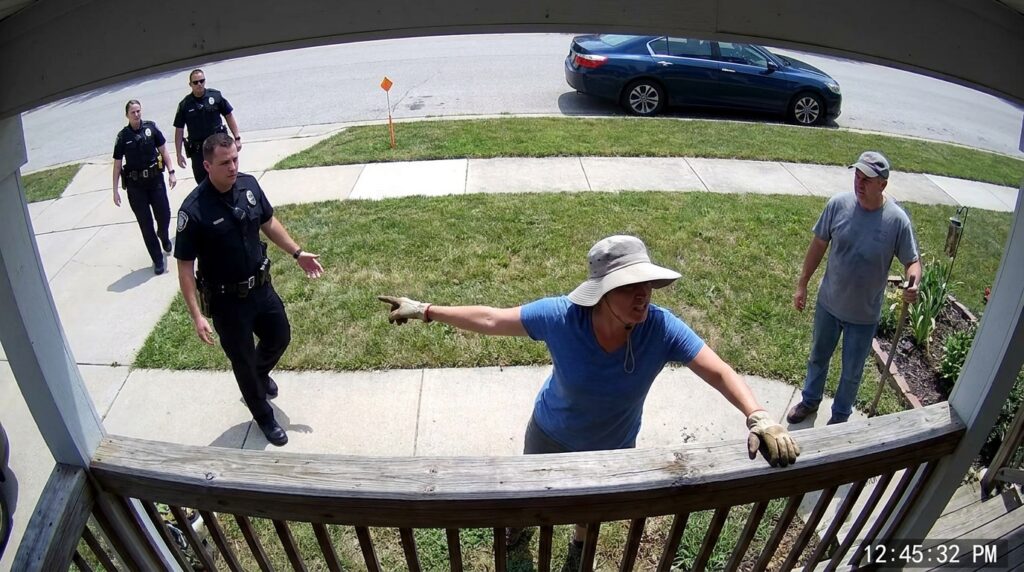
The sunglasses hit the sun-baked concrete sidewalk with a sharp, plastic clink, the lenses skittering into the parched fescue just an inch away from the bright orange survey marker. Helen didn’t reach down to retrieve them. Her unprotected eyes blinked under the intense, white glare of the overhead sun, wide and dry, staring blankly past the lead officer’s shoulder toward her own garden bed.
Beside the rear trunk of the dark blue sedan, Arthur didn’t move to bolster her remaining narrative. His heavy, gloved hands slowly slid down the smooth ash handle of the shovel, allowing the metal blade to remain wedged deep in the clumpy, fuel-soaked loam. He sank back against the car panel, his boots tracking slick, black clay across the crisp line of the sidewalk. When he spoke, his voice was thin, stripped entirely of the neighborhood authority Helen had performed for fifteen years.
“It started weeping into the foundation drain during the spring thaw, Helen,” Arthur muttered. He didn’t look up at his wife. His gaze remained pinned to the wet, dark trench where the stocky backup officer was still clearing away the roots. “I told you the patch wouldn’t hold. I told you when we laid the new landscape timber that the easement check would catch the pressure drop.”
Helen’s jaw worked silently, her mouth opening and closing without a sound. Her fingers, still curled inside the yellow leather work gloves, twitched against the sleeves of her blue T-shirt. The split halves of the 1994 layout slipped from her underarm, the weathered sheets falling into the dirt like dead leaves, the large, grease-soaked smudge at the corner glistening under the midday heat.
The stocky officer cleared another heavy shelf of clay with the edge of his boot, exposing a broad, horizontal curve of heavily pitted, corroded iron casing buried twenty inches below the sod. A dark, iridescent sheen was bubbling up from a jagged fracture in the steel, a slow, continuous leak that had turned the entire subterranean root system into a black, saturated sponge. The air between our lots grew thick, choked with the pungent, oily reek of old heating oil baking under a July sky.
“Miller, get the city environmental response unit on the wire,” the stocky officer called out, his boots sinking with a wet, heavy sucking sound as he climbed back out of the trench. He didn’t use a civil tone. He wiped a smudge of the black grease onto his tactical trousers, looking at Helen with a cold, administrative finality. “This isn’t an association fence issue. The containment layer under this entire block has been breached. It’s draining right into the secondary storm lateral.”
The female backup officer took half a step forward, her hand resting flat against her duty belt, her form creating a solid physical perimeter that pinned Helen against the side of the sedan. “Ma’am, you need to step away from the vehicle,” she instructed.
Helen looked up from the sidewalk, her gaze drifting past the officers, past the orange dump truck, until it landed squarely on me. I remained behind the white wooden porch railing, my palms flat against the warm, flaking timber. The five dark, greasy fingerprint shapes she had left pressed into the wood were already starting to dry and crack under the intense midday heat, turning into permanent stains against the paint.
She had spent a decade using municipal codes and association bylaws as a precise, tactical scalpel to slice away at her neighbors’ property lines, creating an unassailable record of local perfection. But her overreach hadn’t been an act of pride; it was a desperate, bad-faith maintenance loop designed to keep anyone from ever bringing a surveyor’s tape or a county shovel near the rotted iron buried under her driveway. Her authority hadn’t collapsed because the rules changed—it collapsed because the physical ground beneath her feet could no longer sustain the weight of the truth.
Across the cul-de-sac, the shadows behind the window screens had stopped moving. Three separate neighbors had stepped out onto their front porches, their silent, watchful faces tracking the uniform boots moving through the mud.
The lead officer pulled a small, heavy plastic clip from his belt, his eyes fixed on Helen’s rigid, crossed-arm stance. “Arthur,” he said, his voice clipped and dry as he reached toward his radio. “Step clear of the trench. Nobody touches the soil until the containment inspector locks the boundary down.”








