CHAPTER 4: THE SLAM OF THE RAILING
The thick glop of black grease on the brass probe looked almost purple under the direct, unyielding glare of the midday sun. It didn’t drop; it clung to the metal thread, slow and heavy, giving off a sharp, sharp chemical stench that cut right through the diesel exhaust of the idling dump truck. The utility worker pulled a coarse white rag from his utility pocket and wiped the brass clean with a single, practiced stroke, his boots twisting into the dry weeds at the edge of the property line.
“That’s not county water lateral,” he said, his voice dropping into a flat, level grunt that carried across the parched yard. He held the stained rag out toward Helen, though he didn’t take his eyes off the dark, wet clods of loam Arthur had thrown onto the sidewalk strip. “You’ve got a dead iron casing down there, ma’am. Two feet down, right where your plans say there’s only drainage tile.”
Helen’s hand moved before her mind did. Her yellow leather work gloves went rigid, her fingers clamping down so hard on the edge of the 1994 layout that the weathered paper split clean through the middle crease. The dry rasp of the tearing sheet was thin, like an old leaf crushing under foot, but it broke the last remaining hold she had on her performative composure.
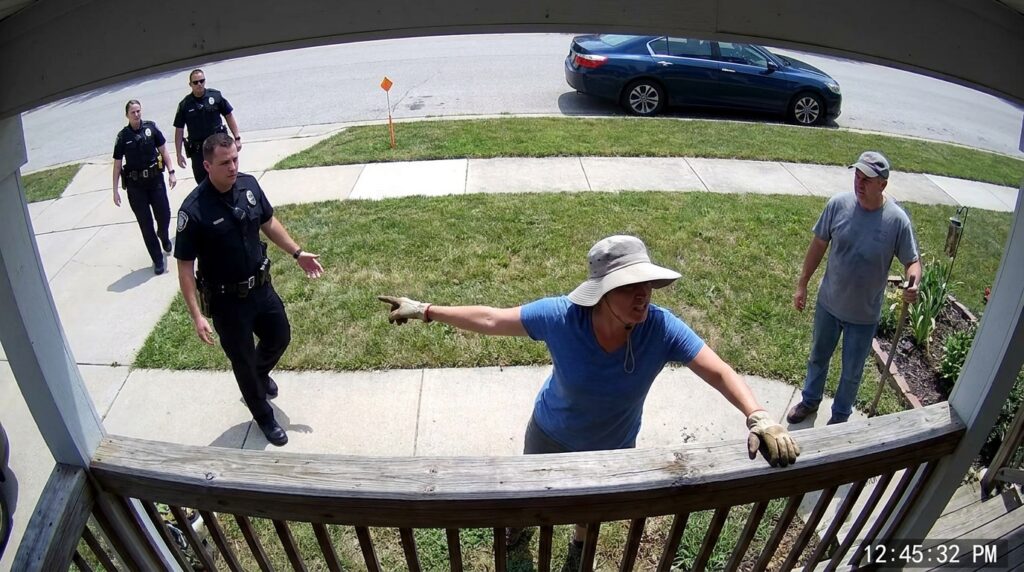
She turned away from the subcontractor, her heavy frame pivoting with a sudden, violent momentum that kicked a shower of loose gravel against the rear tire of her dark blue sedan. She covered the distance between the sidewalk and my front yard in three broad, heavy steps, her face completely flushed beneath the shadow of her wide-brim straw hat. Her sunglasses slid down the bridge of her nose, exposing her wide, calculated eyes as she stopped right at the bottom step of my porch.
“This is an old residential line,” she said, her voice rising into a sharp, raspy bark that echoed off the light vinyl house siding. She didn’t look down at the small orange lawn marker she was currently trampling into the fescue. She leaned forward, her weight shifting onto her front foot until her shadow swallowed the lower half of the steps. “It’s a grandfathered connection from the original farm boundary. It’s covered under the ninety-four easement map. You don’t get to stand up there on your clean little porch and call county inspectors to rewrite the history of this lot.”
She reached up and slammed her gloved palm hard against the top beam of the wooden porch railing.
The impact was a dull, heavy thud that rattled the old white paint scales from the wood, sending a small shower of plaster dust onto the dry grass below. She kept her palm flat against the railing, bracing her weight against the structure as her other hand lifted, her finger pointing straight toward my face. Her knuckles were dead white inside the leather.
“You don’t walk onto my place and judge how we keep this block together,” she spat, her breath hot and fast in the stagnant air. “We dug these beds. We built the standard. You think a three-inch plastic stake gives you the authority to tell me what’s under my own driveway?”
I stayed exactly where I was, my palms flat against the unyielding wood six inches away from her gloved fingers. The texture of the wood beneath my hands was rough, weathered by years of winter frost and blistering summer sun, but it didn’t give. In the strict economy of property disputes, volume is the first sign of a collapsing position. She was yelling because the physical boundaries were beginning to narrow around her.
“Arthur,” I said, my eyes tracking past her shoulder to the silent figure standing by the garden bed. “The ninety-four layout shows the driveway line, but it doesn’t show the three-foot municipal setback the city retained when they widened the cul-de-sac. The corporate line cuts right through the center of your perennial bed. That’s what the iron pin proved. That’s why the inspector is here.”
Arthur didn’t defend her. He let go of the long-handled shovel entirely, allowing the heavy ash handle to tip sideways until the iron spade fell with a dry clatter against the brick border of the bed. He stepped two feet backward, his boots leaving deep, clumpy impressions in the black loam that continued to ooze that dark, industrial grease. He looked at his wife’s back, then down at his own dirty work gloves, his mouth opening slightly but producing nothing more than a faint, dry wheeze.
“He doesn’t have the authority, Helen,” Arthur muttered quietly, his voice lacking any of the sharp resolve his wife was performing against the porch. He didn’t look up to see if she heard him. He just looked at the dark blue sedan, his shoulders dropping as if the weight of the heat had finally crushed the spine out of him.
The worker in the safety vest didn’t wait for them to finish. He turned back toward the idling orange truck and made a short, horizontal cutting motion across his throat. The driver killed the diesel engine. The sudden silence that followed was immense, heavy and sudden, leaving only the sound of a crow calling from the top of a distant utility pole and the dry, scraping sound of Helen’s boots as she tried to maintain her stance against my railing.
Then came the sound of a car door clicking open from the street lane behind the sedan—not the heavy clatter of a contractor’s truck, but the crisp, solid snap of a municipal vehicle door.