CHAPTER 5: THE CRUNCH OF THE GRAVEL
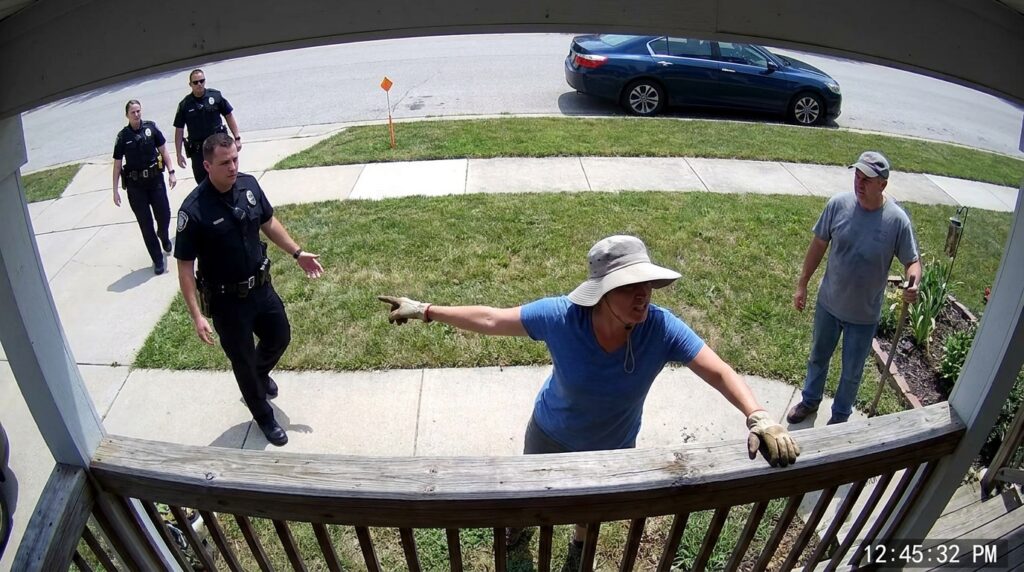
The crisp, solid snap of the municipal vehicle door was instantly followed by two more, the synchronous metallic thuds echoing down the windless asphalt of the cul-de-sac. It wasn’t the slow, heavy rattle of an arriving contractor. It was the distinct, clean weight of factory-sealed steel panels shutting under authority. Through the split pane of my porch railing, I watched three figures emerge from the lane adjacent to Helen’s dark blue sedan.
The lead officer didn’t rush. He moved with a measured, upright command posture, his black boots grinding with a dry, rhythmic crunch into the loose stones scattered along the curb. His dark, unmarked police uniform looked nearly blue-black under the blinding noon sun, the rigid leather of his duty belt creaking slightly with every step. Behind him, two backup officers split wide—a sharp, dark-haired female officer tracking the left yard line, and a stockier, older male officer with closely cropped gray hair moving into a supportive flanking position near the garden bed.
Helen didn’t lower her arm immediately. Her yellow leather glove remained clamped to my top rail, though her weight shifted backward off her front boot, her heels scraping across the dry fescue. The flaking white paint scales she had dislodged with her palm still drifted in the stagnant air between us, fine as ash.
“Is there a problem here, officer?” Helen asked, her voice hitching slightly as she tried to reconstruct the sharp, proprietary register she had used a moment prior. She didn’t remove her hand from the railing, bracing herself against the wood as if the physical structure could lend her status. “We are simply correcting an unpermitted property alteration. This resident has driven structural hazards into a grandfathered community drainage easement.”
The lead officer stopped exactly where the concrete sidewalk met my lawn, his alert eyes tracking from Helen’s flushed face down to her dirty work boots, which were still buried four inches deep inside my boundary line. He didn’t look at the torn 1994 layout she was clutching against her hip. His hands remained low, open, and clear of his holster, but his posture remained completely unyielding.
“Ma’am,” the lead officer said, his voice clipped, cool, and carrying the flat weight of an official directive. “Step back off the porch. Step onto the sidewalk where I can see your hands.”
The silence that followed was dense, broken only by the faint, rhythmic ticking of the cooling dump truck engine at the curb. Helen’s sunglasses slipped another fraction down her nose. For fifteen years, she had been the one who called the city; she had been the one who stood on the curb with folders, directing county inspectors toward other people’s violations. To have the uniform facing her, treating her silhouette as the active disruption, was a structural calculation she didn’t know how to complete.
“I am the lot owner at four-hundred-and-four,” she said, her voice rising an octave, the leather of her glove groaning as her grip tightened on the hot wood. “My husband Arthur is currently stabilizing our retaining wall footer. We have the legal description right here—”
“I didn’t ask about the lot description, ma’am,” the lead officer interrupted, taking one deliberate step forward into the pressure lane. His movement was fluid, but it placed his bulk directly between Helen and her dark blue sedan, cutting off her line of retreat. “Step behind the marker. Right now.”
Behind them, near the dug-up trench of the perennial bed, the stocky backup officer stopped beside Arthur. Arthur hadn’t moved since he dropped the shovel. His cap was pulled down so low his eyes were entirely in shadow, his gloved fingers twitching against his thighs. When the older officer glanced down into the trench, his brow furrowed beneath his short gray hair. The dark, saturated loam inside the hole was still oozing that thick, unctuous grease, the chemical smell of old machinery rising from the raw earth like a heat mirage. The older officer didn’t look at the boundary line; he looked at the texture of the soil, his boot heel testing the edge of the trench to see how deep the saturation went.
The utility contractor in the safety vest walked over to the female backup officer, holding out the brass probe that was still coated in the purple-black sludge. He pointed toward the concrete driveway line, then down toward the iron casing buried two feet below the perennial roots.
I kept my palms flat against the wood of my railing, watching the physical layout shift. The line wasn’t just an abstract legal concept anymore; it was being enforced by three distinct sets of uniform boots. Helen was losing the yard, inch by inch, her shadow shortening as the sun reached its absolute peak.
She slowly pulled her hand away from my railing, leaving five dark, greasy fingerprint shapes pressed into the flaking white paint. She took one step back, then another, her boots scuffing the concrete as she yielded the grass. Her shoulders went rigid beneath her blue shirt, her arms folding across her chest in a tight, defensive knot that looked more like an admission than a strategy.
The lead officer didn’t buy into her silence. He kept his palms out, his alert gaze locked on her face as he closed the remaining distance between them, his boots coming to a halt exactly beside the orange survey marker.