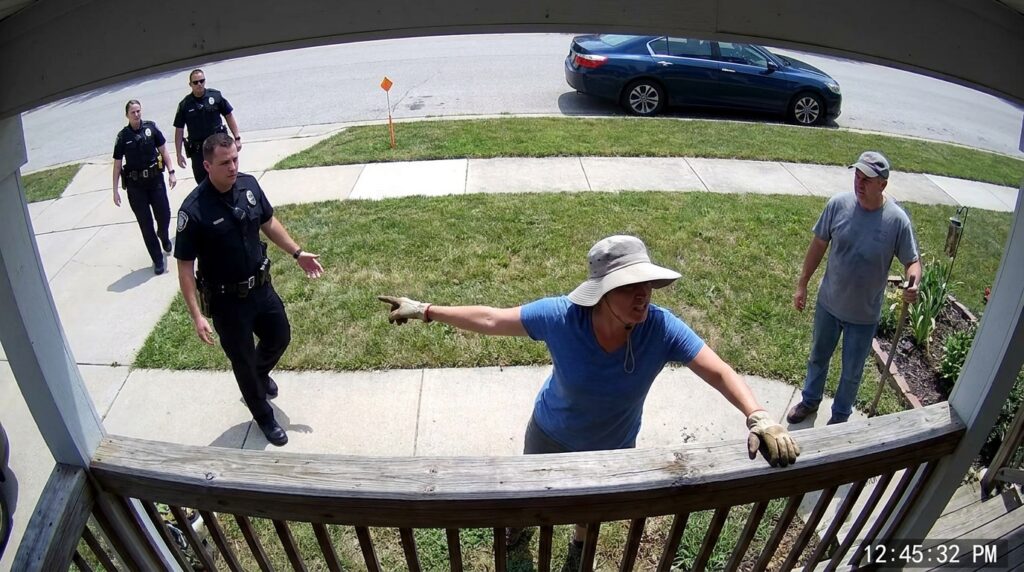
CHAPTER 2: THE GLARE AT THE LINE
The click of the security camera housing was a tiny, plastic snap against the silence, but it signaled a shift in the air. Helen didn’t hear it—her focus was entirely on the distance between her dirty work boots and the small orange lawn marker driven into the fescue—but I did. Her left boot came down squarely on the parched grass four inches past the surveyor’s iron stake. The dry fescue crunched under her weight, a dull, snapping sound that felt loud in the oppressive midday heat.
She held the crumpled 1994 home association layout aloft like a fading flag. The paper was worn soft at the creases, its margins covered in frantic, heavily smeared pencil notations that had long since turned into a gray haze. But as she extended it toward me, the blistering sun caught the top corner of the page, illuminating a thick, unctuous stain that had seeped through the fiber. It wasn’t water. It was a dark, dark gray smudge, viscous and heavy, throwing off a faint, chemical odor as the heat baked the paper. It smelled vaguely of old machinery, of ancient iron gears drowned in fuel, a scent completely out of place against the standard suburban fragrance of cut grass and dry dust.
“Look at the line,” Helen said, her voice dropping into a raspy, defensive register that scraped against the quiet of the cul-de-sac. She didn’t take her eyes off me, her sunglasses reflecting twin distorted versions of my front porch. She gestured with the document, her yellow leather glove tightening until the paper groaned. “Look at the original platting from ninety-four. The drainage easement gives the perimeter committee the right to dictate landscape continuity. You don’t get to drive stakes into a unified drainage strip.”
I remained stationary behind the wooden porch railing, my fingers curled lightly over the grain of the top beam. The wood was hot, nearly blistering, the old white paint flaking off in dry scales under my palms. I felt the physical friction of the environment—the heat radiating up from the concrete sidewalk, the heavy hum of an air conditioning compressor kicking on three houses down, the dead weight of the afternoon.
“The city surveyor didn’t use a ninety-four sketch, Helen,” I replied, my voice measured, stripped of any inflection that she could seize upon as emotional leverage. I kept my eyes on the leather of her gloves, tracking her knuckles. “He pulled the coordinates from the county registry. The iron pin is exactly where the deed says it belongs. You’re four inches over it right now.”
Behind her, Arthur shifted his weight against the long-handled shovel. The spade end of the tool was buried three inches into the loose, turned earth of their unauthorized garden bed. When he moved, the metal blade scraped against a hidden stone with a sharp, iron shriek that set my teeth on edge. He didn’t look at his wife, and he didn’t look at me. Instead, his gaze was fixed on the soil at his feet. The earth in that specific section of their perennial bed didn’t look like the bright, reddish-tan clay native to this part of the county. It was darker, almost black, clumpy and saturated despite the three-week drought that had cracked the rest of the neighborhood’s lawns. Every time he stirred the dirt with the shovel, that same faint, oily machinery smell drifted across the grass, heavier now, hanging low in the stagnant air.
Helen’s jaw tightened, the muscles along her neck going rigid. “The county registry doesn’t live on this street,” she snapped. She took another half-step forward, her right boot dragging a small clod of my parched soil across the invisible boundary line. “We built the standard here. We kept the values up when the original developer went under in ninety-eight. I am not going to let some newcomer use city technicalities to ruin the sightlines of this entire curb.”
She was calculating her options; I could see it in the way her weight shifted from her heels to the balls of her feet. She wanted me to come down off the porch. She wanted the confrontation on the grass, where the lack of a physical barrier would give her bulk and her volume tactical utility. In the structural logic of neighborhood disputes, the person who leaves their threshold surrenders their legal advantage. I stayed where the shadow of the eave met the heat.
“Arthur,” I said, redirecting my gaze past her shoulder to the silent figure by the garden bed. “The city code enforcement officer is already reviewing the permit layout for that retaining wall you’re digging. If that spade hits the main utility conduit because you’re working past the lot line, it won’t be an association issue anymore.”
Arthur froze. His hands, also covered in work gloves, tightened around the weathered ash handle of the shovel. He looked up then, his eyes squinting beneath the brim of his cap, his face pale despite the heat. He opened his mouth as if to speak, to offer some quiet, pragmatic compromise that would allow them to retreat across the sidewalk without losing face.
But Helen didn’t give him the space. She stepped directly into his line of sight, her wide-brim hat cutting off his view of the porch. “Arthur, keep digging,” she commanded, her voice rising, losing its calculated restraint. She turned back to me, her face flushed red beneath the shadow of her straw hat, her finger pointing straight at my chest. “You don’t get to threaten my husband on my property. You don’t walk onto my place and judge how we maintain this block.”
She was entirely across the line now, both boots planted firmly in my yard, her shadow stretching across the grass toward the steps of the porch. The heat between us felt like a physical wall, thick with the smell of parched fescue, dry clay, and that persistent, metallic tang rising from the crumpled paper in her hand.
I looked past her toward the far end of the cul-de-sac. A low, rhythmic rumble was growing louder, the unmistakable sound of a heavy diesel engine shifting gears as it turned the corner into Whispering Pines.