CHAPTER 6: THE INVIOLED SURVEY
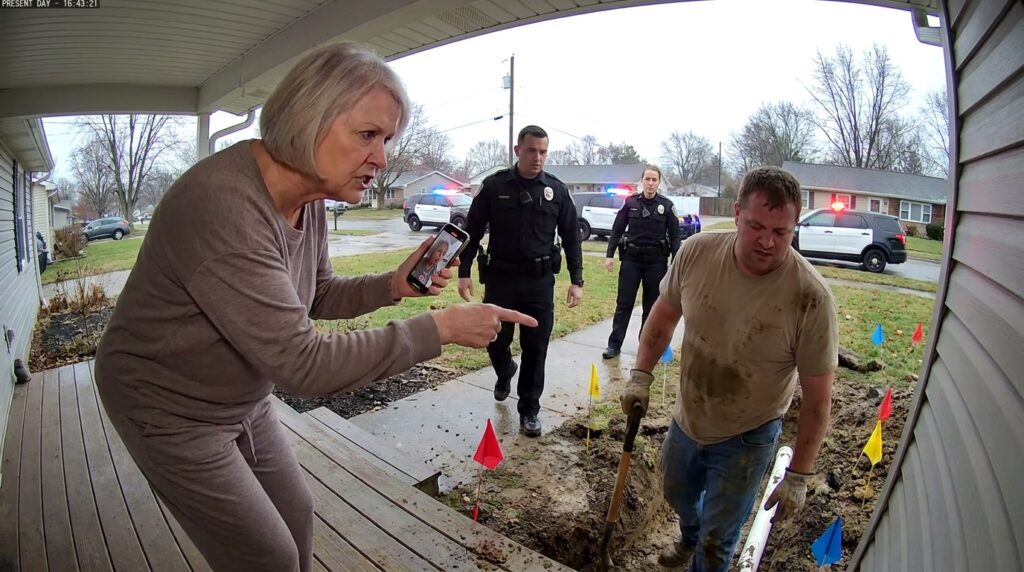
The screen of the tracking pad didn’t flicker, but the crisp blue lines of the 1995 county survey amendment laid a cold, unyielding grid over the messy dirt of the trench. The lead deputy’s thumb remained flat on the glass, pinning the historical deed data right beneath Mrs. Vance’s line of sight. The heavy engine vibration from the two idling police cruisers rattled the plastic edge of the tablet, a dull, rhythmic frequency that hummed through Miller’s boots and into the wet spade handle.
Mrs. Vance didn’t take a step back, but her arm dropped. The phone she had held up like a weapon for two hours swung down to her side, its screen going dark against the heavy taupe fabric of her lounge set. The morning sun was finally breaking over the roof eaves, cutting through the exhaust mist to hit her short gray-blonde hair, casting sharp, pale shadows across her face that made her jaw look like chiseled limestone.
“The 1995 registration was an administrative error,” she said, her voice dropping into a raspy whisper that lacked its previous legal momentum. “The syndicate was under no obligation to record the internal data grids with the county clerk. It was proprietary development infrastructure.”
“Proprietary doesn’t cover a direct splice into a federal highway line, ma’am,” the lead deputy said. He turned his torso squarely toward the porch, his hand leaving the tablet to point down at the trench floor where the younger officer was clearing the final layer of mud. “And it certainly doesn’t cover hiding a commercial trunk route under a residential deed to avoid state utility taxes for thirty years. Your late husband didn’t just write these plats—he drew them two feet short to keep the city trucks from looking at his server crawlspace.”
Miller didn’t drop his shovel. He leaned into the hickory shaft, watching the wet clay drip off the rusted iron head back into the pit. The white PVC water main was fully exposed now, a neat four-inch pipe that sat perfectly within the city’s legal margin. The split near the joint was weeping softly, the clear water rinsing a path through the dark loam to expose the deep iron benchmark pin that had stayed hidden since the subdivision was built. The hand-filed notch on the orange pin was an exact match for the fraudulent measurements recorded in the syndicate’s private ledger—a deliberate falsification of the earth designed to protect a multi-million dollar corporate bypass.
“The town isn’t going to absorb the cost of this repair, Mrs. Vance,” Miller said, his voice low, gravelly, and steady. “And my company isn’t pulling my permit. This leak gets fixed right now, and the water district is tagging this unmapped line for immediate federal seizure.”
The younger officer stood up from the crawlspace grate, her leather gloves slick with dark grease. She held a small yellow plastic tag she had snipped from the internal routing box inside the foundation vent. “It’s live, sir. The routing tags are registered to a shell asset held by an offshore trust under the name Vance Commercial Assets. The line has been drawing unmetered industrial bandwidth since ninety-six.”
Mrs. Vance didn’t look at the tag. She looked at the street where three neighbors had gathered near the curb, their faces pale and unreadable under the flashing blue lights of the interceptors. The total silence that had held the block all morning had turned brittle. The power structure that had governed the Oakridge Gate for a generation—the strict aesthetic rules, the weaponized code violations, the threat of legal ruin for anyone who crossed her lawn—collapsed into the wet loam of the utility ditch.
“This is an invasion of privacy,” she muttered, her white sneakers stepping backward onto the brick riser, her shoulders shrinking beneath the expensive fabric of her set. “The department has no jurisdiction inside the foundation line.”
“The trench is outside the line, ma’am,” the lead deputy replied, his voice flat as he unclipped a heavy aluminum citation folder from his utility belt. “And your house is sitting on top of an active felony obstruction charge. Back up onto the porch and keep your hands where my partner can see them while I write the civil injunction notice.”
Miller didn’t watch her retreat. He turned back to the white pipe, adjusted his heavy iron channel locks, and clamped them down over the split PVC sleeve. The metal teeth bit deep into the plastic, sealing the leak with a sharp, clean click that signaled the restoration of the street’s pressure line. The water stopped weeping. The dirt began to dry. He took a long, steady breath of the diesel-tinged air, drove his spade back into the stone base, and began the work of closing the hole.