CHAPTER 5: THE SEPARATION LANE
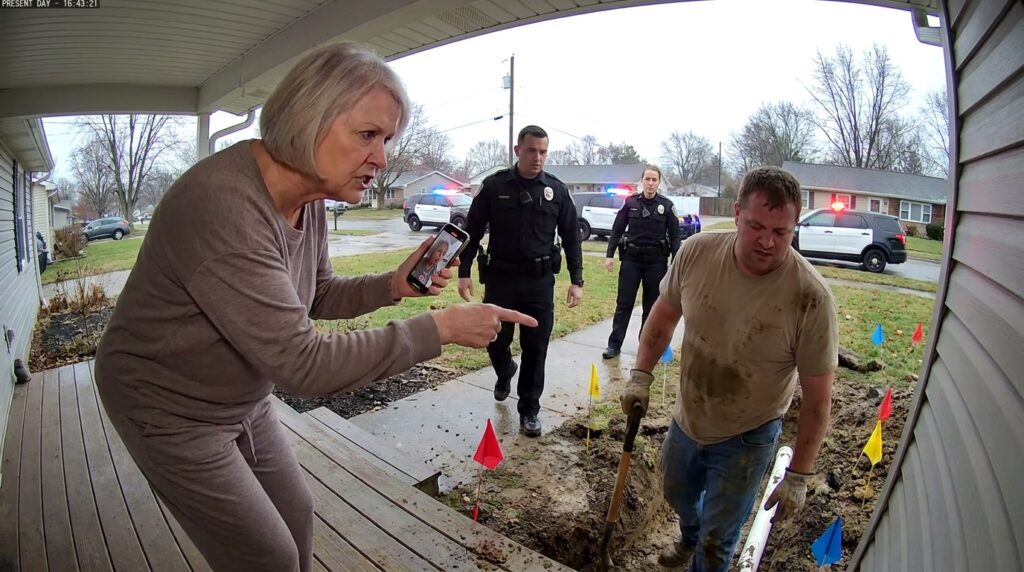
The lead deputy’s heavy black boot came down right on the line where the manicured sod had been cut, flattening one of Miller’s neon-pink plastic flags into the gray limestone dust. He did not touch his holster, but his broad shoulders squared, creating a physical barrier between the concrete walkway where Mrs. Vance stood and the muddy trench where Miller was holding his spade. The wet red and blue strobe lights from the interceptors flashed rhythmically across the officer’s face, turning his skin an oily purple under the morning mist.
“Nobody’s arresting anyone yet, ma’am,” the deputy said, his voice carrying the dry, hollow drone of an enforcement officer who had spent decades watching property owners treat county margins like personal kingdoms. “But nobody’s moving any more dirt until we see where the real iron is.”
Miller didn’t drop his shovel. He let the rusted steel blade settle into the muck at the bottom of the pit, his wet leather gloves sticking slightly to the ash handle. “The real iron is forty inches out from her foundation riser, Deputy. There’s an old surveyor pin buried right under that split root if your partner shines her light down here.”
The younger officer didn’t wait for the instruction. Her flashlight beam sliced through the diesel exhaust lingering over the yard, illuminating the dark, narrow crevice beneath the main white PVC water line. The bright circle of light reflecting off the wet clay revealed a small, square column of rusted iron—a benchmark stake driven deep into the glacial till during the initial county survey. It was painted with a faded coat of high-visibility orange zinc, but a secondary, hand-filed notch had been cut directly into the metal face, two inches lower than the official county mark.
“I have already informed you that the survey pins were updated during the ninety-two phase,” Mrs. Vance said. She didn’t lower her phone. Her slim fingers remained clamped to the plastic chassis, her manicured nails bloodless from the cold air. “My husband’s firm handled the absolute title clearance for this entire parcel. If that deputy is suggesting our foundation encroaches on the municipal lane, he’s misreading the plat.”
“I’m not reading the plat yet, ma’am,” the lead deputy said, turning his head slightly toward her but keeping his body locked in the separation lane. “I’m looking at the tracking pad on Mr. Miller’s tool roll. The district water board has this entire block flagged for a structural emergency. If he doesn’t secure that split coupling, the pressure drop is going to compromise the primary fire main down the road. That’s a state-level infrastructure hazard.”
“The water board does not hold a superior title to a deeded residential improvement,” she replied, her voice sharpening for the first time, losing its smooth, deposition-like cadence. Her white sneakers shifted on the brick riser, stepping closer to the mud line. “This is an illegal, retaliatory audit. You are allowing an uncertified laborer to vandalize private commercial assets under the guise of an emergency.”
The younger officer reached down, her gloved fingers scraping away a handful of loose, gravelly clay from the side of the unmapped copper data line. Through the split canvas insulation, the thick copper shielding was sweating under the heat of the transmission.
“Deputy,” she called out, her flashlight beam tracking the line past the iron benchmark toward the foundation vent. “This line isn’t running to the regional utility loop. It bypasses the street terminal completely. It’s tied directly into the high-voltage commercial trunk that runs under the state highway.”
Miller watched Mrs. Vance’s face in the strobe light. The calculation in her eyes didn’t stop; it shifted. Her phone hand didn’t drop a millimeter, but her shoulders went rigid against the taupe fabric of her lounge set. She wasn’t looking at Miller anymore; she was tracking the younger officer’s movements along the basement riser.
“The infrastructure was laid by the development syndicate,” Mrs. Vance said, her words dropping into a cold, deliberate cadence that sounded less like an accusation and more like a warning. “Any modification of that network without a federal utility warrant is an administrative violation. If you touch that line, Deputy, you are exposing the county to a civil damages suit that your precinct budget cannot absorb.”
The lead deputy didn’t flinch. He reached down and picked up the rugged tracking tablet from Miller’s tool roll, his thumb scrolling through the digital deed registry maps provided by the municipal water board. The screen cast a pale blue glow over his face, competing with the red strobe flashes from the street.
“The water board didn’t draw this map, Mrs. Vance,” the deputy muttered, his eyes locked on the digital lines. “The county registrar did. And according to the ninety-five amendment, your husband’s firm didn’t retain the subterranean rights. They leased them back to a shell company that dissolved during the mortgage collapse.”
He looked up from the screen, his gaze moving from the rusted iron pin in the mud straight to the black dome of her doorbell camera under the roof eave.
“And that shell company didn’t have a permit to lay commercial fiber inside a residential utility easement,” the deputy added. “We’ve got an active infrastructure theft here, and your house is the terminal.”
Miller felt the ground beneath his boots shift—not from the leaking main, but from the sudden, total collapse of the homeowner’s legal leverage. He leaned his weight against the shovel, waiting for the deputy to make the final call at the boundary line.