CHAPTER 3: THE EXPOSED MAIN
The canvas fibers did not pull away easily from the clay. They had spent decades bonding with the wet iron sediment in the soil, turning into a tough, synthetic skin that required the short serrated edge of Miller’s pocket utility knife to split. He worked with small, deliberate strokes, the stainless-steel blade grating against the armored copper shield beneath the insulation. Every scrape sent a distinct vibration straight up his thumb—a dull, metallic rasp that confirmed the structural integrity of the illicit wire.
He did not look back up at the porch where Mrs. Vance stood with her thumb resting on her phone’s screen. Instead, he forced his attention down into the narrower shelf of the pit, scraping out three more pounds of damp, compacted earth from the side of the municipal water line. The white PVC main was there, six inches beneath the stolen data run, its surface dull and slick with a fine film of escaping water. The leak wasn’t a sudden burst; it was an old, weeping split near the coupling, the steady pressure carving a tiny, smooth cave into the surrounding limestone bed.
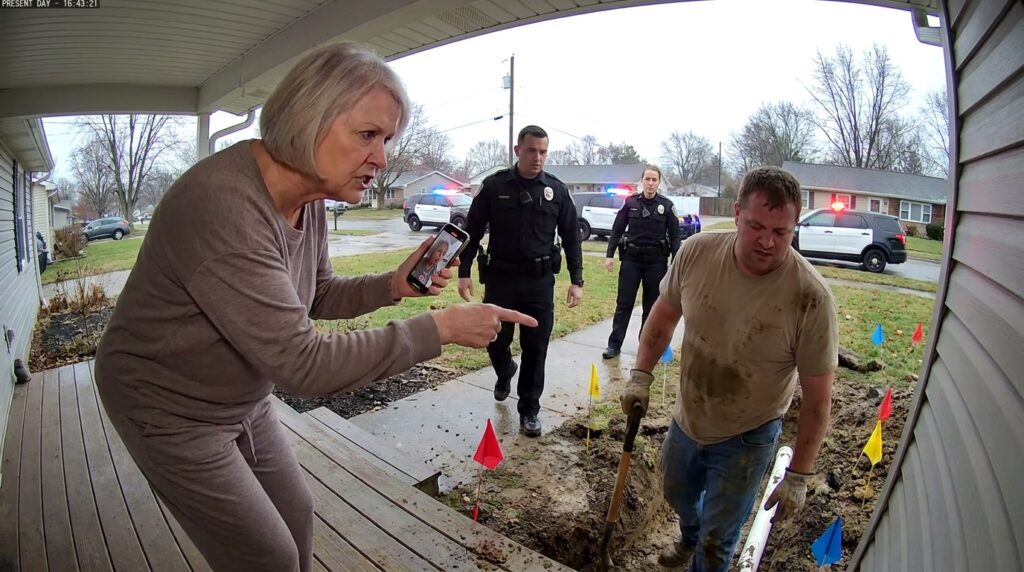
“The water isn’t coming from the street, ma’am,” Miller said, his voice flat as he shoved the spade back into the gray limestone dust at his heels. “It’s pooling right underneath your porch pillars because this secondary run is pinned over the city line. It’s forcing the coupling down. The weight is splitting the joint.”
“Your technical assessments are irrelevant, Mr. Miller,” she said. The voice remained high, thin, and static, coming down from the top step with the same bureaucratic weight as her initial warning. “The county zoning map dictates that any physical excavation within twelve feet of my property foundation requires a civil engineer’s signature. You are an hourly field technician. You do not possess the statutory authority to evaluate structural stress on private improvements.”
Miller wiped his palms against the rough denim of his jeans, the fabric stiff with gray clay. He reached into the leather tool roll sitting on the dry section of the concrete walkway and pulled out a heavy pair of iron-jawed channel locks. The tool was rusted along the hinge, the pitting deep enough to hold the dark grease he used to keep the pins from seizing. He didn’t want to cut the data line yet. In the city registry, an undocumented utility line was technically classified as abandoned material unless someone stepped forward with an active commercial lease number.
And Vance & Co. Infrastructure Ltd. had been liquidated twelve years ago, according to the bankruptcy listings he had scanned during the previous winter’s corridor overhaul.
“I have an emergency repair ticket from the district water board,” Miller muttered, adjusting the iron teeth of the pliers until they locked around the lower sleeve of the leaking coupling. “That overrides the local signature rule when the loss exceeds fifty gallons a day. If I don’t set this collar now, the whole walkway is going to crack by sunset. I’m saving your concrete, ma’am.”
“You’re destroying an asset,” she corrected sharply. For the first time, her white sneakers took a single step down the brick riser. The phone came up again, the camera angle shifting down to capture the precise location of his iron pliers against the city main. “The wire you are pulling at has a registered corporate easement attached to the original ninety-two plat. My husband didn’t just write the deeds—he secured the infrastructure corridors for the entire subdivision. The city cannot retroactively absorb a private commercial trunk line just because your map is missing a page.”
Miller paused, his forearms locked against the resistance of the rusted pliers. He looked at the way the canvas-wrapped line ran straight through the foundation vent, its black sleeve vanishing cleanly behind a custom-cut iron grate. It wasn’t an old utility stub left behind by a construction crew. It was a live tap, the faint, high-frequency hum of high-voltage data transmission vibrating through the spade head whenever he rested his boot against the steel edge.
He took his left hand off the pliers and pulled a pocket multimeter from his tool belt, pressing the two copper leads through the torn canvas skin of the Vance line. The digital screen blinked twice, then settled on a steady, high-frequency signal that didn’t match any municipal telemetry standard. It was private data—massive, unmetered, and pulled straight out of the county’s commercial backbone line down the state highway.
He understood the angle now. The property line dispute wasn’t about the grass or the color of the dirt. It was about the forty inches of hidden dirt that kept the city from looking under her porch floorboards.
“This isn’t an asset, Mrs. Vance,” Miller said, his voice dropping into the quiet, hard tone of an operator who had just found the real boundary marker. “This is a bypass lane. And your husband forgot to pay the state tax on the trench.”
The woman did not retreat. Her mouth set into a thin, colorless line, and her thumb finally pressed the glass surface of her screen, her voice rising slightly as she spoke into the active speaker. “This is Unit forty-two at the Oakridge Gate. I have an aggressive, un-certified laborer actively destroying buried private property and refusing to clear the residential setback. Send a deputy down immediately.”