CHAPTER 2: THE PLAT MAP DISCREPANCY
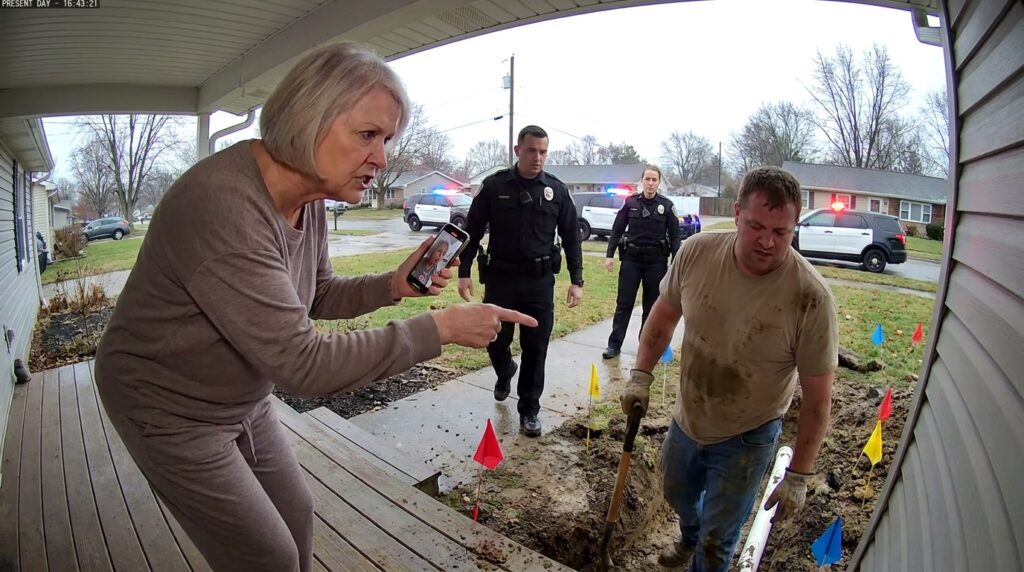
Miller did not take his hands off the iron grip of the shovel. If he lifted the spade now, he ceded the physical territory he had spent forty-five minutes clearing through the limestone crust. He let his weight settle into the boot heel, pressing the blade deeper into the dark, liver-colored loam until he felt the dull, scraping shudder of iron grinding against the frayed canvas insulation of that unmapped cable.
“The county clerk has the ninety-two plat, ma’am,” Miller said, his tone dry, flat, and entirely unbothered by the lens pointed at his chest. “But the city utility registry has the ninety-five amendment for the regional water loop. That gives us forty-eight inches from the curb face. If I stop digging, the pressure drop down the block snaps the fire line by noon.”
The woman—Mrs. Vance, according to the small bronze plaque screwed into the oak pillar of her porch—did not shift the phone. Her fingers were steady, the pale skin over her knuckles tight and bloodless. The taupe fabric of her lounge set didn’t ruffle in the slight, dusty breeze coming off the asphalt. She was looking at the small, ragged lip of dirt he had piled onto her manicured sod.
“The ninety-five amendment was struck down in the third circuit during the development’s secondary phase,” she said. Her lips barely moved, the words dropping like small, hard gravel. “My husband was the lead counsel for the Oakridge Syndicate. We retained the subterranean rights to every linear foot from the curb to the foundation. You are destroying private improvements, Mr. Miller. Every shovel of earth you turn is a separate misdemeanor count.”
Miller looked down into the trench. The rusted iron head of his spade was wedged between a thick taproot of an old cedar and the strange, canvas-wrapped sleeve. The insulation was rotten, the weave splitting apart under the damp pressure of the loam to reveal a glimpse of thick, armored copper underneath. It wasn’t water. It wasn’t residential electric. It was heavy-gauge commercial data infrastructure, buried deep, entirely missing from his utility breakdown sheet, and running straight toward the crawlspace vent beneath her porch.
He felt the small, sharp prickle of an anomaly. In his line of work, an unmapped line was either a death sentence or a lie. If he hit it with a pick, the arc could blind him; if it was dead, it meant someone had put it there without paying the county its pound of flesh.
“Your husband might have written the deeds, ma’am,” Miller said, his voice dropping into the quiet rhythm of an operator who knew the limits of his machinery. “But he didn’t lay the pipe. This main is leaking three gallons a minute into your foundation wall. If I don’t clear the shoulder of this valve now, the clay under your walkway is going to turn to soup before the mail truck gets here.”
“Then let it sink,” she replied. She finally lowered the phone, but her thumb remained locked on the glass screen, the red recording indicator still pulsing a faint, regular heartbeat against her palm. “I have an injunction template already drafted for municipal overreach. It takes five minutes to file the emergency stay. If that shovel touches the white PVC line again, I’m calling the county precinct.”
Miller took his boot off the shoulder of the spade. He reached down slowly, his thick leather work gloves scraping against the side of the trench, and cleared a handful of loose, crumbly limestone dust away from the frayed canvas wire. The insulation wasn’t just old—it was branded. Through the gray mold and grease, he could see the rusted imprint of a corporate logo: Vance & Co. Infrastructure Ltd.
The name matched the bronze plate on her porch.
He didn’t look up to see if she was watching his hands, but he knew she was. The silence from the porch had changed; it had lost its aggressive, bureaucratic momentum and turned into something heavy, watchful, and still. The blue ledger light on her doorbell camera kept up its mechanical blink, recording a man in a mud-stained t-shirt staring at a hidden corporate signature buried four feet inside a public right-of-way.
“You knew this was down here,” Miller muttered, his fingers tracing the rusted canvas where the copper wire disappeared under her concrete walkway.
“I know what belongs to me,” she said from the top step. Her white sneakers didn’t move, but her posture had shifted, her shoulders squaring against the light as she raised the phone once more, her thumb hovering over the speed-dial lane for the local sheriff’s dispatch. “And I know exactly what it costs to remove someone who doesn’t understand where their permit ends.”