CHAPTER 4: THE WEAPONIZED CALL
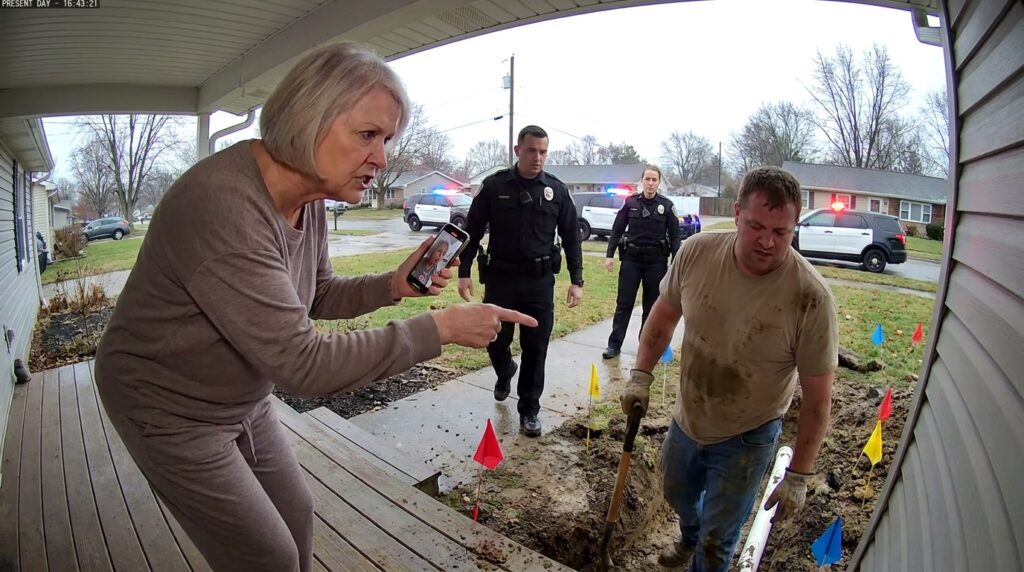
The low, hydraulic growl of a diesel engine rolled down the block before the first strobe flash caught the underside of the cedar branches. It wasn’t the single cruiser Mrs. Vance had asked for; it was two standard county sheriff interceptors, their tires crunching over the loose gravel at the edge of the asphalt line as they pulled up abreast of Miller’s utility van. The red and blue lights didn’t look heroic in the early mist—they looked greasy, reflecting off the damp concrete walkway and casting long, rhythmic bars of violet light across the dug-up trench.
Miller didn’t take his work gloves off. He remained standing in the two-foot deep cut, his boots embedded in the heavy loam, one hand still resting on the rough ash handle of his trenching spade.
Mrs. Vance didn’t retreat to her screen door. She held her ground on the lower riser of her brick porch, her phone pinned between her thumb and palm like an iron sight, her eyes tracking the lead deputy as he cleared the driver-side door. The taupe lounge set she wore caught the quick strobe pulses, changing from soft gray to sharp blue with every cycle of the light bar.
“He’s in the cut,” she said before the deputy could reach the property line. Her voice didn’t rise to meet the rumble of the idling engines; she maintained that flat, statutory level, directing the authority toward the trench like a finger pointing out a code violation. “He was instructed three separate times to stand down until an engineer verified the easement boundary. He has intentionally severed a private data trunk line and is actively undermining the walkway support.”
The first officer—a broad-shouldered man with a salt-and-pepper buzz cut and a black uniform that smelled faintly of vehicle grease and stale coffee—didn’t look at the dirt first. He looked at Miller’s hands, then down at the iron-jawed pliers resting near the exposed white PVC main. His badge number, stitched in gray thread over his pocket, caught the light as he stepped into the gap between the concrete path and the trench wall.
“Step out of the hole, sir,” the officer said. The command wasn’t aggressive, but it carried the dead weight of an operator who had spent twenty years handling civil boundary disputes in subdivisions where everyone owned a lawyer.
Miller didn’t move his feet. He felt the cold mud sucking at the rubber soles of his work boots, the weight of the earth keeping him pinned to the utility lane. “I’m within the forty-eight-inch municipal margin, Deputy. I’ve got a live split on a three-inch main line water feed. If I drop this pressure collar to climb out, the back-flow goes straight under her sub-floor.”
“I don’t care about the water pressure, Deputy,” Mrs. Vance interrupted, her sneakers stepping off the brick completely, landing on the very edge of the grass line where Miller had planted his pink plastic flags. “The county code is explicit under Section twelve. Unauthorized interference with a registered utility corridor by a third-party contractor constitutes criminal mischief in the second degree. I want him cited and the equipment impounded.”
The second officer—a younger woman with her hair pulled into a tight bun—moved along the rear edge of the property line, her eyes scanning the dark crawlspace vent where the canvas-wrapped line ran beneath the porch floorboards. She didn’t speak, but her flashlight beam cut through the mist, tracking the black wire down into the loam where Miller’s spade had split the synthetic insulation.
Miller felt the tactical trap closing. It was the same mechanism the Oakridge Syndicate had used since the first foundation was poured—using the local department like a private security force by citing conflicting ordinances faster than a field worker could read a registry sheet. If he yielded the trench now, his company would pull his certification before noon to avoid a county lawsuit.
“Check the tracking pad, Deputy,” Miller said, nodding toward the small, rugged tablet clamped to the side of his tool roll on the concrete. “The district water board pushed an automatic override at five-thirty. This isn’t a standard service call. It’s an active infrastructure failure. The line running over the top of the water main doesn’t have a county tag because it shouldn’t be here.”
The lead deputy paused, his boots catching on the edge of a split survey stake Miller had uncovered an hour ago. He didn’t look at the tablet. He looked at Mrs. Vance, then down at the branded canvas insulation that Miller had cleared with his knife. The corporate logo—Vance & Co.—was fully visible now under the strobe lights, the rusted iron sediment making the letters look like they had been burned into the fabric.
“Mrs. Vance,” the deputy said, his voice dropping an octave, losing its formal edge. “Is this line connected to the old commercial relay on the bypass road?”
“The legal status of that line is protected by a non-disclosure rider in the original development contract,” she replied. She didn’t lower her phone, but her index finger twitched twice against the glass case. “The sheriff’s department does not possess the administrative authority to audit private infrastructure. Your instructions are to remove the trespasser.”
The younger officer stopped her flashlight beam right on the iron grate covering the foundation vent. A tiny, oily film of condensation was forming around the rim of the opening—not from the water main, but from the heat generated by an industrial-scale server bank running inside the dark crawlspace.
“We have a problem with the map, sir,” the younger officer called out from the rear lane, her hand resting near her utility belt as she looked back at the lead deputy. “The physical markers don’t match the county dispatch layout.”