
CHAPTER 5: EXCAVATING THE IRON
“Get away from those roots! Don’t you dare touch that soil!”
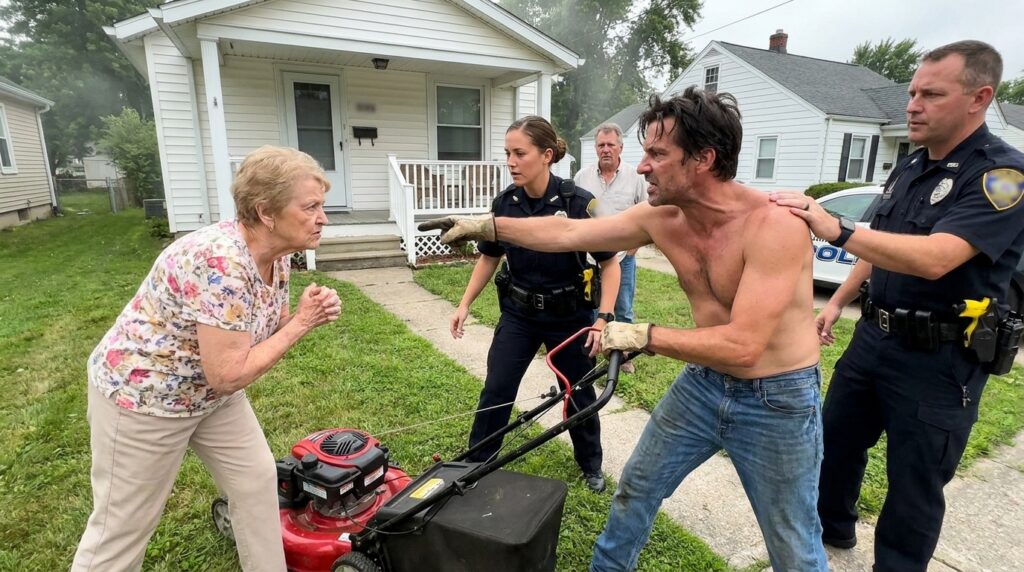
Her scream was different now. The thin, paper-dry sharpness had warped into an erratic panic as Mr. Miller dropped to his knees in the dry fescue. He didn’t look at her. His thin fingers, black with engine grease from his shift, tore at the matted weeds around the base of the irregular pine post. He jammed a short steel trowel into the red clay, the blade striking something solid with a dull, hollow thud that didn’t sound like rock.
The primary officer stepped closer, his heavy leather utility belt creaking under the strain of his movement. He held the yellowed 1984 easement sketch open in one palm, his eyes tracking the handwritten hatch marks from the paper down to the hole Miller was clearing. The black nylon sleeve of his uniform was stained with red dust, his stocky frame casting a wide shadow over the excavation lane.
“Hold on, sir,” the officer ordered, his voice flat but turning sharp as a dark, thick moisture began to well up from the puncture mark in the dirt. “Let’s verify the marker before you dig any deeper.”
“The marker is right here,” Miller muttered. His voice was raw, his face flushed a deep, dangerous crimson under the noon glare. He wrenched a thick hydrangea root aside, his knuckles scraping against the rough bark. “The county blueprint says the easement lane was modified for a stormwater overflow. But look at this. This isn’t stormwater.”
A heavy, low gurgle vibrated through the ground beneath my work boots—the same deep thrumming I had felt under the yellow mower deck, but louder now, un-muffled by the soil. The black mud at the bottom of the shallow trench began to bubble, a thick, dark fluid oozing out around the fractured edge of an un-stamped plastic pipe. The stench hit us a second later: a foul, sulfurous wave of untreated septic waste, heavy and suffocating, instantly killing the clean scent of chopped fescue and dry pine resin.
The neighbor froze. Her hands, still clamped onto the top rail of the weathered fence, began to tremble so violently that the old pine panels rattled against their rusted nails. The pink cotton of her floral blouse looked stark and absurd against the black mud pooling at her feet. She tried to step back into her gravel driveway, but her rubber sole slipped on the slick moss encroaching from the boundary, her hip checking hard against the wooden rail.
“It’s an old line,” she whispered, her face draining of color until her skin looked as gray as the rotted cedar posts. Her eyes darted from the primary officer to the secondary officer, who was already pulling his radio from his shoulder strap. “The developer laid it. It was part of the eighty-four variance. We have the right to drain the runoff.”
“This isn’t runoff, ma’am,” I said, taking a step toward the fence. I pointed my work boot at the broken pipe. The fluid wasn’t clear; it was thick, grey-black, and it was pumping directly from the direction of her foundation, crossing underneath the weathered fence line by exactly thirty inches before draining into Miller’s yard. “Your husband didn’t set this fence to mark a boundary. He set it to hide the bypass. He buried his sewer line three feet into this lot because the county wouldn’t let him build over his own septic field.”
The primary officer looked down at the hand-drawn sketch, his thumb rubbing the fading blue ink along the margin. The “temporary bypass allowance” wasn’t a county-sanctioned utility easement at all. It was a private, un-recorded deal scribbled on the back of an old plot map, a thirty-year-old deception designed to keep the health department from condemning her property. The false framework she had used to bully the block for decades had just collapsed into the mud.
“Call code enforcement and the health department out here,” the primary officer directed over his shoulder, his voice dropping into a cold, transactional register. The secondary officer nodded, his radio spitting a static-heavy confirmation into the hot valley air. The officer turned his full bulk back toward the neighbor, his black uniform cutting off her path to the house. “Ma’am, you need to step away from the fence and stay on your driveway. This is an active code violation site now.”
She didn’t move. Her mouth opened, but no sound came out—no more accusations, no more county maps, no more threats of the marshal. The performance was over, the script had run out, and the unyielding iron truth was finally rising through the turf.








