CHAPTER 2: PAPER BORDERS
“You look at this screen, boy. You look at it right now and tell me you have the right to pull that starter cord again.”
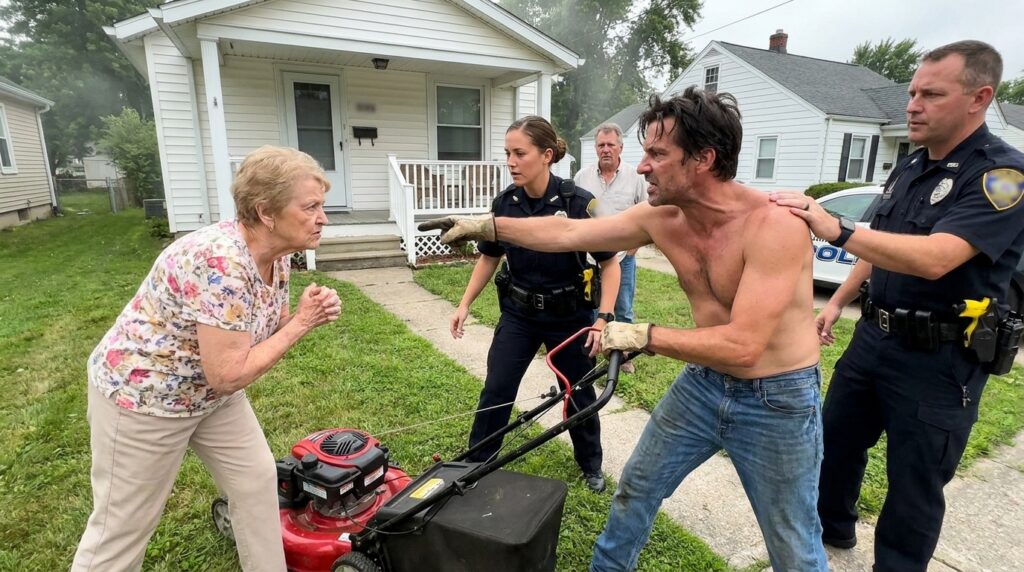
The glare from her smartphone was a blinding, blue-white square in the thick noon heat. She thrust the device forward, her wrist shaking slightly, the silver bracelets around her arm clicking like dry cicadas. On the glass, a standard satellite navigation app showed a pixelated green patch bisected by a bright red, computer-generated line. According to the satellite’s rough rendering, the yellow mower deck was sitting dead center inside a zone marked as her private parcel. The digital boundary looked clean, sharp, and absolute.
I didn’t reach for the phone. I kept my fingers wrapped around the coarse, pitted rubber of the mower handle, feeling the grit of dry topsoil beneath my skin. I looked past the glowing screen to the fence post directly behind her shoulder. The wood there was different. The other posts were spaced exactly eight feet apart, weathered uniformly by thirty years of valley rain, but this particular upright was rough-hewn, set closer to the hedge, its base choked by a dense, unpruned cluster of blue hydrangeas. The iron hardware holding the rail to the timber was flaky with bright orange rust, the scale peeling away in brittle layers that dropped into the dirt.
“That app’s running on a consumer-grade GPS grid, ma’am,” I said, my voice dropping into the low, monotonous rhythm of someone who spent his weeks reading land records instead of arguing with neighbors. “It has a margin of error up to fifteen feet near residential canopy. It’s not a legal plat.”
“It’s the county map,” she snapped, her thumb jabbing the glass so hard the screen went white under her pressure. “The homeowners association uses it. The tax office uses it. My husband verified it before he passed. You think your little piece of sweaty paper overrides the county grid?”
I flattened the work order against the steel shroud of the engine block. The heat from the cooling fins was already baking the ink on the page, the smell of warm oil rising between us like an invisible wall. “Mr. Miller’s deed isn’t based on a satellite ping. It’s tied to the benchmark at the intersection of Old Creek Road. I spent three hours in the assessor’s basement on Tuesday before I loaded the trucks.”
Her expression didn’t soften, but her arm dropped an inch, the phone screen tilting away from my face. For a split second, her eyes flicked toward the base of the hydrangeas—not at the grass I was supposed to cut, but at the dark, sunken depression where the earth dipped slightly beneath the root balls. There was a faint, sour odor rising from that patch of soil, something heavier than rotting mulch, a dampness that didn’t belong in a three-week drought.
“You’re a contractor,” she said, her voice dropping from a shriek into a tight, defensive hiss. Her fingers tightened around the top rail of the pine fence, the gray splinters digging into her palms. “You don’t care about the integrity of the block. You just want to clear your square footage and cash Miller’s check. If you touch those roots with that steel blade, you’re destroying forty years of cultivation.”
“I’m not touching the shrubs,” I said, my boots shifting on the dry turf. The ground felt hard beneath my soles, but when I pressed my heel down near the fence line, the earth gave way with an unnatural, spongy elasticity. It was a minor discrepancy, a small pocket of moisture beneath a sun-baked crust, but it ran parallel to the irregular fence line. “But the fire lane easement requires three feet of clear clearance from the structure of the wood. If the city inspector drives through that alley on Friday and sees these weeds choking the bottom rail, Mr. Miller gets the five-hundred-dollar citation. Not you.”
She leaned in closer, the pink floral cotton of her blouse catching on a jagged splinter along the top rail. She didn’t seem to notice the fabric tear. Her eyes were fixed on my tool belt, specifically on the brass-bound folding rule tucked into the side pocket.
“The fence is the border,” she whispered, her voice tightening with an intensity that had nothing to do with municipal ordinances. “The wood has been here since before you were born, boy. The community accepts the wood. You don’t get to come in here with a piece of paper and re-draw the world just because it makes your morning faster.”
I reached down, my fingers brushing the cool, heavy iron of the mower’s height-adjustment lever. The metal was burning from the sun, the spring-loaded notch snapping into place with a sharp, heavy clank that echoed off her concrete driveway.
“The wood is thirty inches out of alignment with the iron in the ground, ma’am,” I said, pointing directly at the rusted tip of the surveyor’s pipe buried in the fescue. “We can measure it by the link chain right now, or we can wait for the state line to verify it. But I have three more yards to drop before the sun hits the ridge, and this grass is getting cut.”
Her face went pale, the artificial ridge of her hair silhouetted sharply against the clear, white sky. She didn’t look at the rusted pipe I was pointing to; instead, her hand went into her dark pocket, her fingers closing around the phone once more with a slow, deliberate finality.
“I gave you your warning,” she said.