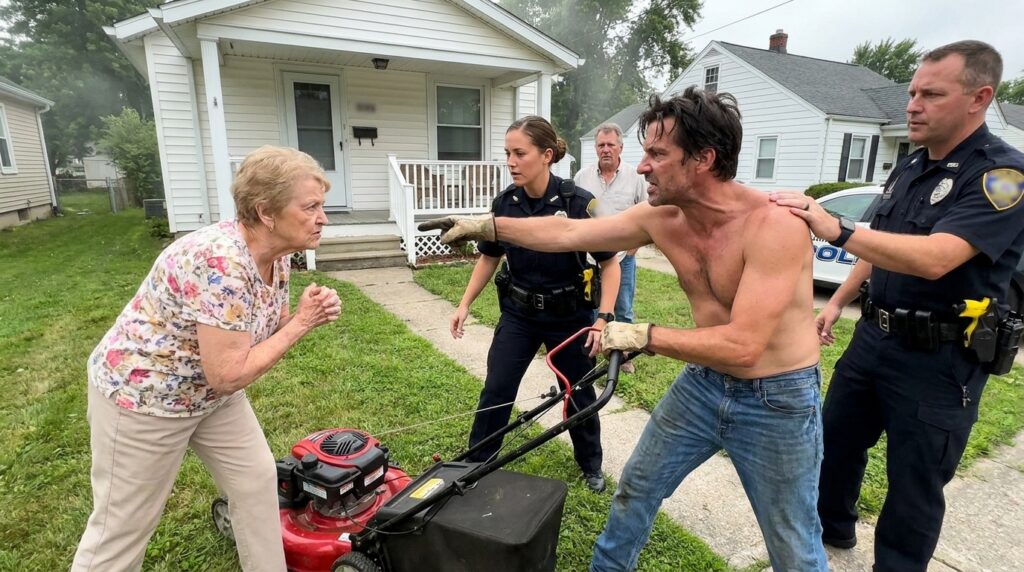
CHAPTER 3: THE CALL TO THE LINE
“Dispatch, I have an uncooperative subject actively destroying private landscape structures at forty-two-twelve Meadow Lane. He is aggressive, he is ignoring the boundary limits, and he is threatening my safety.”
She didn’t lower the phone. Her voice had changed—no longer the high, frantic screech she had leveled at me over the pine rail, but a measured, rhythmic reporting that sounded practiced, almost bureaucratic. She held the black plastic casing inches from her mouth, her knuckles white, her silver bracelets frozen against the graying grain of the wood. Her gaze remained pinned to my hands, watching for any sudden movement toward the mower handle, tracking the heavy brass buckles of my tool belt as if they were tactical hardware.
I stayed still. The midday sun hit the back of my neck like an iron bar, baking the dust into the sweat under my collar. I didn’t reach for my keys, and I didn’t pull the starter cord. In the three-foot gap between the yellow machine deck and the hydrangeas, the ground had begun to sweat too. The sour, heavy odor of stale water had grown sharper since the engine died, pooling in the low depression where the grass felt like wet foam under my work boots.
“The subject is refusing to clear the workspace,” she continued into the receiver, her eyes narrowing as I took a slow, deliberate step to the right, adjusting my weight on the hard-packed clay. “He has an altered document. Send a unit out before he cuts through the main utility line.”
The line went dead with a soft, mechanical click. She slid the phone back into the pocket of her dark pants, her palm lingering on the fabric as if to ensure the weapon of the state remained within reach. The pink cotton of her blouse rustled with her breathing, the small tear along the splintered top rail pulling wider, revealing a pale, trembling patch of skin near her collarbone.
“You should have loaded that trailer when I told you to,” she said. Her tone was lower now, steady with the cold confidence of someone who had spent decades using the city’s resources to carve out her own small sovereignty on this block. “The county doesn’t tolerate code violations from day laborers. They’ll impound that machine before the afternoon is out.”
“I’m not a day laborer, ma’am,” I said, my voice flat, matching the unyielding weight of the dry air. I reached down, slowly lifting the brass folding rule from my side pocket. I didn’t expand the sections; I just held the heavy metal block across my palm, letting her see the stamped industrial grading along its edge. “And the only utility line within six feet of this fence is the old clay main from the fifties. It’s supposed to run six feet under the gravel alley, not beneath these shrubs.”
Her fingers twitched against the wood. Her eyes flicked down to the base of the irregular post once more, her boots shifting back an inch into her own gravel driveway. A low, dull vibration seemed to hum through the soil beneath the mower—not the high-frequency rattle of an engine, but a deep, hollow thrumming that caused the grey water in the sunken patch to ripple slightly against the red clay roots. It was an old sound, the kind that came from fluid moving through a collapsed pipe under pressure.
“The infrastructure here is private,” she said quickly, her words clipping together as she tried to crowd out the sound from below. “My husband laid the drainage tiles himself. He cleared it with the developer in eighty-four. We have the variance locked in the house.”
“The developer didn’t have the authority to grant a variance on a municipal fire lane, ma’am,” I answered, my fingers tracing the cold, zinc-plated hinge of the rule. I looked toward the street corner, where the heat was already distorting the asphalt into a shimmering, oil-slick mirror. “If those tiles are crossing into Miller’s parcel, they aren’t a variance. They’re an encroachment.”
She didn’t answer. She just tightened her grip on the fence line, her posture hardening into a defensive block as the distant, rising wail of a siren cut through the dead valley air. It started low, two miles out near the state highway, a thin, mechanical screech that began to bounce off the vinyl siding of the surrounding tract houses.
I didn’t move the mower. I grounded my boots into the red dirt, my thumbs hooked into the webbing of my tool belt, waiting for the blue lights to break the glare at the end of the lane. The iron below the turf was still ticking, and the paper in my pocket was starting to feel like the only solid thing left on the block.