CHAPTER 4: THE SEPARATION LANE
“Ma’am, step back, let us handle this now.”
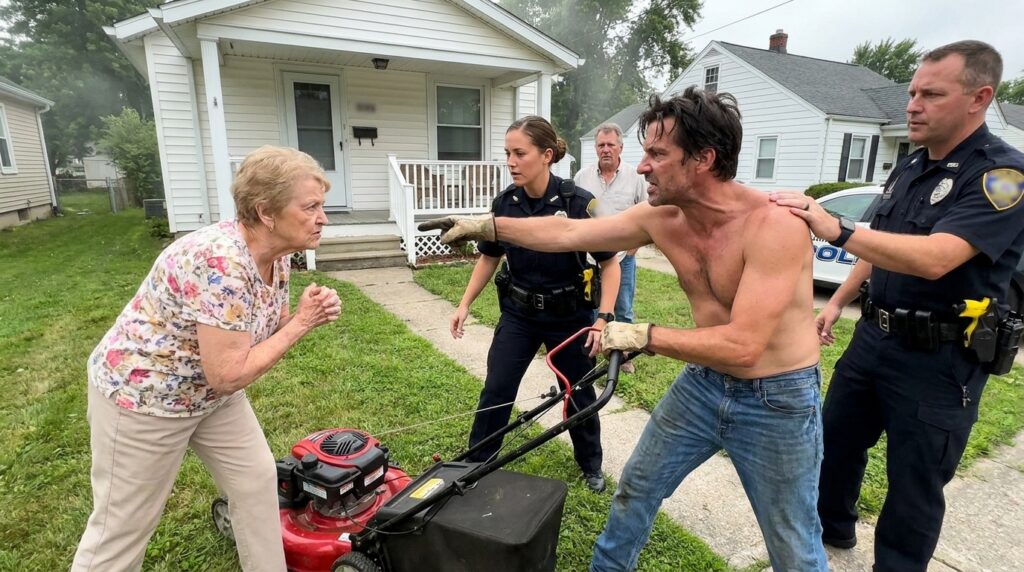
The words didn’t cut through the heat; they dropped into it like lead weights. The heavy sole of a tactical boot crunched down onto the dry gravel strip right where the driveway met the grass. The primary officer was wide, his stocky build framed in rigid black nylon that didn’t yield to the midday glare. His short dark hair was damp along the temples, his clean-shaven jaw set into a hard line as he swung his torso around, effectively cutting off the neighbor’s line of sight to my hands. His left arm came up, an unyielding bar of black cloth that forced her back toward her side of the pine rail.
Behind him, the secondary officer—younger, leaner, his hands resting loose but ready near the plastic retention clips of his utility belt—took up a support lane by the curb. The black-and-white cruiser sat idling twenty feet away, its roof-mounted light bars throwing rhythmic, silent flashes of blue across the parched white vinyl siding of the Miller house.
“Officer, he’s ignoring a civil notice,” she began, her hand flashing out of her pocket, her trembling index finger pointing directly over the officer’s shoulder at my blue cap. The pink cotton of her floral blouse wrinkled and pulled tight across her shoulder blades as she tried to lean around his bulk. “He’s destroying private improvements. He was told to vacate the parcel and he refused.”
The primary officer didn’t look at her phone. He didn’t look at the map she was trying to shove into his chest. His eyes stayed on me, tracking my posture, assessing the heavy brass hinges of the folding rule still resting across my palm.
“Drop the tool on the deck, son,” he said, his voice flat, professional, and entirely devoid of neighborly sympathy. “Step three paces back from the machine.”
I didn’t argue. I let the brass rule drop onto the steel casing of the mower engine with a sharp, metallic clink. I took three steps backward into the sun-baked yard, my rubber soles slipping slightly on the matted fescue until I felt my heels hit the firmer, un-mowed clay closer to the Miller porch. My forearms were still buzzing from the residual vibration of the two-stroke engine, but my chest felt cold.
“I have a valid work order, Officer,” I said, keeping my hands clear of my belt, my thumbs hooked loosely into my pockets. “It’s signed by code enforcement. The fire lane requires three feet of clear clearance from the wood line.”
“I don’t care about the fire lane right now,” the officer said, his head turning five degrees to check my position before he turned fully toward the fence. He planted his boots wide, creating a living wall in the two-foot gap between the yellow mower shroud and the hydrangeas. “Ma’am, I need you to lower the phone and keep your hands where I can see them. We’re establishing a separation lane here until we get the property holder on site.”
“The property holder is a fool who doesn’t know his own boundaries!” she screamed, her voice cracking as the performance of controlled civic authority finally broke. She slammed both her palms down onto the top rail of the weathered fence, the old pine groaning under her weight. “My husband spent forty years protecting this block from people like him. You have no right to stop me from securing my own dirt!”
“Everyone stay back and give him space,” the primary officer barked, his voice rising to mask her shouts as he turned his attention toward the driveway. He wasn’t looking at her anymore; he was looking at a gray sedan that had just pulled up behind the idling cruiser.
The car door clicked open. Mr. Miller stepped out, his thin face drawn, his fingers gripping a faded blue plastic folder with a desperate, white-knuckled intensity. He didn’t look at the neighbor. He walked straight toward the secondary officer at the curb, his breath coming in short, ragged gasps that showed through his grease-stained work shirt.
“Officer,” Miller called out, his voice shaking as he unzipped the folder. “I have the deed. I have the certified plat from the eighty-four closing. It’s all right here.”
I stepped closer, my eyes tracking the folder as Miller pulled out a sheet of brittle, yellowed paper that looked older than the house itself. It wasn’t a standard modern blueprint. It was a hand-drawn utility easement modification from 1984, the lines drawn in fading blue ink, showing an irregular hatch pattern right where the fence post sat.
The primary officer took the paper, his rough fingers tracing the border of the sketch. I leaned in slightly, my eyes catching a handwritten notation along the margin: Temporary bypass allowance—subject to municipal review upon line termination.
“What is that?” I asked, my voice dropping.
The officer didn’t answer. He just looked from the paper down to the dark, spongy depression beneath the hydrangeas, where the sour smell of stagnant moisture was growing thicker by the minute under the crushing heat. The decoy had just landed, and the ground below us was shifting.