Chapter 9: The Road Home
Spring arrived slowly in the Vermont mountains.
The snowbanks shrank.
Water ran along the roadside ditches.
The pine trees shed their heavy white coverings, and patches of brown grass appeared beside the driveways.
By late April, Walter could sit on his front porch without a winter coat.
He brought Margaret’s blue ceramic mug outside and filled it with coffee.
The maple trees were beginning to bud.
For the first time in months, the neighborhood felt quiet.
Not the uneasy silence that followed an argument.
A genuine quiet.
The kind Walter remembered from the years when Margaret was alive.
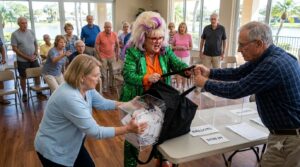
The HOA held its annual meeting in early May.
This time, the financial reports were distributed in advance.
Residents had time to read them.
Questions were answered without accusations.
The board presented a revised winter maintenance budget, including the returned settlement funds, outstanding expenses, and projected costs for the coming season.
There would be no new special assessment without a documented need and proper approval.
Thomas announced that he would step down as interim president after the election.
Patricia Lowell was elected to lead the board.
She had served the community for years and had earned respect by helping coordinate emergency supplies during the storms.
Her first announcement was simple.
The HOA existed to maintain shared property and services, enforce legitimate rules fairly, and protect the community’s long-term interests.
It did not exist to make one homeowner more important than another.
Walter looked toward Helen.
She was smiling.
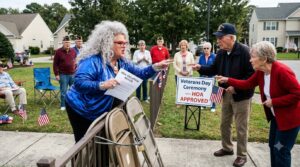
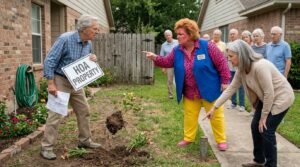
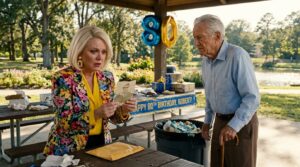
Later that afternoon, the residents gathered outside the clubhouse for a small spring potluck.
There were casseroles, sandwiches, homemade pies, and a large container of lemonade.
George had brought folding tables.
Linda had organized name tags.
Children and grandchildren visiting for the weekend played near the pond.
Walter stood beside the railing, watching the gathering.
He remembered the winter morning when six elderly residents had stood beside a buried road, wondering whether anyone in authority cared about them.
Now the same neighbors were laughing together in the sunshine.
Helen approached him carrying two paper plates.
She handed him one.
On it was a slice of apple pie.
She told him she had made it using her husband’s favorite recipe.
Walter thanked her.
They sat on a bench overlooking the pond.
For a while, neither spoke.
Walter watched a pair of ducks move through the shallow water near the shore.
He thought about Margaret.
She had always believed that the measure of a neighborhood was not the size of its houses or the beauty of its landscaping.
It was whether people showed up when someone needed help.
During the winter, Pine Hollow had nearly forgotten that.
But it had found its way back.
A few minutes later, Daniel Mercer arrived in his work truck.
He had come to meet with Patricia about spring road maintenance.
Several residents greeted him warmly.
George shook his hand.
Helen thanked him for keeping the road open.
Daniel seemed almost embarrassed by the attention.
He said he had only been doing his job.
Walter understood the modesty.
But he also knew that doing an ordinary job well could matter enormously to people depending on it.
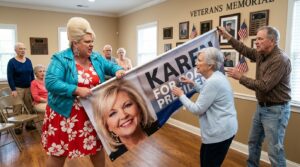
Near the clubhouse entrance, Walter noticed Karen Whitcomb.
She had arrived quietly.
She wore a plain navy jacket, dark pants, and sunglasses.
There was no neon-green coat.
No enormous purple hat.
For a moment, she stood apart from the gathering.
Walter wondered whether she would leave.
Instead, Patricia walked over and greeted her.
Karen accepted a paper plate and moved toward the food table.
No one rushed to embrace her.
No one pretended that the winter had never happened.
But no one tried to humiliate her either.
She was still a homeowner.
And Pine Hollow was still her community.
Walter considered that an important distinction.
Justice did not require endless punishment.
It required responsibility, fair rules, and a willingness to repair what could be repaired.
As the afternoon continued, Walter returned home.
He walked slowly along the road, enjoying the smell of damp earth and pine needles.
The road surface showed signs of another difficult winter.
There were cracks to fill and drainage channels to clear.
The community would have to pay for those repairs.
There would be meetings, estimates, and disagreements.
There always were.
But the process would be different now.
No single person would decide everything behind closed doors.
No homeowner would be expected to accept unexplained charges simply because an HOA president demanded it.
And no resident would have to choose between asking a reasonable question and fearing an arbitrary fine.
When Walter reached his driveway, he stopped.
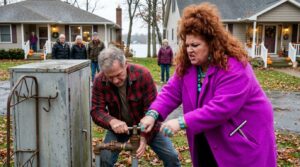
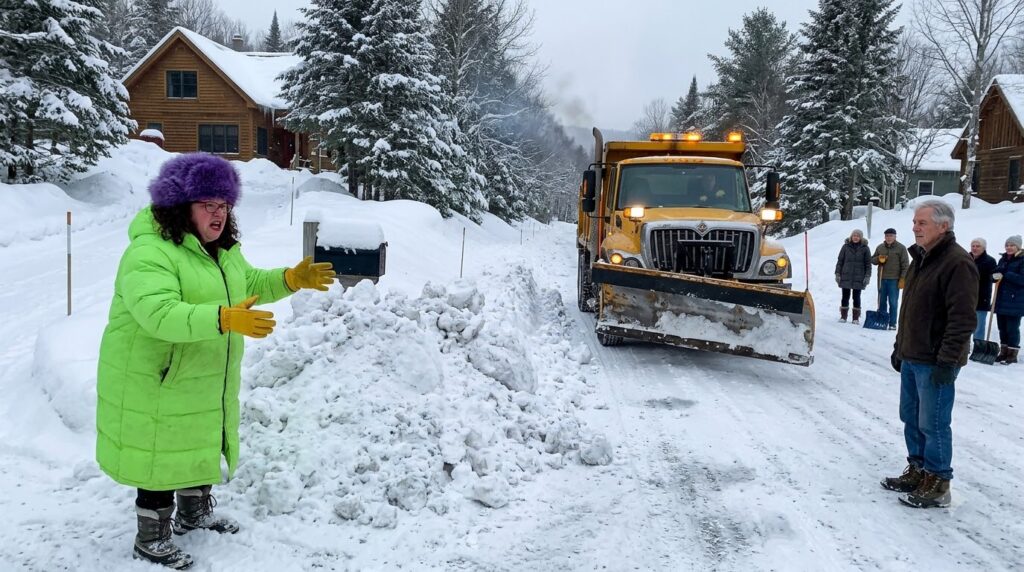
He remembered Karen standing beside the snowplow, her yellow-gloved hand striking the maintenance control.
He remembered the steel blade turning.
He remembered her furious insistence that she could decide where the snow went.
Then he remembered the great white mound that had formed across her own driveway.
The image still held a certain irony.
But Walter no longer thought it was the most important part of the story.
The real turning point had come afterward.
When Linda preserved the recording.
When Thomas admitted he had failed to ask enough questions.
When Helen stood before her neighbors and explained what the HOA’s actions had cost her.
When ordinary homeowners decided that being respectful did not mean remaining silent.
Walter walked up his driveway.
His front porch needed painting.
The flower beds needed attention.
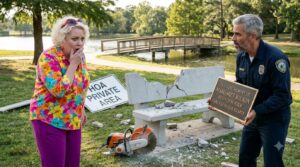
Margaret’s old wooden garden bench had begun to weather.
He planned to repair it before summer.
There were plenty of small jobs waiting.
For the first time in months, he looked forward to them.
That evening, Walter sat on the porch as the sun disappeared behind the mountains.
A car passed slowly along Pine Hollow Lane.
Farther down the road, someone was mowing a lawn.
The neighborhood sounded ordinary again.
Walter took a sip of coffee and looked toward the maple trees.
He wished Margaret could have seen how the community had come together.
She would have been proud of Helen.
She would have admired Linda’s persistence.
And she would certainly have had something memorable to say about Karen’s snowplow incident.
Walter smiled at the thought.
Then he looked down the road one last time.
The pavement was clear.
The neighbors were safe.
The accounts were being watched.
And the homes that people had worked their entire lives to afford were no longer subject to one woman’s unchecked decisions.
Karen Whitcomb had believed that being HOA president meant controlling everyone around her.
She had tried to control a snowplow, a contractor, a board, and an entire neighborhood.
But the mountain had taught her a lesson that no amount of shouting could change.
Authority did not make someone right.
A title did not place someone above the rules.
And the people who paid for a community’s roads deserved more than the privilege of watching someone else take priority.
Walter stood, carried his empty mug inside, and switched on the porch light.
Tomorrow, he would work on Margaret’s garden bench.
Tonight, he was simply grateful to be home.
And at Pine Hollow, home finally felt like home again.