Chapter 3: A Fine for Standing in the Snow
The violation notice arrived at Walter’s house at 9:15 the following morning.
It was delivered by hand.
A young property-management assistant named Brian Ellis climbed the front steps, placed a white envelope beneath the door handle, and hurried back to his car without ringing the bell.
Walter discovered it while clearing ice from the porch.
The envelope bore the Pine Hollow HOA logo.
Inside was a formal notice accusing him of interfering with an authorized snow-removal operation.
The alleged violation carried a $350 fine.
Walter read the notice twice.
Then he noticed the final paragraph.
If the fine remained unpaid for thirty days, additional administrative charges could apply under the association’s governing documents.
Walter sat at his kitchen table.
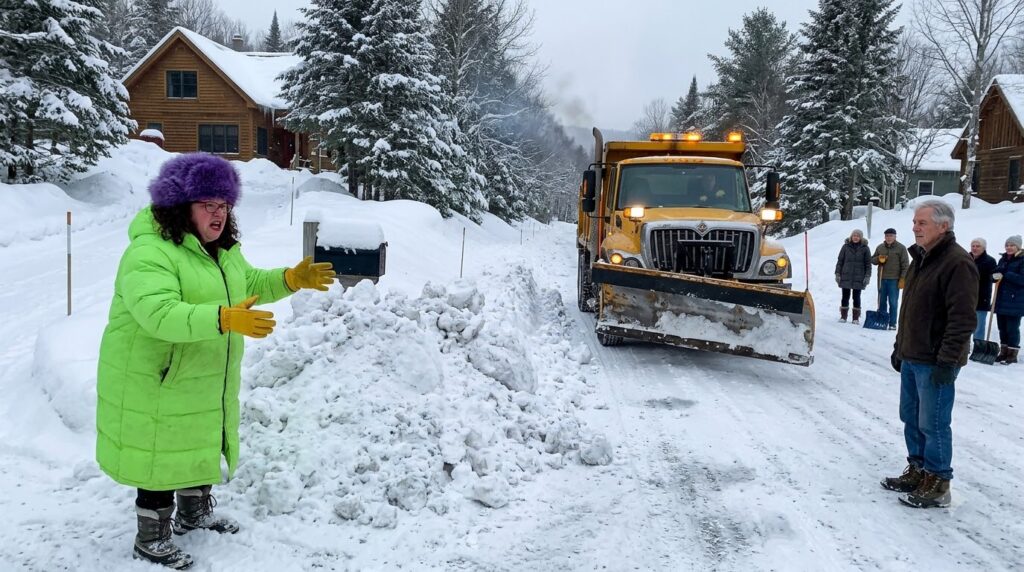
He had spent the previous morning standing safely beside the road, watching Karen interfere with a contractor’s equipment.
Now he was being punished for it.
He called Linda.
She had received a notice too.
Hers accused her of creating an unauthorized recording of HOA operations and distributing material that could damage the association’s reputation.
Her fine was $500.
Linda had not distributed the video.
She had shown it only to Walter.
But Karen apparently knew it existed.
By lunchtime, four other residents had received warning letters for allegedly obstructing the snow-removal process.
One was seventy-nine-year-old George Ellis, who had been holding a shovel near his mailbox.
Another was Helen Morrison.
Helen’s violation notice stated that she had failed to maintain proper emergency access to her property.
Walter felt his anger rise when he heard that.
Helen had spent the storm waiting for a road-clearing service funded by her own association dues.
Now the association was blaming her for conditions she couldn’t control.
He drove to her house after the oxygen delivery truck finally arrived.
Helen was sitting at the dining table, staring at the notice.
She had always been proud of paying her bills promptly.
Even after her husband’s death, she had kept meticulous records.
The possibility of owing money to the HOA distressed her more than she wanted to admit.
Walter took the letter and examined it.
The notice cited Section 14.6 of the community rules.
He recognized the number.
He had helped review the governing documents years earlier.
Section 14 concerned landscaping and exterior property maintenance.
It had nothing to do with snow-removal operations.
Walter returned home and retrieved his copy of the HOA rules.
He found the section.
As he suspected, it addressed vegetation, outdoor storage, and seasonal property upkeep.
There was no provision authorizing a fine for witnessing a snowplow incident.
That evening, Linda came over with more information.
She had contacted Daniel Mercer, the snowplow contractor, through the business number printed on his truck.
Daniel had agreed to speak with her, but only about the work he had personally performed.
He confirmed that the approved route required clearing the shared road before individual driveway entrances.
He also confirmed that the designated roadside deposit area beside Karen’s property was part of the normal snow-storage plan.
The driver had not intentionally targeted her driveway.
He had simply continued clearing the road after checking that the blade was safely positioned.
Daniel was concerned about Karen’s contact with the maintenance controls.
He had documented the incident in his daily work report.
That detail caught Walter’s attention.
A professional contractor’s report could provide independent evidence.
But Daniel had another concern.
His company had not received full payment for work completed during the previous two storms.
The HOA was behind on its invoices.
Walter looked at Linda.
The community had collected an extra $20,400 specifically for winter maintenance.
Yet the contractor responsible for keeping the roads open was waiting to be paid.
Linda opened her notebook.
She had been comparing the HOA’s published financial statements with older budget reports.
Several expenses had appeared under vague descriptions.
There were payments for consulting, administrative coordination, emergency access management, and special property services.
None identified the work performed.
Walter asked whether the board had approved them.
Linda didn’t know.
The minutes from the last three board meetings contained only brief summaries.
No detailed votes were recorded.
That was unusual for an association handling significant community funds.
Walter decided they needed more than suspicions.
They needed documents.
The next morning, he and Linda prepared a written request for financial records, vendor contracts, invoices, and board meeting minutes.
They delivered it to the HOA management office and kept a copy.
Karen’s response came that afternoon.
She announced an emergency board meeting.
The stated purpose was to address resident misconduct, contractor interference, and the spread of damaging accusations.
Walter read the announcement carefully.
The meeting would be held Friday evening at the community clubhouse.
Only three days away.
He had attended enough difficult meetings to recognize what Karen intended.
She wanted to turn the people asking questions into the problem.
But she had overlooked one thing.
Walter and Linda were no longer the only residents asking them.