Chapter 8: What the Records Finally Revealed
Removing Karen from the board did not answer every question.
The residents understood that.
Within days, the remaining directors appointed an interim president according to the association’s bylaws and began organizing a full review of the winter maintenance account.
Thomas agreed to serve temporarily.
He made it clear that he did not intend to remain president longer than necessary.
His first priority was restoring trust.
The board retained an independent accountant to examine the relevant transactions.
It also asked legal counsel to review the vendor approval process, the conflict-of-interest provisions, and the fines issued after the snowplow incident.
The review took several weeks.
Walter found the waiting difficult.
He had expected the facts to become obvious once the documents were gathered.
Instead, every answer seemed to require another invoice, email, or explanation.
The accountant eventually confirmed that Summit Property Services had received $19,050 from HOA funds.
Some supporting records existed.
There were emails concerning seasonal planning and a brief document describing general winter maintenance priorities.
But the documentation was insufficient to establish that the full amount billed represented completed, reasonably priced services.
The review also found that Karen’s relationship with Michael Whitcomb had not been disclosed to the board before the company received its payments.
Certain expenditures lacked the approvals required by the association’s internal procedures.
The accountant did not declare that every dollar had been stolen.
That was not the accountant’s role, and the available records did not support such a conclusion.
Instead, the report identified unsupported charges, inadequate oversight, and failures in the association’s financial controls.
Legal counsel recommended seeking repayment of the disputed amounts and preserving the records for any further action.
Summit initially defended its invoices.
Michael Whitcomb maintained that his company had performed consulting and coordination work.
But when asked to provide detailed records of the work completed, the company could not substantiate several of its largest charges.
After negotiations through counsel, Summit agreed to return $13,500 to the association.
The settlement did not establish criminal guilt or resolve every disagreement about the services.
It did, however, restore a substantial portion of the money residents had contributed.
The board also adopted new financial procedures.
Vendor relationships involving directors or their relatives would require written disclosure and independent review.
Payments above established limits would require documented board authorization.
Detailed financial reports would be made available to homeowners through appropriate records procedures.
And no individual director would be permitted to issue fines without the process required by the governing documents.
The board’s legal review found that the snowstorm-related fines against Walter, Linda, Helen, George, and the other residents had not been properly supported.
They were rescinded.
Any associated charges were canceled.
Written corrections were sent to the affected homeowners.
Walter placed his letter in the same folder as the original fine.
He did not throw either away.
The documents reminded him how easily authority could be misused when no one asked questions.
The board also resolved the overdue snow-removal invoices.
Daniel Mercer’s company agreed to continue serving Pine Hollow under a revised contract with clearer payment terms and operational responsibilities.
The contract expressly prohibited unauthorized residents or board members from interfering with equipment controls.
Emergency road-clearing priorities were documented.
Contractors would determine safe operating methods within the agreed service plan.
The association would oversee performance and payment without attempting to operate machinery.
Walter thought that last provision should never have been necessary.
But after everything that had happened, he understood why it mattered.
Karen remained a homeowner in Pine Hollow.
She was no longer HOA president.
She had not been ordered to leave her home, and the association did not attempt to punish her beyond the procedures supported by its rules and the documented findings.
For several weeks, she avoided community gatherings.
Her driveway was cleared by a private contractor.
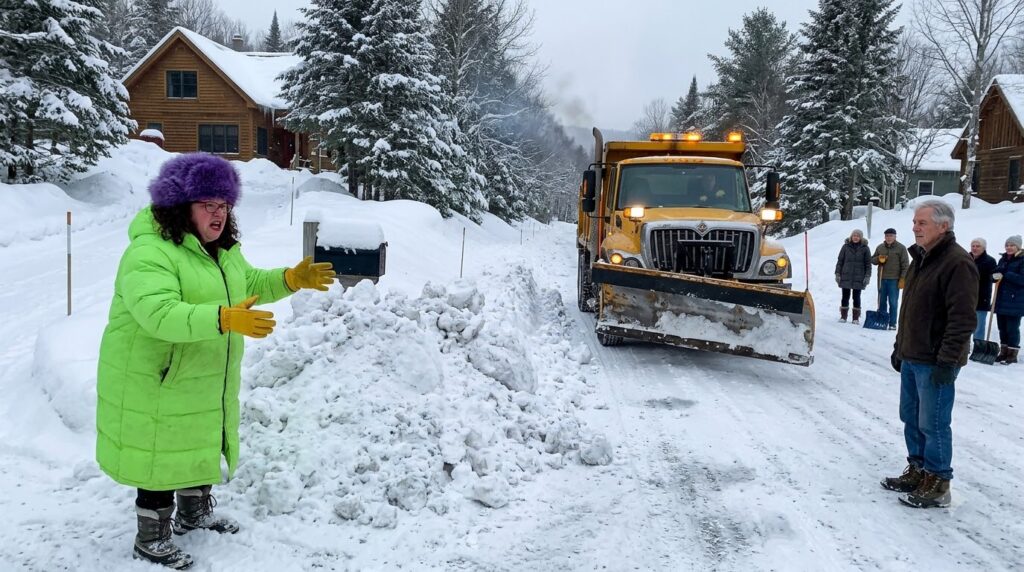
The giant mound from the original incident had long since melted into ordinary winter runoff.
But the consequences of that morning remained.
Walter occasionally saw Karen driving through the neighborhood.
They did not speak much.
He no longer felt the anger he had experienced when Helen received her fine.
Mostly, he felt tired.
Tired of the conflict.
Tired of paperwork.
Tired of seeing neighbors suspicious of one another.
Yet he also felt something he had not expected.
Relief.
The community had faced a problem without surrendering to it.
And the people who had been most vulnerable were no longer being treated as obstacles.
Still, Walter knew that changing the leadership was not enough.
Pine Hollow needed to decide what kind of place it wanted to become.