Chapter 8: The Neighborhood We Chose to Save
Six months after the fire, the grass around the repaired utility box had grown back.
The sidewalk had been restored.
The temporary barriers were gone.
Most people passing the spot would never have guessed what had happened there.
But the residents of Willow Creek remembered.
The legal proceedings had taken time.
Patricia eventually entered a guilty plea to criminal charges arising from the intentional fire and the damage to utility property.
The court imposed a sentence that included supervised probation, community service, restrictions on her involvement in association management, and restitution obligations.
The exact financial losses required further documentation, but the electric utility had established substantial repair costs.
The court also considered the danger posed to residents who depended on uninterrupted electrical service.
Patricia’s attorney argued that she had acted impulsively during a period of severe emotional stress.
The court acknowledged the evidence presented about her circumstances.
It did not excuse her conduct.
The judge emphasized that holding a position of community responsibility did not grant anyone the right to endanger others.
Marcus attended the hearing with Helen and Robert.
He did not speak to Patricia.
He had already said everything necessary through his witness statement and cooperation with investigators.
The financial investigation produced separate consequences.
The independent accounting review confirmed that the HOA’s oversight procedures had been seriously inadequate.
Certain payments to Whitmore Advisory Group were not properly disclosed or approved.
The association pursued recovery of improperly authorized funds through a civil settlement.
Harborstone agreed to terminate its contract and resolve disputed billing claims without admitting criminal wrongdoing.
Investigators did not establish that Harborstone’s employees had participated in planning or setting the fire.
Thomas Grant’s account helped clarify the events leading up to the incident, but the evidence did not support treating the entire company as a participant in Patricia’s actions.
That distinction mattered to Marcus.
He wanted accountability.
He did not want innocent people punished merely because they had been connected to someone who had done something terrible.
The HOA’s insurance and liability issues were also resolved over the following months.
The association paid certain costs from its reserves and recovered part of its losses through the settlement and restitution process.
Homeowners avoided the enormous emergency assessment Patricia had threatened.
The proposed $214,500 infrastructure contract was canceled.
Instead, the utility company completed the necessary repairs to its own equipment, coordinating with the association only where neighborhood property was affected.
The new HOA board introduced several reforms.
Financial records would be made available to homeowners through a secure online portal.
Major contracts would require competitive bids unless a documented exception applied.
Board members would have to disclose potential conflicts of interest.
Violation notices would be reviewed through a consistent process, with meaningful opportunities for homeowners to appeal.
And no single officer could approve significant expenditures without appropriate oversight.
George Harlan served temporarily as board president while the association organized a new election.
He declined to run for a full term.
“I’ve had enough excitement for one retirement,” he told Marcus.
Helen laughed when she heard that.
Robert agreed to serve on the finance committee, but only after the board adopted clearer reporting requirements.
Dorothy Lawson’s old fines were reviewed.
Several were canceled or refunded because the association could not establish that they had been properly imposed.
When Dorothy received her refund check, she carried it to Evelyn’s house.
The two women sat at the kitchen table, drinking tea and discussing their grandchildren.
Marcus overheard Dorothy say something he would remember for years.
“I never cared about the money as much as I cared about being treated like I mattered.”
Evelyn reached across the table and squeezed her hand.
“You always mattered.”
By autumn, Willow Creek had begun to feel like the neighborhood Marcus remembered from childhood.
Families gathered for a community picnic beneath the old oak trees.
Neighbors organized a volunteer group to help elderly residents with small home repairs.
A retired electrician offered free safety workshops.
A local emergency preparedness coordinator visited the clubhouse to explain backup power options and household evacuation planning.
The association established a voluntary emergency contact program, with clear privacy protections, so residents who needed additional assistance during outages could request help without having their medical information publicly shared.
Marcus was especially proud of that change.
His mother’s experience had shown him how quickly a routine utility failure could become dangerous for vulnerable neighbors.
He wanted future emergencies handled with compassion rather than confusion.
One Saturday afternoon, he stood in his mother’s driveway watching children ride bicycles down the street.
Evelyn sat on the porch, wrapped in a light sweater.
The afternoon sunlight caught the silver in her hair.
Marcus walked over and sat beside her.
“Do you ever think about moving?” he asked.
She smiled.
“Why would I?”
“After everything that happened?”
Evelyn looked across the street.
Helen was trimming her roses.
Robert was helping a young couple repair a loose fence.
Dorothy was walking slowly along the sidewalk, stopping to greet neighbors.
“This is my home,” Evelyn said.
Marcus nodded.
For years, he had thought of home as a building.
A mortgage.
A place where people kept their belongings and locked their doors at night.
But Willow Creek had taught him something more complicated.
A home could be threatened by fire, financial pressure, intimidation, and the misuse of authority.
It could also be protected by ordinary people who decided that their neighbors deserved dignity.
The following week, Marcus attended the first meeting of the newly elected HOA board.
He had been encouraged to run for president.
He declined.
He did, however, agree to serve on a temporary committee reviewing the association’s transparency policies.
He wanted to help create a system that would not depend on finding one unusually brave or unusually honest leader.
Good rules, he believed, should protect everyone.
Including the people who disagreed with those in charge.
Near the end of the meeting, the new president, a retired school principal named Margaret Collins, asked whether anyone had additional concerns.
Marcus raised his hand.
He suggested that the board establish an annual review of homeowner complaints and enforcement decisions.
Not to eliminate rules.
Not to make the neighborhood disorderly.
But to ensure that the rules were applied fairly.
Margaret agreed to place the proposal on the next agenda.
No one threatened him.
No one accused him of disloyalty.
No one warned him that questioning the board would have consequences.
It was an ordinary exchange between neighbors.
And that simple fact felt extraordinary.
Later that evening, Marcus walked home beneath the streetlights.
He passed the utility box where the fire had started.
The repaired cover sat flush with the sidewalk.
Beside it, someone had planted a small bed of yellow flowers.
There was no plaque.
No dramatic memorial.
Just a quiet reminder that damaged ground could become beautiful again.
Marcus stopped for a moment.
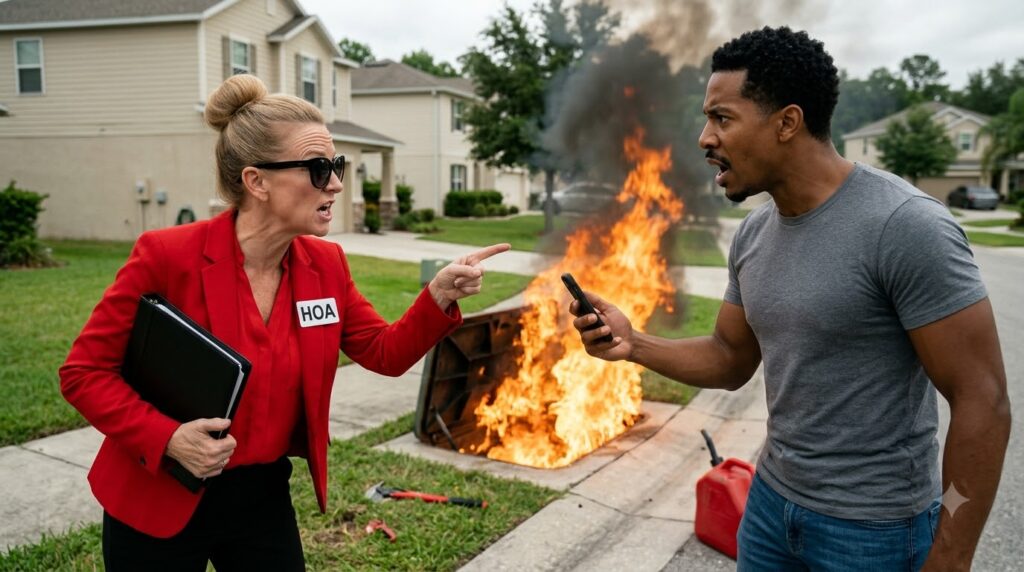
He remembered Patricia standing beside the flames, her red blazer illuminated by the fire, shouting that the neighborhood belonged to her.
He remembered the fear in his mother’s eyes when the power went out.
He remembered the letters, the threats, the hidden payments, and the homeowners who had been too frightened to speak.
Then he thought about what had happened afterward.
Helen had preserved the truth.
Robert had found the courage to revisit painful memories.
George had admitted his mistakes.
Dorothy had spoken when she thought her voice no longer mattered.
And dozens of ordinary residents had chosen to stand together.
No single person had saved Willow Creek.
They had saved it together.
When Marcus reached his mother’s porch, Evelyn was waiting with two cups of coffee.
She handed him one.
“Everything all right?”
He looked back toward the quiet street.
“Yeah, Mom. I think it finally is.”
Evelyn smiled.
Then she said something that captured everything the neighborhood had learned.
“A person can own a house, Marcus. But nobody gets to own the people living around it.”
He sat beside her as the evening settled over Willow Creek.
The porch lights glowed.
A dog barked somewhere down the block.
Children laughed in a nearby backyard.
The neighborhood was not perfect.
There would still be disagreements about fences, parking, landscaping, and money.
There would still be difficult decisions and people who saw the world differently.
But the residents had learned the difference between leadership and control.
They had learned that fairness required more than written rules.
And they had learned that silence could become dangerous when someone in authority stopped accepting responsibility.
Patricia Whitmore had once stood beside a wall of flames and declared that if the neighborhood burned, it burned.
She believed power meant never having to answer to anyone.
But the people of Willow Creek had discovered a different kind of power.
The power to ask questions.
The power to protect their neighbors.
The power to demand accountability without surrendering their dignity.
And most importantly, the power to decide what kind of community they wanted to leave for their children and grandchildren.