Chapter 2: The Woman Who Owned the Rules
By Thursday morning, Willow Creek Estates looked almost normal.
The lawns were green. The sidewalks were clean. Delivery trucks moved quietly through the streets. Most of the homes had electricity again.
But beneath that peaceful appearance, something had changed.
Neighbors who had once waved politely from their driveways now stood in small groups, discussing what they had seen.
Some were angry.
Others were frightened.
A few insisted there had to be an explanation.
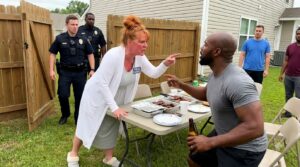
Patricia Whitmore had spent eleven years cultivating the image of a woman who knew how to keep Willow Creek respectable.
She had served as HOA president for six of those years.
Before retiring, she had managed regional operations for a commercial property company. She understood contracts, budgets, insurance, and the kind of official language that could make ordinary people feel helpless.
Her husband, Richard, had died four years earlier.
Since then, the association had become the center of her life.
Every violation notice, landscaping decision, and architectural application passed through her hands.
She inspected fences.
She measured grass.
She complained about holiday decorations that remained up too long.
She once fined a retired Marine because his American flagpole stood eighteen inches closer to the sidewalk than the community guidelines permitted.
But the most troubling part of Patricia’s leadership was not her strictness.
It was her inconsistency.
Homeowners who supported her rarely received fines.
Those who challenged her suddenly discovered violations they had never known existed.
Marcus had learned this the previous spring.
After returning to Willow Creek to help care for his mother, he had asked why the HOA was spending nearly forty thousand dollars annually on administrative consulting.
Patricia told him the information was confidential.
Marcus politely reminded her that homeowners had rights to inspect certain association records under state law.
Two weeks later, Evelyn received a violation notice for a flower bed that had been in the same location since 1998.
A month after that, she was fined for leaving a recycling container visible from the street.
The fines were small enough to seem insignificant.
Together, they amounted to nearly six hundred dollars.
Evelyn had wanted to pay them.
Marcus refused.
He believed his mother had earned the right to live peacefully in the home she and his late father had worked decades to afford.
Now, after the fire, he understood that Patricia’s retaliation could become much more serious.
At ten that morning, a certified letter arrived.
It accused the Bennett household of interfering with HOA maintenance operations.
The letter claimed Marcus had approached an active work area, distracted association personnel, and contributed to the resulting emergency.
It demanded that he cease making public accusations against the board.
Attached was a preliminary notice of a five-thousand-dollar special assessment, pending investigation.
Marcus stared at the document.
His mother sat across from him at the kitchen table.
“Five thousand dollars?” she asked.
“She hasn’t even waited for the fire report.”
Evelyn took the letter.
Her hands trembled slightly as she read it.
Marcus knew that look.
It was the same expression she had worn years earlier when his father was diagnosed with cancer.
Not panic.
Calculation.
She was quietly measuring how much trouble the family might be facing.
“We can fight this,” Marcus said.
Evelyn folded the letter.
“I know. But I don’t want you spending your savings defending me.”
Marcus had spent fifteen years working as a telecommunications field engineer before starting a small consulting business. He was financially stable, but he had recently reduced his workload to spend more time with his mother.
He had no desire to spend months fighting a homeowners association.
Yet he could not ignore what Patricia was doing.
That afternoon, he visited Helen Crawford.
Helen lived alone in a white colonial house across from the damaged utility box.
Her husband had died seven years earlier, and she had become one of the neighborhood’s most familiar faces.
She kept extra keys for traveling neighbors, collected mail for people recovering from surgery, and remembered every child’s birthday.
When Marcus arrived, she already had coffee waiting.
“I thought you might come,” she said.
She led him to her dining room, where a laptop sat open.
On the screen was the recording from her porch camera.
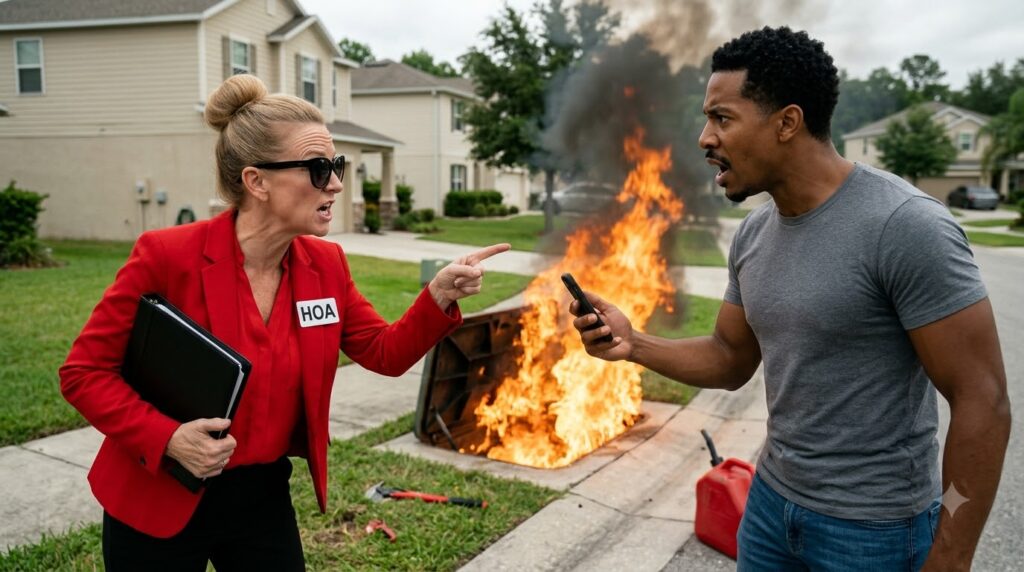
The footage showed Patricia arriving shortly after eight in the morning.
She inspected the utility opening.
She looked up and down the street.
Then she brought the red container closer.
The camera had no trouble capturing the fire.
It also recorded Patricia’s declaration that she could do whatever she wanted.
Marcus watched in silence.
Helen paused the video.
“There’s something else.”
She opened an earlier recording.
The timestamp showed 7:41 a.m., nearly twenty minutes before the fire.
A dark SUV had stopped beside the utility box.
A man wearing a navy work jacket stepped out and spoke with Patricia.
He pointed toward the underground cables.
Patricia appeared agitated.
After several minutes, the man returned to his vehicle and drove away.
Marcus leaned toward the screen.
“Do you know who that is?”
Helen shook her head.
“But I know that SUV.”
She opened a folder containing photographs from the previous month’s HOA meeting.
One picture showed Patricia standing beside a smiling man in a navy jacket.
Behind them was a sign reading:
HARBORSTONE COMMUNITY SERVICES
Marcus recognized the company.
It was the same consulting firm whose payments he had questioned the previous spring.
And suddenly the fire looked less like a random act of rage.
It looked like the final moments of a dispute someone had been desperate to keep hidden.