Chapter 6: The Evidence That Changed Everything
The official fire investigation moved more slowly than the neighborhood wanted.
Investigators had to document the damaged equipment, interview witnesses, review available video, and coordinate with the electric utility.
Marcus understood the need for care.
Still, every passing day gave Patricia more opportunities to influence the story.
She continued sending association emails.
She questioned the reliability of Helen’s camera.
She described Thomas Grant as a disgruntled contractor.
She claimed that the Whitmore Advisory payment had been properly authorized.
Then, on Wednesday afternoon, the fire investigator contacted Marcus.
Detective Angela Ruiz from the county fire investigation unit asked him to come to the station.
Ruiz was forty-nine, with a calm manner that made Marcus immediately more comfortable.
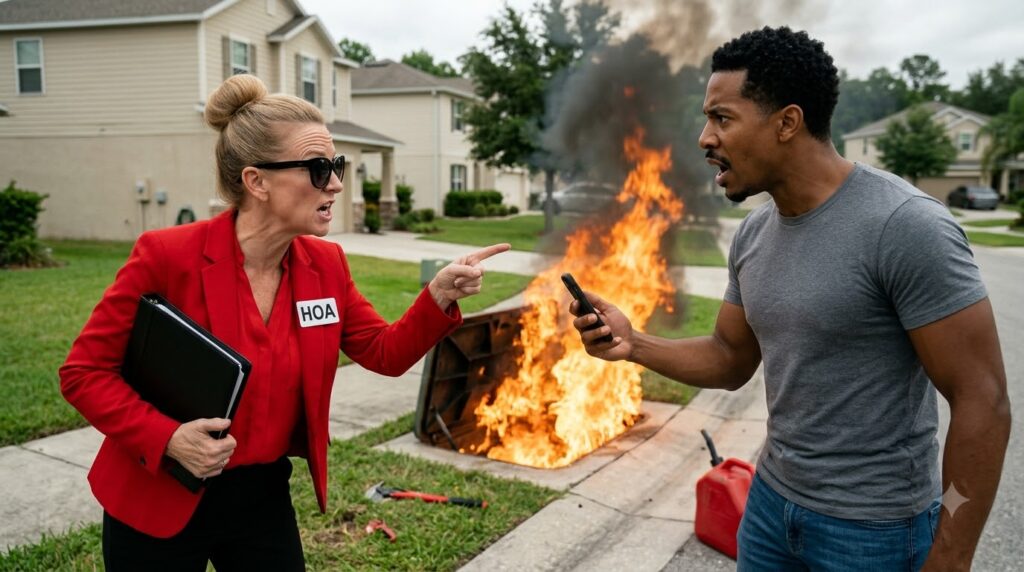
She explained that the investigation had confirmed the fire was deliberately set.
The physical evidence was consistent with the use of an ignitable liquid.
Helen’s original video showed Patricia pouring liquid from a container and igniting the contents of the utility opening.
Investigators had also obtained footage from another nearby camera.
It captured the moments before and after the fire from a different angle.
Marcus listened carefully.
He had expected confirmation.
What surprised him was what Ruiz said next.
The electric utility had confirmed that the damaged equipment was not owned by the HOA.
It was part of a utility-controlled distribution system serving multiple homes.
The association had no authority to modify or destroy it.
Ruiz also explained that investigators were examining the relationship between the fire and the proposed replacement contract.
Marcus handed over copies of the Harborstone email and the financial documents, explaining where he had obtained them.
Ruiz accepted them without commenting on their significance.
Before he left, she gave him a warning.
“Don’t confront anyone about these records. Let us do our work.”
Marcus agreed.
He had no intention of becoming a vigilante.
He wanted the law to do what it was supposed to do.
That evening, he returned home to find Evelyn sitting on the back patio.
She had placed two glasses of iced tea on the small table.
Marcus sat beside her.
For several minutes, they watched birds moving between the oak trees.
Then Evelyn asked him a question.
“Do you remember when your father wanted to sell this house?”
Marcus frowned.
“No.”
“It was about twenty years ago. The factory had closed, money was tight, and he thought we should move somewhere cheaper.”
“What changed his mind?”
Evelyn smiled.
“Our neighbors.”
She explained that several families had quietly helped them during that difficult year.
One man repaired their roof without charging for labor.
Another family brought groceries when Marcus’s father was between jobs.
Helen’s husband had helped them refinance their mortgage.
“We stayed because this wasn’t just a house,” Evelyn said. “It was a place where people looked after one another.”
Marcus looked toward the street.
“Doesn’t feel much like that anymore.”
“Then maybe it’s time we remembered how.”
The next day, Marcus helped organize a neighborhood meeting at the public library.
More than fifty homeowners attended.
Some came because they opposed Patricia.
Others came because they wanted to understand what had happened.
A few were still loyal to her.
Marcus began by explaining that the meeting was not a trial.
He presented the documented costs of the outage, the proposed emergency contract, and the available financial records.
He avoided speculation.
Helen confirmed that she had provided her original footage to investigators.
Robert explained the concerns he had raised while serving as treasurer.
George described the board’s failure to obtain adequate documentation for certain payments.
Then Dorothy Lawson stood.
Marcus had not expected her to speak.
She walked slowly to the front of the room, carrying her stack of violation notices.
She explained how the fines had affected her finances.
She described the humiliation of receiving repeated warnings about a home she had maintained for more than three decades.
Her voice trembled.
But she continued.
“I don’t mind following rules,” she said. “I just want the rules to be fair.”
The room grew quiet.
Dorothy looked around at her neighbors.
“I buried my husband from that house. I raised my children there. I shouldn’t have to be afraid of opening my mailbox.”
When she finished, people began applauding.
Not loudly at first.
Then the sound filled the room.
Marcus saw tears in Helen’s eyes.
The meeting ended with homeowners signing a petition for a special membership meeting and an independent financial review.
They also agreed to establish a temporary volunteer committee to help residents affected by the fire.
For the first time since the incident, Marcus felt something other than anger.
He felt hope.
But when he returned home, Laura had left a message.
Patricia’s attorney had contacted the HOA’s insurance company again.
This time, Patricia was claiming that Marcus had provoked her into acting under extreme emotional distress.
The woman who had nearly burned down their street was now trying to make him responsible for her decision.